




KATHMANDU: With only seven days remaining until the election to the House of Representatives (HoR) scheduled for March 5, preparations have entered the final stage.
The Election Commission (EC) has already dispatched ballot papers and election materials to around 70 districts, and election officials are working under pressure to complete the remaining tasks.
The Commission is set to enforce the election code of conduct from midnight on March 2. As a result, candidates now have just five days left to reach out to voters. However, in Kathmandu-1, election enthusiasm appears subdued.
In four elections since 2064 BS, voters in this constituency elected Nepali Congress (NC) leader Prakash Man Singh, who went on to serve multiple times as minister and deputy prime minister. This time, however, Nepali Congress President Gagan Thapa has fielded Prabal Thapa as the party’s candidate instead of Singh.
Another strong contender is Rabindra Mishra of the Rastriya Prajatantra Party (RPP), who has competed in this constituency since 2074 BS and lost twice but remains in the race.
Similarly, Ranju Darshana of the Rastriya Swatantra Party (RSP), who moved from the proportional list to direct competition, has also posed a challenge. In total, 29 candidates, including Mohan Raj Regmi from CPN-UML, Menuka Bhandari from Nepali Communist Party (NCP), and several independents, are campaigning door to door.
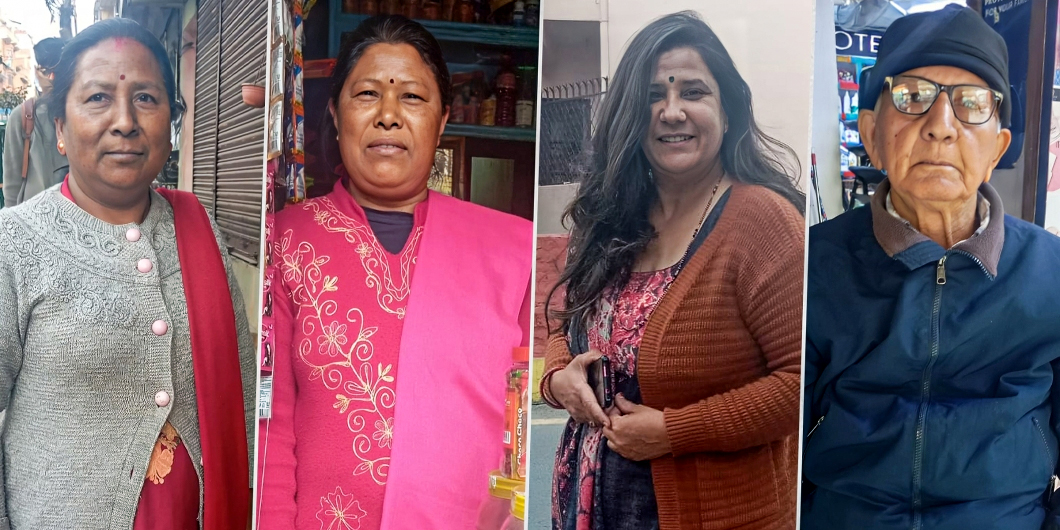
On Tuesday, Khabarhub visited the constituency to gauge voter sentiment. Many expressed frustration with both old and emerging political forces.
Bhawani Timalsina (New Baneshwor)
Bhawani Timalsina says the traditional parties have failed to value her vote. “Since I was 14, I followed the ‘tree’ (election symbol of Nepali Congress) and the four-star flag. Now that I am nearly 50, what have we gained besides the same quarrels, accusations, and corruption?” she asked.
“People facing hardship are being provoked with empty dreams. The new ones may not be any different tomorrow. The campaign style is still the same — accusations and counter-accusations. What difference will it make?” he asked.
She believes there is no alternative but to give emerging forces a chance. However, she warned that new leaders do not have the freedom to ignore public issues for personal gain, as she alleges previous leaders did.
“They neglected development and only rewarded their loyalists. Now they have become arrogant and unwilling to listen. It is hard to expect corruption-free leadership. Still, this time we have no option but to try someone new. We must push them to deliver,” she said. She added that new leaders must not disappoint voters the way older leadership did.
Ram Kumar Khadka (Mid-Baneshwor)
Ram Kumar Khadka, a retired Nepali Army personnel who served until 2065 BS, says he has witnessed elections since 2047 BS.
“Development has happened to some extent, but there was too much nepotism and favoritism among the old leaders,” he said.
When asked what the country has achieved since the restoration of democracy after the People’s Movement of 1990 and the adoption of a federal democratic republican system, Khadka replied briefly: “The people have experienced disappointment and suffering.”
He added that beyond gradual changes over time and periodic public anger, the country has seen little transformation. “New parties have emerged, but there is no guarantee they will do justice either. Still, I hope this election will help calm public frustration,” he said.
Gita Shrestha (Ghattekulo)
Geeta Shrestha says she feels little motivation to vote. “Leaders who are paid from our taxes should improve services starting from the ward level. Work that should take one day takes four or five. At courts and hospitals, people wait endlessly. Where is the ease of public service?” she questioned.
With a sigh, she added, “I don’t even feel like voting. If I don’t go, I feel I’ll be socially excluded. It seems neither the old nor the new have delivered. So whom should I vote for?”
Nanu Manandhar (Old Baneshwor)
About 100 meters from Old Baneshwor Chowk, along the road toward Maitidevi, Nanu Manandhar was busy arranging goods in her grocery shop when she shared her concerns. In her mid-twenties, she complained that no candidate had personally approached her to ask for her vote.
“I see candidates driving past in cars, waving flags. Perhaps they don’t even have time to stop and ask for votes. So far, not a single candidate has come to me,” she said.
Recalling a recent incident, she added, “The other day, a candidate came while I was inside getting goods requested by a customer. Instead of waiting for a moment, he just left a pamphlet and walked away.”
She questioned whether leaders who cannot spare even two minutes during campaigning would listen to voters’ concerns after being elected. “If a candidate cannot wait for two minutes now, will he listen to our complaints tomorrow after winning our votes?” she asked skeptically.
Manandhar also expressed frustration over taxation and lack of development. “Taxes are high, but we don’t receive services accordingly. We can’t even raise our voices about it. If taxes are collected, there should be facilities in return, but there aren’t,” she said.
She urged the next government to reduce the cost of living, particularly household expenses, and to create employment and business opportunities for women.
“Some positive changes have happened since Balen Shah became mayor of Kathmandu Metropolitan City, but not everyone has benefited. We are struggling to educate our children. Women need to be connected to employment. Our ward has not done anything significant. Prices are high, and they need to come down,” she suggested.
Surendra Bahadur Singh (Old Baneshwor)
Eighty-four-year-old Surendra Bahadur Singh, whom we met at Old Baneshwor Chowk, said the campaign style of candidates itself raises doubts.
“Candidates seem to be praising themselves. Instead of convincing us with concrete plans and addressing our real issues, they go around saying, ‘I am honest, vote for me.’ Why should we believe them?” he questioned.
He criticized candidates for failing to demonstrate tangible work. “They haven’t shown results, yet expect us to trust their words alone,” he said. According to Singh, while older leaders failed to deliver, new candidates are now misleading voters with unrealistic promises.
“People facing hardship are being provoked with empty dreams. The new ones may not be any different tomorrow. The campaign style is still the same — accusations and counter-accusations. What difference will it make?” he asked.
There are 48,489 registered voters in Kathmandu-1. The Election Commission has set up 22 polling locations with a total of 57 polling centers for the constituency.



Comment