




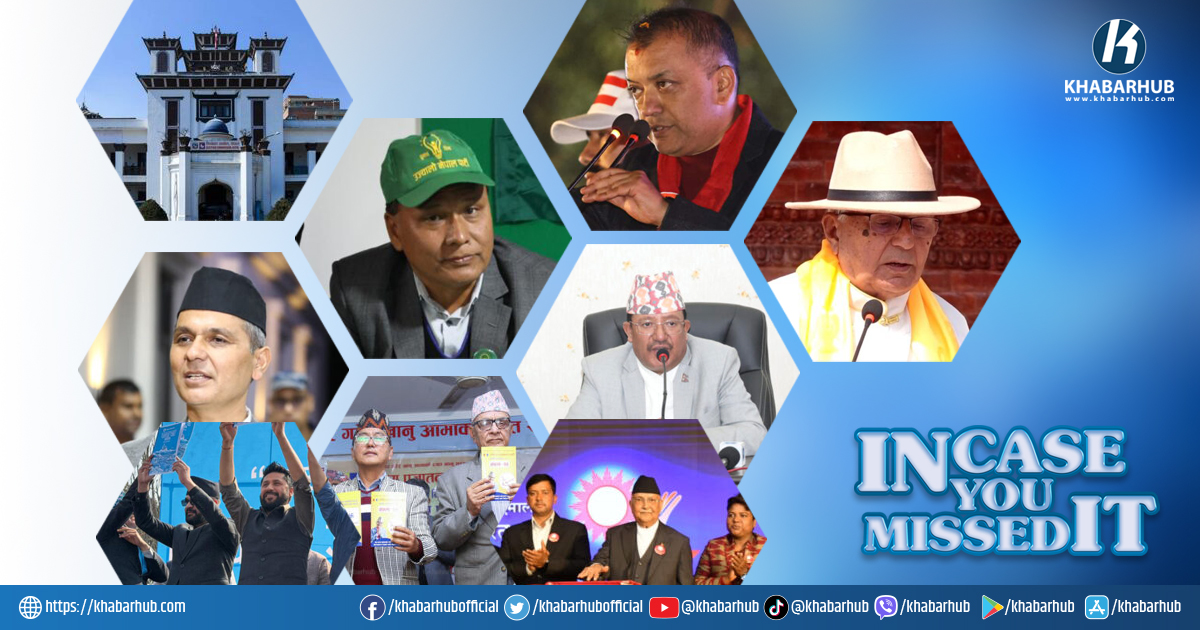
KATHMANDU: Last week in Nepal unfolded as a dense convergence of electoral regulation, manifesto politics, constitutional debate, governance reform, communal tension, and sporting disappointment. With the March 5 House of Representatives (HoR) election approaching, institutions and political actors moved into high gear, each attempting to shape not only voter perception but the broader narrative about the country’s future.
The developments, ranging from a 64-point directive issued by the Election Commission Nepal to a pointed intervention by former monarch Gyanendra Shah, illustrate a polity at once competitive, restless, and searching for direction.
Tightening the Electoral Framework
The most immediate institutional intervention came from the Election Commission Nepal, which unveiled a detailed 64-point directive governing campaign conduct and finance. Announced by Acting Chief Election Commissioner Ram Prasad Bhandari, the directive operationalizes the election code of conduct in granular terms: fixed campaign dates (Falgun 4–18), restricted daily campaign hours (7:00 am–7:00 pm), mandatory banking channels for election expenses, and a 35-day deadline for expense reporting after results are declared.
The prohibition on distributing campaign merchandise bearing party symbols—T-shirts, caps, bags, masks, lockets—is particularly noteworthy. In Nepal’s electoral culture, such items have long functioned as both identity markers and informal inducements. By banning them, the Commission is attempting to curb the monetization and materialization of political loyalty. Likewise, the insistence that all election-related transactions pass through formal financial institutions reflects a broader state ambition to reduce the opacity that has historically characterized campaign finance.
The coming days will reveal whether the convergence of regulation, rhetoric, and civic engagement yields a more accountable and cohesive polity, or merely another cycle of raised expectations and deferred transformation.
Crucially, the Commission coupled procedural strictness with a credible enforcement threat: violations may result in warnings, fines, cancellation of candidacy, and even disqualification from political competition for up to six years. This is not merely regulatory housekeeping; it signals an assertion of institutional authority. In a political environment often marked by fluid alliances and transactional politics, the Commission is positioning itself as a guardian of electoral integrity rather than a passive administrator.
Yet enforcement will be the real test. Nepal’s past elections have seen uneven compliance with codes of conduct, particularly in rural constituencies where local networks and patronage structures are entrenched. Whether the Commission’s monitoring mechanisms are sufficiently robust to ensure uniform application across parties—large and small—will determine whether this directive marks a genuine shift toward rule-bound competition or remains aspirational.
Voter Education in the Age of TikTok
In parallel, the Commission launched an innovative voter education campaign through TikTok, offering cash prizes for one-minute videos promoting voter awareness and code compliance. This move reflects an acute recognition of demographic realities: a youthful electorate, high social media penetration, and the need to make civic participation relatable.
The initiative reframes electoral participation as a “national democratic exercise” and invites citizens to become co-creators of democratic messaging. By incentivizing originality and interactivity, and by promising visibility through official platforms, the Commission is leveraging digital culture to combat voter apathy and misinformation.
However, the campaign’s reliance on viewership metrics for awarding prizes raises questions. Popularity on social media does not necessarily correlate with informational quality. There is a risk that sensational or emotionally charged content could overshadow nuanced civic education. Nonetheless, the experiment represents a meaningful attempt to bridge the gap between institutional messaging and youth engagement—a gap that, if left unaddressed, could undermine democratic consolidation.
Democracy and Cultural Cohesion
Amid these electoral preparations, Ram Chandra Paudel appealed to citizens to ensure a successful HoR election. Speaking at Sheetal Niwas during Gyalpo Lhosar celebrations, he emphasized elections as the legitimate mechanism for reflecting the people’s will in a democracy. His remarks linked democratic participation with cultural pluralism, highlighting indigenous festivals as vehicles for harmony and unity.
The President’s message was twofold. First, it reinforced procedural democracy: periodic elections are non-negotiable. Second, it foregrounded social cohesion, especially in a country marked by ethnic, linguistic, and regional diversity. By praising the Sherpa community’s global contributions, he situated minority identities within a national narrative of pride and prestige.
The subtext is important. With communal tensions flaring in Gaur and former royalist sentiments resurfacing, the presidency sought to anchor the national conversation in unity, constitutionalism, and shared responsibility. While largely ceremonial, presidential rhetoric can serve as a stabilizing force in moments of political contestation.
Immigration and Institutional Modernization
In the legislative arena, Om Prakash Aryal addressed the National Assembly regarding reforms to the Immigration Act, 1992. A new immigration bill is reportedly in preparation, incorporating recommendations from parliamentary committees.
Immigration management in Nepal intersects with labor migration, remittance flows, and national security. Millions of Nepalis work abroad, and remittances form a substantial share of GDP. Streamlining immigration services is therefore not merely bureaucratic reform; it has macroeconomic and social implications. Training immigration staff and digitizing services could reduce corruption and enhance efficiency at border points and airports.
The unanimous approval of the proposal to discuss the study report signals cross-party recognition that outdated legal frameworks require modernization. In an election season often dominated by grand promises, this episode stands out as a quieter but substantive governance initiative.
Manifesto Politics: Competing Visions of Prosperity
The campaign trail intensified as major and minor parties unveiled manifestos, each articulating a blueprint for economic transformation and social reform.
Nepali Congress: “Vision 10” and Congress 2.0: Under the leadership of Gagan Kumar Thapa, the Nepali Congress launched its “Vision 10” manifesto from Janakpur. Framed as the foundation of “Congress 2.0,” the pledge outlines aspirations ranging from dignified living and employment generation to rule of law and modern national identity.
Thapa’s rhetoric emphasizes renewal: lessons learned from past shortcomings, a five-year work plan, and a commitment to measurable delivery. The focus on creating 500,000 jobs annually aligns with demographic pressures—youth unemployment and outward migration. The party underscores the role of the private sector, investment-friendly policies, and the potential of information technology to attract foreign capital.
The Congress message blends social democratic commitments (healthcare, education, shelter) with market-oriented pragmatism. Its challenge lies in credibility. Having alternated in power for decades, the party must persuade voters that this iteration truly differs from its predecessors.
UML: Ambitious Macroeconomic Targets
The Communist Party of Nepal (Unified Marxist-Leninist) (UML), led by KP Sharma Oli, unveiled a manifesto heavy with quantitative targets: a Rs 20 trillion economy within a decade, 7–9 percent annual growth, $3,000 per capita income, and 500,000 jobs annually.
The party’s roadmap emphasizes industrial expansion, hydropower exploitation, export growth, and rural-urban integration. Plans to initiate commercial gas production in Dailekh and iron extraction from Dhaubadi signal a resource-driven development model. The proposal to double industry’s GDP share to 20 percent reflects a desire to shift from a remittance- and import-dependent economy toward domestic production.
These ambitions are bold, perhaps aspirational. Achieving sustained high growth requires political stability, regulatory predictability, infrastructure investment, and regional trade facilitation. UML’s narrative hinges on disciplined governance and centralized direction—an implicit contrast with coalition fragmentation.
RSP: Anti-Corruption and Social Guarantees
The Rastriya Swatantra Party (RSP) foregrounded zero tolerance for corruption, institutional independence for the anti-graft commission, and public asset declarations. Its manifesto combines governance reform with universal health insurance and education restructuring, including free education for up to three children per family.
By emphasizing transparency and digital economy initiatives, RSP appeals to urban, reform-oriented voters disillusioned with traditional parties. Its promise of 500,000 jobs within five years echoes competitors but is framed through startups, entrepreneurship, and digital transformation rather than heavy industry.
RPP: Systemic Overhaul and Monarchy
The Rastriya Prajatantra Party (RPP) took a starkly different path, advocating restoration of the monarchy, reestablishment of Nepal as a Hindu state, and abolition of the provincial structure in favor of a two-tier system.
The election’s outcome will determine parliamentary arithmetic, but the deeper question concerns trajectory. Will stricter enforcement of electoral norms strengthen institutional credibility?
This platform challenges the post-2008 republican federal consensus. By invoking “Prithvi Path” philosophy and criticizing party-centric politics, RPP taps into nostalgia and frustration. While its electoral base remains limited, its ideas resonate in certain constituencies, particularly amid perceptions of instability and underperformance.
Ujyalo Nepal: Technocratic Energy Focus
The Ujyalo Nepal Party, chaired by Kulman Ghising, centered its manifesto on energy expansion—12,000 MW by 2030, 25,000 MW installed capacity, and positioning Nepal as an energy exporter. It coupled this with free university education, rural health expansion, aggressive job creation, and severe anti-corruption penalties.
The party’s technocratic tone and sector-specific targets aim to differentiate it from legacy parties. Yet scaling from manifesto to mass support remains a formidable hurdle for newer formations.
Questioning the Electoral Moment
Perhaps the most politically charged development was the video message from Gyanendra Shah, released on the eve of Democracy Day. While acknowledging the necessity of periodic elections in principle, he argued that elections should follow, not precede, the resolution of national crises through all-party consensus.
This framing subtly delegitimizes the immediate electoral process without outright rejecting democracy. By invoking instability, poverty, and threatened national dignity, Shah seeks to position himself as a unifying moral voice above partisan politics. His gratitude to supporters and emphasis on geography-aligned systems hint at skepticism toward federal republican arrangements.
Although the monarchy was abolished in 2008, royalist sentiment persists in segments of society. Shah’s intervention adds an ideological dimension to the election: it is not only a contest among parties but also a referendum—however indirect—on the post-monarchy order.
Communal Tension in Gaur
While leaders debated policy and ideology, events in Gaur exposed the fragility of local coexistence. A dispute triggered by overlapping wedding music and Ramadan prayers escalated into communal clashes, prompting deployment of Nepal Police, Armed Police Force, and Nepal Army personnel and the imposition of an indefinite curfew.
The incident underscores how quickly localized grievances can morph into broader unrest, particularly in polarized political climates. The District Administration Office’s mediated six-point agreement initially calmed tensions, but renewed clashes suggest deeper mistrust.
For national leaders emphasizing unity and prosperity, Gaur serves as a sobering reminder: economic blueprints and constitutional debates mean little if communal harmony fractures. Effective governance requires not only macroeconomic strategy but also grassroots conflict resolution and inclusive civic culture.
Sporting Setback: A Symbolic Parallel?
Finally, Nepal’s heavy defeat to West Indies in the ICC World Cup at Mumbai’s Wankhede Stadium provided a sporting counterpoint to political developments. Despite a fighting half-century by Dipendra Singh Airee, Nepal succumbed by nine wickets.
While sport and politics are distinct arenas, national teams often embody collective aspiration. The loss, marked by glimpses of promise but overall imbalance, mirrors the broader national narrative: talent and resilience exist, yet structural gaps remain against more established competitors.
Conclusion: Democracy in Motion
Taken together, last week’s events portray a democracy in motion—regulated, contested, and reflective. The Election Commission Nepal seeks to impose procedural discipline; parties compete with expansive promises; reformist and royalist narratives vie for attention; communal tensions test social cohesion; and citizens are invited to participate not only at ballot boxes but on digital platforms.
The election’s outcome will determine parliamentary arithmetic, but the deeper question concerns trajectory. Will stricter enforcement of electoral norms strengthen institutional credibility? Can ambitious economic targets translate into tangible job creation? Will anti-corruption pledges overcome entrenched patronage networks? And how will Nepal reconcile calls for systemic overhaul with the commitments of its republican constitution?
In this charged pre-election moment, Nepal stands at an inflection point. The coming days will reveal whether the convergence of regulation, rhetoric, and civic engagement yields a more accountable and cohesive polity, or merely another cycle of raised expectations and deferred transformation.





Comment