




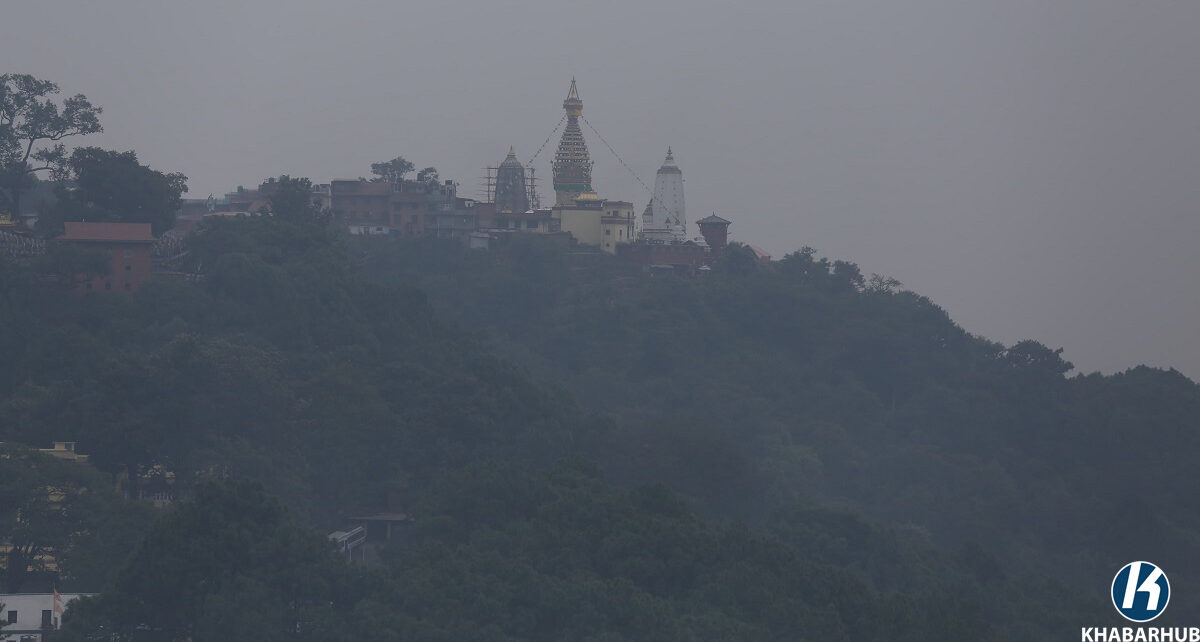
KATHMANDU: Air pollution in the Kathmandu Valley remained at an unhealthy level on Wednesday, with the Air Quality Index (AQI) measured at 192 by midday, according to the Department of Environment.
On Sunday, the Valley’s AQI stood at 175. Pollution levels rose to 192 on Wednesday and have shown no significant improvement, the department said.
Department Director General Gyanraj Subedi attributed the persistent pollution to the prolonged absence of rainfall and wind movement.
“The Valley is bowl-shaped. When there is no wind and no rainfall, pollutants cannot disperse elsewhere. Smoke and dust remain suspended in the air,” he said. “Industrial operations and rapid development and construction activities have also contributed to rising pollution levels. Industrial emissions and cross-border pollution have further affected air quality.”
Subedi warned that pollution levels could increase further if rainfall does not occur soon. He added that relevant agencies have been advised to adopt sustainable and environmentally friendly development measures.
According to global air monitoring data, Kathmandu ranked as the eighth most polluted city in the world on Tuesday. India’s New Delhi topped the list with an AQI reading of 247.
Disaster management expert Dr Dharma Raj Uprety explained that an AQI between 0 and 50 is considered good (green category), while 51 to 100 indicates moderate conditions requiring caution (yellow category). An AQI of 101 to 150 is regarded as unhealthy for sensitive groups, particularly those with respiratory and heart conditions.
An AQI ranging from 151 to 200 is considered unhealthy for everyone, 201 to 300 is very unhealthy, and levels above 300 are deemed hazardous.
As per the Air Quality Management Action Plan for Kathmandu Valley, 2019, the government classifies AQI levels above 300 as a disaster situation. The action plan outlines measures such as banning the burning of waste, increasing the use of road sweepers and vacuum machines for street cleaning, and issuing public advisories urging children, senior citizens and patients to take special precautions.
The National Environment Policy, also envisions preparing and implementing national standards to control pollution related to air, water, soil, noise, electricity, electromagnetic waves, radioactive radiation and hazardous chemicals. It further calls for establishing monitoring stations in major cities, industrial areas and high-risk locations to map air, water and noise quality.






Comment