



KATHMANDU: The Pragatisheel Loktantrik Party (PLP), formed by leaders breaking away from the Maoist Centre, the Rastriya Swatantra Party (RSP), and the Nepal Samajwadi Party, appears increasingly disorganized as elections approach.
Leaders involved in the formation of PLP have failed to develop a common approach on candidate withdrawals, coordination, cooperation, or mutual support. Instead, election activities by several leaders suggest calculations driven more by individual political gain than by party strategy.
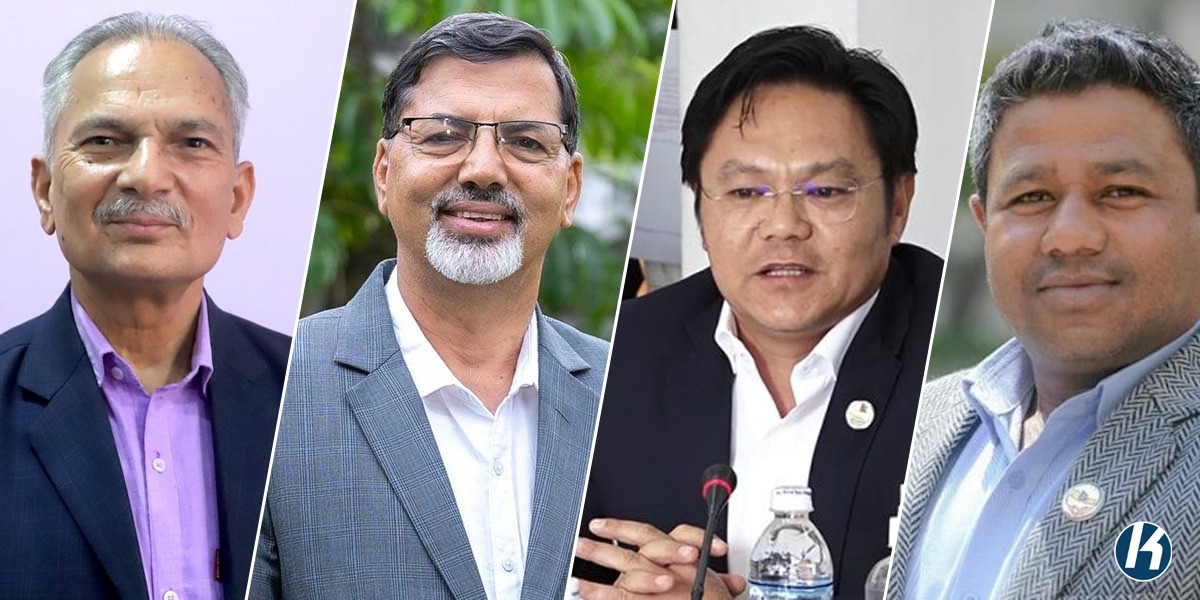
Baburam seeking space, Janardan tilting toward UML and Harka Sampang
The Pragatisheel Loktantrik Party is neither a party born out of a single split nor one formed by entirely new political actors. The initiative to form the party was led by Dr. Baburam Bhattarai and Janardan Sharma, neither of whom held formal leadership positions at the time. Santosh Pariyar of the RSP is also believed to have played a significant role in the party’s formation.
However, Pragatisheel Loktantrik Party’s political direction since its formation has surprised many. Dr. Bhattarai initially announced that he would not contest the upcoming elections, but later filed his candidacy from Gorkha-2, only to withdraw again. Since withdrawing, he has not endorsed any candidate.
At the time, public statements and political developments fueled speculation that Bhattarai had reached an understanding with the RSP. According to multiple sources, Bhattarai held discussions with both the Nepali Communist Party and the RSP during the withdrawal process. The RSP reportedly assured him of a high-level state position in the future, leading to informal speculation that this assurance influenced his decision.
Rukum West has a single constituency. Candidates in the race include Nandaram Devkota (UML), Raju KC (Nepali Congress), Gopal Sharma (NCP), and Man Bahadur Shahi (RSP).
Meanwhile, Gopalbabu Shrestha, who had filed his candidacy from Gorkha-1 on behalf of Pragatisheel Loktantrik Party , has also withdrawn, leaving the constituency vacant for the party.
Janardan Sharma, another central figure in Pragatisheel Loktantrik Party’s formation, moved toward negotiations with the CPN-UML soon after registering his candidacy. It later emerged that UML Chair KP Sharma Oli had encouraged Sharma to contest using the UML’s election symbol, the sun.
Subsequently, an understanding was reached under which the UML would support Pragatisheel Loktantrik Party candidates in Rukum East, where Maoist Centre chair Pushpa Kamal Dahal ‘Prachanda’ is contesting, and Rukum West, where Sharma himself is in the race. In return, Pragatisheel Loktantrik Party agreed to support UML candidates across Karnali Province, except in Humla and Jumla.
However, the UML later backed away from the agreement, citing concerns that a nationwide surge in support for the RSP could politically damage the party if it appeared aligned against the Maoist Centre. On Wednesday, the two parties finalized a new three-point agreement.
Under the revised deal, the UML will support Janardan Sharma in Rukum West, while Pragatisheel Loktantrik Party will back UML candidates in all Karnali districts except Jumla, Humla, and Mugu. Political observers suggest that Sharma has aligned with the UML primarily to secure his own electoral prospects.
Fragmented support across districts
Party chair Sudan Kirati has already expressed support for Harka Sampang in the upcoming elections. In Sunsari-1 and Bhojpur, Pragatisheel Loktantrik Party has backed candidates of Harka’s Shram Sanskriti Party.
In several districts, Pragatisheel Loktantrik Party candidates have withdrawn in favor of RSP candidates, while others have extended support to different parties independently.
According to publicly available information, Tikaram Regmi, Pragatisheel Loktantrik Party’s candidate from Syangja-2 and considered close to Dr. Bhattarai, has withdrawn in support of the RSP candidate. Similarly, Pragatisheel Loktantrik Party’s Siraha district in-charge, Arvind Kumar Yadav, has agreed to support the RSS candidate from Siraha–2.
In Kalikot, Pragatisheel Loktantrik Party candidate Dharmaraj Neupane withdrew his candidacy in favor of Maoist Centre candidate Khadka Bahadur Bishwakarma.
Pragatisheel Loktantrik Party’s electoral approach
An examination of Pragatisheel Loktantrik Party’s electoral coordination and alliances suggests the absence of a clear or consistent political approach. In Karnali Province, Pragatisheel Loktantrik Party has cooperated with the CPN-UML in some districts, while in Kalikot it has aligned with Maoist candidates.
At the same time, Pragatisheel Loktantrik Party has extended unconditional support to the Rastriya Swatantra Party in Syangja and Siraha. In Bhojpur and Sunsari-1, it has backed Dhruba Rai and Harka Sampang of the Shram Sanskriti Party.
In recent Nepali politics, tensions and mutual accusations between the UML and the RSP have been frequent, making any immediate cooperation between the two appear unlikely. Yet Pragatisheel Loktantrik Party has chosen to collaborate with both. Additionally, it has supported Maoist candidates who have openly rejected such arrangements. This has raised questions about the party’s guiding principles in electoral cooperation.
Explaining this approach, Pragatisheel Loktantrik Party Central Council Chair Santosh Pariyar said decisions were taken at the Council level after assessing local power balances. He added that the party’s policy is to cooperate with democratic and progressive forces.
“The decision to support the UML across Karnali with Janardan at the center was also based on local power equations,” Pariyar said. “In this political system, no one moves forward alone. From the central council, we decided to cooperate based on local balance, in line with our policy of working with democratic and progressive forces.”
However, Pariyar’s position does not appear to reflect consensus within the party. During the withdrawal of candidacies by Dr. Baburam Bhattarai and others, Janardan Sharma’s brother, Anil Sharma, publicly expressed dissatisfaction on social media.
In Rukum West, some voters may still back Sharma based on his political legacy and future calculations. However, defeating the Maoist Centre by relying primarily on UML support will not be easy, and a victory for Sharma remains far from assured.
“It is acceptable to try to win on one’s own strength,” he wrote on Facebook. “But escaping defeat by entering arrangements cannot be considered democratic, no matter the justification. We will stand on our own and do whatever we can.”
Can Janardan win on UML’s strength?
Party chair Sudan Kirati has chosen not to contest the elections in Koshi Province, instead backing the Shram Sanskriti Party. Dr. Bhattarai has withdrawn from the race, while Ram Karki and Santosh Pariyar are also absent from the electoral field. As a result, Janardan Sharma in Rukum West remains Pragatisheel Loktantrik Party’s only comparatively strong candidate nationwide.
So far, there is little visible momentum in Pragatisheel Loktantrik Party’s favor. Sharma, who has been winning elections from Rukum West continuously since 2064 BS, has this time been compelled to seek UML support. His alliance appears driven more by personal electoral security than by party strategy, extending even to committing Pragatisheel Loktantrik Party’s support for the UML across Karnali.
Rukum West has a single constituency. Candidates in the race include Nandaram Devkota (UML), Raju KC (Nepali Congress), Gopal Sharma (NCP), and Man Bahadur Shahi (RSP).
In the 2022 election, Sharma, then representing the Maoist Centre, won with 39,549 votes. His closest rival, UML’s Nandaram Sapkota, secured 12,961 votes. Sharma’s victory was supported by the Nepali Congress and Unified Socialist.
In that election, the Nepali Congress received 8,766 votes in Rukum West, while the Unified Socialist secured 1,510 votes. The UML obtained 8,069 votes under the proportional representation system.
This time, however, following the split within the Maoist Centre, most district-level leaders in Rukum West have not aligned with Sharma. Although Sharma has remained an influential figure in the area since the Maoist armed conflict and continues to wield personal influence, the key question is how many Maoist voters he has managed to retain after breaking away from Prachanda and forming a new party.
Those voters will be decisive. Even if the UML formally supports Sharma, it is uncertain whether younger voters will follow the party directive. Moreover, Pragatisheel Loktantrik Party appears unlikely to secure victories elsewhere in the country.
In Rukum West, some voters may still back Sharma based on his political legacy and future calculations. However, defeating the Maoist Centre by relying primarily on UML support will not be easy, and a victory for Sharma remains far from assured.


Comment