




The idea of a “game” is both intuitively appealing and analytically useful. Games offer controlled environments where players test strategies, anticipate responses, and pursue objectives within known constraints.
Because they reflect basic human instincts, competition, survival, dominance, game frameworks can also illuminate real-world conflicts. The Israel–Gaza war can be examined through the lens of game theory as a simplifying tool that helps clarify strategic choices, incentives, and recurring outcomes. While game theory cannot capture the full moral, historical, or human complexity of the conflict, it can provide partial insights into why cycles of violence persist and why equilibrium remains elusive.
The roots of the Israel–Palestine conflict lie in the UN Partition Plan of 1947, which proposed separate Arab and Jewish states following Britain’s withdrawal from Palestine. While the plan provided the legal basis for Israel’s establishment, it was rejected by Arab states, leading to the 1948 war and the displacement of a large Palestinian population. Subsequent wars, particularly the 1967 conflict, left Gaza and the West Bank under Israeli control, fragmenting Palestinian territory and undermining prospects for viable statehood.
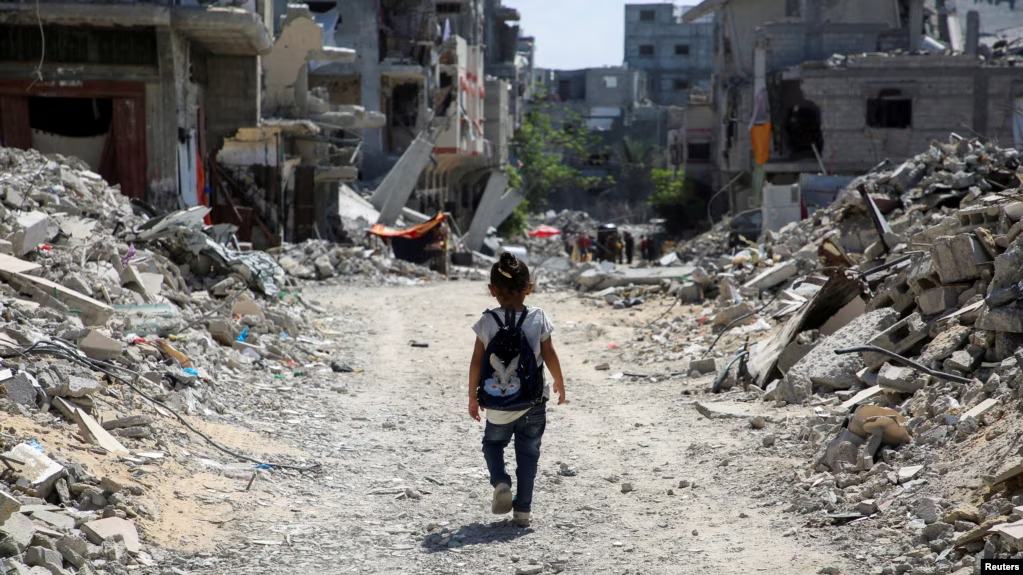
Gaza remained under Israeli occupation until 2005 and has since been subject to blockade and repeated military confrontations. Major escalations since 2008 have followed a familiar pattern: attacks or kidnappings by Hamas, followed by overwhelming Israeli retaliation, resulting in severe civilian casualties and humanitarian devastation. Gaza, home to over two million people, has been described as an open-air prison, marked by restricted movement, economic collapse, and chronic insecurity.
The prolonged confrontation, characterized by occupation, blockade, and asymmetrical force, has drawn accusations from international observers of apartheid-like conditions and, more recently, allegations of genocidal conduct. This historical backdrop forms the setting for a conflict that is not episodic but structurally entrenched.
Game theory and rationality
Game theory rests on assumptions of rationality, predictability, and utility maximization. A rational actor is not necessarily moral or peaceful; rather, it consistently pursues outcomes aligned with its preferences. Crucially, utility need not be limited to material gain or physical security. It may include ideological goals, political survival, identity preservation, or symbolic resistance.
Viewed through this lens, Hamas’s October 7, 2023 attack, despite the certainty of devastating retaliation, can be understood as rational within a utility framework that prioritizes resistance, political leverage, and symbolic defiance over civilian safety or organizational survival. Similarly, Israel’s overwhelming military response, though costly in humanitarian terms and global opinion, aligns with a strategic utility emphasizing deterrence, dominance, and territorial control. Both sides act rationally within their own frameworks, even as the aggregate outcome appears catastrophic.
Unlike closed-form games with fixed players and outcomes, real-world conflicts are dynamic and recursive. Strategies evolve, rules shift, and new actors enter the field. Historical precedents shape expectations, but each iteration unfolds under altered conditions, technological advances, regional realignments, or ideological shifts, making the conflict less a replay of the same game than a continuously reconfigured one.
The conflict as an infinite game
The concept of the infinite game helps explain this persistence. Unlike finite games such as chess or football, which have fixed rules and clear endpoints, infinite games have no defined conclusion. Players come and go, rules evolve, and the objective is not victory but continued participation. Survival, endurance, and legitimacy matter more than winning.
Applied to Israel–Gaza, neither side appears to seek a definitive resolution. Israel leverages military superiority to maintain strategic dominance, while Palestinians resist displacement to preserve identity, land, and political relevance. Periodic escalations, ceasefires, and failed peace initiatives suggest that both sides prioritize remaining in the game over achieving a stable equilibrium. The conflict continues not because solutions are unavailable, but because exiting the game, through compromise or concession, carries unacceptable costs for each actor.
Infinite-horizon bargaining
This logic is reinforced by an infinite-horizon bargaining dynamic. In repeated interactions, actors often delay agreement in the belief that future rounds may yield better terms. Ceasefires, prisoner exchanges, territorial arrangements, and humanitarian pauses become temporary bargains rather than final settlements.
From this perspective, Palestinian refusal to accept proposals that involve permanent displacement, even under the threat of massive violence, reflects a utility structure in which self-determination and historical attachment outweigh immediate survival or material relief. Likewise, Israel’s repeated military campaigns signal a belief that postponing political resolution preserves strategic advantage. Because the game is ongoing, neither side perceives urgency to settle now when tomorrow may bring improved leverage.
Non-cooperative bargaining
The Israel–Gaza conflict also resembles a non-cooperative bargaining game, where actors pursue individual gains without binding agreements or mutual trust. Power asymmetry does not eliminate resistance; rather, it incentivizes the weaker side to prolong confrontation in hopes of extracting concessions, shifting international opinion, or altering long-term costs.
Empirical studies suggest that when disputed territory holds high strategic value, stable division is unlikely. Instead, stronger actors pursue gradual territorial consolidation while weaker parties acquiesce as their bargaining position erodes. This pattern mirrors settlement expansion in the occupied territories since 1967, reinforcing the argument that such expansion is driven less by Palestinian violence than by enduring Israeli strategic interests.
The prisoner’s dilemma of distrust
Underlying these dynamics is a classic Prisoner’s Dilemma. Both sides understand that cooperation could reduce suffering, yet persistent distrust makes defection the safer choice. Each fears that restraint will be exploited by the other, prompting preemptive escalation. Even when ceasefires are agreed upon, neither side fully believes in the other’s commitment, ensuring that cooperation remains fragile and temporary.
Viewed through game theory, the Israel–Gaza war is not a series of irrational outbursts but a structurally rational, self-reinforcing conflict. Treated as a zero-sum contest within an infinite game, each side prioritizes endurance and leverage over compromise. The repeated interactions of non-cooperative bargaining and deep distrust ensure that violence remains a recurring strategy rather than a failure of strategy.
This framework does not absolve responsibility or diminish human suffering. Instead, it clarifies why traditional peace initiatives repeatedly falter: they assume a finite game with achievable equilibrium, while the actors themselves operate as if the contest has no endpoint. Unless the underlying rules of the game, its incentives, payoffs, and definitions of success, are fundamentally redefined, the cycle of resistance, retaliation, and mistrust is likely to persist. The central question, then, is not who is winning, but whether the players can imagine an alternative game altogether.
The author is a BA LLB student at Kathmandu School of Law.






Comment