




KATHMANDU: Last week marked a decisive moment in Nepal’s political calendar as candidates across the country filed their nomination papers for the House of Representatives elections scheduled for March 5. The nomination process, conducted peacefully according to the Election Commission (EC), formally set the electoral machinery in motion.
Yet, beneath the procedural calm lies a deeply dynamic and contested political landscape—one shaped by generational change, legal battles, institutional assertions, and a growing public demand for accountability and credibility.
The filing of nominations coincided with the enforcement of the Election Code of Conduct, 2082, signaling the transition from pre-election maneuvering to a regulated campaign phase. Together, these developments framed last week not merely as a routine milestone in Nepal’s electoral cycle, but as a test of the country’s democratic maturity, institutional independence, and political renewal.
Code of conduct and institutional assertion
With 45 days remaining until polling day, the Election Commission’s enforcement of the Code of Conduct represents an attempt to reassert control over a political environment often criticized for misuse of state resources, blurred lines between government and party, and uneven media practices.
The scope of the code, covering everyone from ministers and civil servants to media houses, NGOs, financial institutions, and voters, reflects the EC’s recognition that elections are no longer confined to ballot boxes but are shaped by narratives, money, influence, and administrative power.
Last week was thus not merely a prelude to an election. It was a snapshot of Nepal at a crossroads, negotiating between past burdens and future possibilities, with its democratic institutions under the closest scrutiny they have faced in years.
The Commission’s appeal for cooperation underscores a familiar challenge: enforcement. Past elections have shown that while Nepal’s legal framework is robust on paper, compliance is inconsistent in practice. The real test will be whether the EC can act decisively against violations by powerful actors, particularly incumbents and major parties, without appearing selective or politically influenced.
The code’s application to media and development partners is particularly significant. In an era of social media-driven campaigns, influencer politics, and donor-funded voter education, the boundaries between information, persuasion, and propaganda have become increasingly porous. Whether the EC can regulate these spaces without infringing on free expression will shape the credibility of the election.
Nepali Congress and politics of generational shift
Among last week’s most consequential political decisions was the Nepali Congress’s endorsement of party president Gagan Thapa as its prime ministerial candidate. This move signals an explicit embrace of generational transition within Nepal’s oldest democratic party, long dominated by senior leaders associated with the post-1990 and post-2006 transitions.
By projecting Thapa as its prime ministerial face, the Congress is attempting to align itself with demands for leadership renewal while retaining institutional continuity. Party leaders framed the decision around clearly defined criteria, political background, leadership capacity, experience, and geographic inclusivity, suggesting an effort to legitimize the choice beyond factional politics.
The reference to the “Gen-Z movement” and subsequent internal reforms indicates that pressure from younger cadres and supporters has forced traditional parties to recalibrate. However, the endorsement also carries risks.
Thapa’s elevation raises expectations among voters who are increasingly impatient with incremental reform. If the Congress fails to articulate a clear policy agenda that distinguishes Thapa’s leadership from past governments, symbolic generational change may not translate into electoral gain.
Rastriya Swatantra Party: Momentum and contradictions
If the Congress’s move represents institutional adaptation, the Rastriya Swatantra Party (RSP) embodies disruption. Last week’s events surrounding Balen Shah and Rabi Lamichhane illustrate both the party’s momentum and its contradictions.
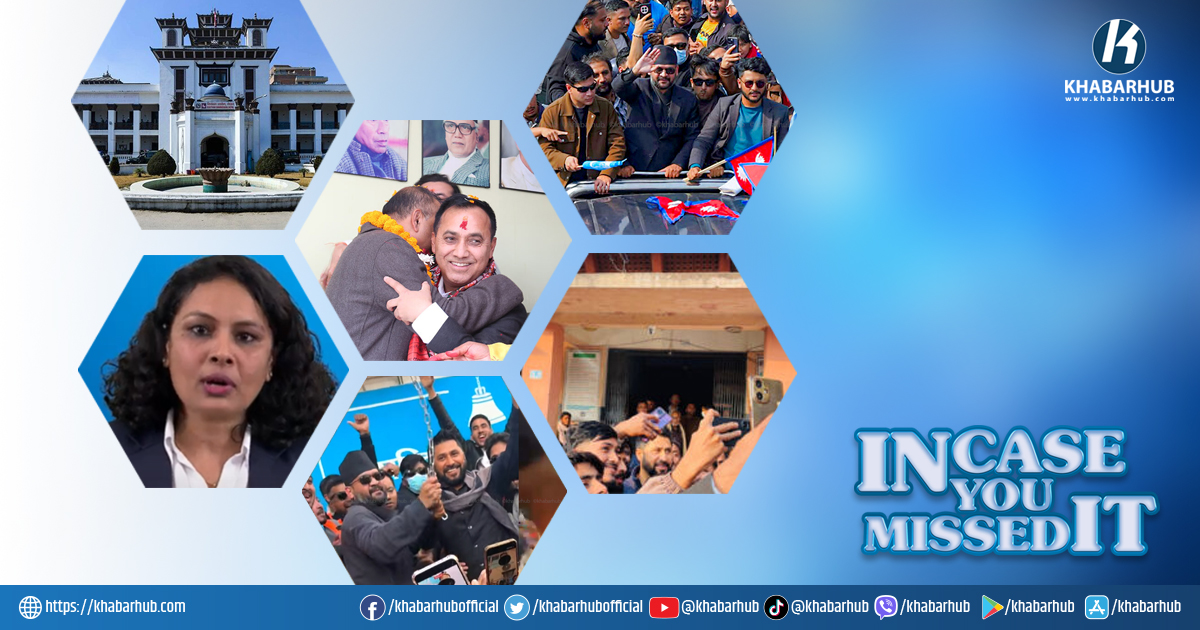
Balen Shah’s resignation as Mayor of Kathmandu Metropolitan City and his subsequent alignment with the RSP marked a dramatic political shift. His symbolic act of ringing the party’s election bell was more than performative, it signaled the consolidation of anti-establishment figures under a single political banner. Shah’s candidacy from Jhapa-5 against former Prime Minister KP Sharma Oli has turned the constituency into a national battleground, pitting insurgent populism against entrenched party power.
The massive turnout during Shah’s nomination filing reflects a broader phenomenon: public enthusiasm for personalities perceived as decisive, technocratic, and unburdened by traditional party hierarchies. Yet this enthusiasm also raises questions about governance continuity.
Shah’s resignation from a directly elected executive post to contest parliamentary politics may reinforce perceptions that political ambition often supersedes institutional stability.
Rabi Lamichhane’s situation further complicates the RSP’s narrative. While he remains a potent mobilizer, his entanglement in multiple cooperative fraud cases, and the courts’ decision to grant bail rather than clear him outright, casts a shadow over the party’s anti-corruption rhetoric. Lamichhane’s claim of persecution and his framing of the election as a referendum on injustice resonate with supporters, but they also test the boundary between political victimhood and legal accountability.
Whether voters reward institutional reform, charismatic disruption, or familiar stability will shape Nepal’s political direction in the years ahead.
The Supreme Court justice’s refusal to hear a writ related to Lamichhane’s cases adds another layer of complexity. It highlights judicial caution amid politically charged litigation but also reinforces public perceptions that legal processes and politics are deeply intertwined.
Law, accountability, and the burden of the past
Beyond electoral politics, last week’s developments underscored Nepal’s ongoing struggle with accountability. The Special Court’s decision to seek bail from former Health Secretary Dr Sangita Mishra in a Rs 140 million corruption case signals continued, if uneven, efforts to address high-level graft. The detailed charges related to procurement irregularities reflect systemic weaknesses in public procurement and oversight.
However, bail decisions, while legally routine, often fuel public skepticism about whether corruption cases lead to meaningful consequences. The credibility of anti-graft institutions like the CIAA depends not only on filing cases but on securing convictions and demonstrating deterrence.
Similarly, the Election Commission’s rejection of Resham Lal Chaudhary’s candidacy from Kailali-1 reinforces the principle that criminal convictions carry political consequences. Given the historical and emotional weight of the Tikapur incident, the decision sends a message that electoral politics cannot override judicial verdicts. At the same time, it may deepen grievances among Chaudhary’s supporters, illustrating the persistent tension between justice and reconciliation in Nepal’s post-conflict politics.
Governance signals beyond the ballot
Several non-electoral developments last week provide important context for the political moment. The Supreme Court’s reversal of its own ruling on the 20-meter buffer zone along the Bagmati River reflects judicial responsiveness to legal coherence and practical governance concerns. While the earlier ruling was welcomed by environmental advocates, its reversal highlights the challenges of balancing environmental protection, property rights, and urban planning in a rapidly expanding Kathmandu Valley.
The government’s decision to scrap the Prime Minister Employment Programme and replace it with the National Employment Promotion Programme marks a tacit acknowledgment of policy failure. Long criticized for inefficiency and politicization, the earlier programme symbolized the gap between populist promises and implementation capacity. The new directive’s emphasis on skills, reintegration of migrant workers, and structured training is promising, but its success will depend on execution across Nepal’s complex federal structure.
Meanwhile, the deportation of 80 Nepali nationals from the United States underscores the international dimension of Nepal’s employment crisis. As long as domestic job creation lags behind aspirations, migration—and the risks associated with it—will remain a defining feature of Nepali society.
Institutions under pressure, democracy on trial
Taken together, last week’s events reveal a democracy in motion but under strain. Elections are proceeding on schedule, institutions are asserting their mandates, and new political actors are challenging old hierarchies. Yet the underlying questions remain unresolved: Can Nepal’s political system deliver governance that matches public expectations? Can institutions enforce rules impartially amid intense political competition? And can emerging leaders translate popularity into policy competence?
The March 5 elections will not provide definitive answers, but they will set the trajectory. Whether voters reward institutional reform, charismatic disruption, or familiar stability will shape Nepal’s political direction in the years ahead. What is clear is that the stakes extend far beyond seat counts. They encompass trust in democracy itself, a trust built not only on peaceful nominations and rallies, but on accountability, consistency, and the ability of leaders to govern once the slogans fade.
Last week was thus not merely a prelude to an election. It was a snapshot of Nepal at a crossroads, negotiating between past burdens and future possibilities, with its democratic institutions under the closest scrutiny they have faced in years.






Comment