




Gagan Thapa, Bishwo Prakash Sharma, and the leadership team: Now is the moment to break free from the limiting roles assigned by societal norms and political traditions. You should actively redefine yourselves, creating a vibrant identity that challenges convention and departs from past stagnation.
Take charge of your story, defying external influences like rivals, history, or the status quo that might try to steer your direction. In modern politics, perception influences reality, so your public conduct must be convincing and impactful to maintain public interest. Keep in mind that charisma without determination is meaningless.
Effective leadership involves surpassing others in your party through consistent effort—your strongest asset. Additionally, demonstrate strategic foresight by recognizing and empowering capable lieutenants, thereby strengthening your party from the ground up.
The new Nepali Congress leadership should focus on positioning the party as the dominant force in Nepali politics. By intentionally distancing itself from the polarized factions of the left and right, the party can adopt a pragmatic and moderate stance.
This balanced approach aims to ensure stability, foster economic development, and reinforce democratic principles that appeal to the moderate majority. Moving toward the center is not merely an option but a critical step for securing the country’s future.
Claims that parts of these institutions were effectively incapacitated and that 76 young people died during this period carry serious implications and require transparent, immediate proof.
Politicians must face a hard reality: insisting on respect for their dignity doesn’t ensure loyalty or compliance, especially if they secretly form alliances or ignore their supporters. In the brutal struggle for power, every move should consider its impact on relationships and public trust over time. Lasting success depends on steady efforts that foster credibility and loyalty, not on temporary wins.
Leaders who want to stay in power need to evaluate both direct and indirect tactics carefully, choose their battles wisely, and anticipate possible outcomes. Sher Bahadur Deuba’s limitations are clear here. Alongside figures like Chandra Bhandari and Sunil Sharma, who were promoted strategically but later exposed as deceitful, there is a lack of resolve. These individuals tried to understand the true power dynamics within the convention to negotiate differently, but they acted like pendulums, spreading lies to boost their influence rather than sticking to principled positions.
Despite ongoing legal issues questioning the legitimacy of the Nepali Congress special convention, selecting new leaders is an essential and unavoidable task. The party must focus on restoring Deuba’s waning reputation, which is at risk due to his narrow advisory circle and the dilemma he faces. While managing political image is important, the Deuba camp’s neglect of public opinion appears nearly arrogant and narcissistic.
This approach is dangerous and shortsighted, as such self-centeredness can weaken political influence and cause long-term damage. Although delaying attention-seeking actions can sometimes be beneficial, the special convention was a necessary legal step to evaluate leadership—something Deuba must confront. This move signifies a shift from arrogance toward greater accountability.
Nepal faces a significant democratic challenge: bridging the gap between its constitutional ideals and actual practice. While functioning as a federal democratic republic, much of the power has been concentrated in the hands of a strong oligarchy dominated by the Oli–Deuba–Dahal alliance for the last twenty years. This group often favors patronage over effective governance, leading institutions to serve elite interests instead of the public good.
Such practices undermine national sovereignty and expose Nepal to external pressures from India, China, and the U.S. The key issue is whether Generation Z’s growing demand for accountability can disrupt this elite dominance before escalating geopolitical tensions threaten Nepal’s independence.
To succeed, Nepal must shift from divisive, dependency-oriented politics toward enhancing economic competitiveness and establishing merit-based institutions. Without reform in leadership, Nepal’s democracy risks remaining superficial, unable to deliver the prosperity and justice necessary to legitimize the state.
Nepal’s democratic stability hinges on effectively managing geopolitical pressures while responding to Generation Z’s legitimate call for accountability. Striking this balance is vital to protecting sovereignty in a landlocked nation facing significant strategic risks. Economically, Nepal needs substantial growth, particularly to support its most vulnerable populations.
It should adopt key ideas from classical economists such as Adam Smith and David Ricardo, focusing on comparative advantage. By developing niche sectors such as hydropower, luxury tourism, or specialized agriculture, Nepal can enhance efficiency without overly spreading its limited resources.
Nepal’s transformation goes beyond economic reforms, encompassing a complete overhaul of its structures, institutions, and communities. It emphasizes democracy’s core values: social justice, mutual aid, and solidarity. The goal is to create an environment where institutions strongly safeguard individual rights, enabling citizens to pursue their goals safely.
The upcoming elections are crucial; they should serve to remove ineffective, self-interested leaders like Oli, Deuba, and Dahal. These leaders form a corrupt political cartel responsible for stagnation and low accountability, jeopardizing Nepal’s future. The objective is to replace them with young, talented leaders capable of fostering innovation and genuine progress.
Effective politicians exercise self-restraint, enabling them to reshape power relations and redefine their societal roles. During a period of deep political awakening among Nepal’s young generation—Gen Z—marked by digital activism, heightened political awareness, and dissatisfaction with traditional politics, the senior leadership failed to respond.
Khadga Oli, then the prime minister and known for unethical tactics to oust opponents, along with his colleagues and other major leaders, did not guide the public in understanding the significance of these unfolding events. Instead, they withdrew from public engagement altogether, which was inhumane and cast doubt on their competence and motives, fostering public distrust. Consequently, the country experienced heightened anxiety and uncertainty.
The youth-led protests on September 8 and 9 exposed longstanding frustrations with governance and reflected a more sophisticated engagement with issues such as sovereignty, development, and foreign influence. These demonstrations clearly indicate that the younger generation seeks to steer the country toward a more meaningful and decisive direction, moving beyond superficial and cautious political moves. When factoring in external geopolitical pressures alongside this generational shift, it marks a critical and potentially transformative period in Nepal’s democratic journey.
The volatile situation has sparked dangerous rumors. Unverified claims of a foreign conspiracy involving an Indo-Western alliance and the Barbara Foundation are widespread, driven by distrust of leadership. Meanwhile, the rapid rise of the Gen-Z movement appears to be pushing Nepal’s constitutional institutions toward crisis.
Unconfirmed reports indicate that this unrest has caused infrastructure damage and led to the deaths of 76 young people. While accusations of government failure and systemic collapse are circulating, a detailed analysis is essential to distinguish facts from rumors and assess the true impact. What is certain is that a crisis is ongoing.
Overreacting isn’t analytically helpful; it often shifts focus toward visibility rather than understanding the underlying causes. In Nepal, public discourse increasingly centers on the belief that the country was deliberately targeted by a foreign conspiracy. Some narratives accuse certain groups of aligning with Indo-Western interests, while others point fingers at organizations such as the Barbara Foundation, the Samata Foundation, and the American Youth Council.
Nonetheless, these claims remain largely speculative and lack solid evidence. For many Nepalese, the blame is directed at domestic political leaders—Khadga Prasad Oli, Pushpa Kamal Dahal, Sher Bahadur Deuba, Baburam Bhattarai, and Madhav Kumar Nepal—whose repeated failures in leadership, accountability, and democracy are seen as a betrayal of the people’s trust.
The political aftermath of the Gen-Z-led uprising further reinforces this interpretation. Deuba, Bhattarai, and Madhav Nepal have largely receded from active political engagement, while Oli and Dahal appear to have incurred indirect but significant political costs that may translate into electoral decline. These developments suggest that the generational challenge confronting Nepal’s political establishment is not merely episodic but structurally consequential.
We can hope for the best, but honesty requires acknowledging that all branches of the Nepali state are currently corrupt. Future progress must involve more than replacing individuals; it must entail a fundamental shift in the country’s political ethos.
While allegations of external interference continue to circulate, the absence of verifiable evidence renders such claims analytically secondary. Excessive emphasis on foreign meddling risks obscuring the more fundamental drivers of the crisis: institutional decay, elite collusion, and the erosion of democratic norms within the state itself. What is empirically observable is that the rapid mobilization of the Gen-Z movement exerted unprecedented pressure on Nepal’s constitutional order, severely testing the functional resilience of the executive, legislature, and judiciary.
Claims that parts of these institutions were effectively incapacitated and that 76 young people died during this period carry serious implications and require transparent, immediate proof. Although reports suggest widespread government paralysis and a system near failure, any conclusion of collapse must be grounded in comprehensive evidence rather than rhetorical exaggeration.
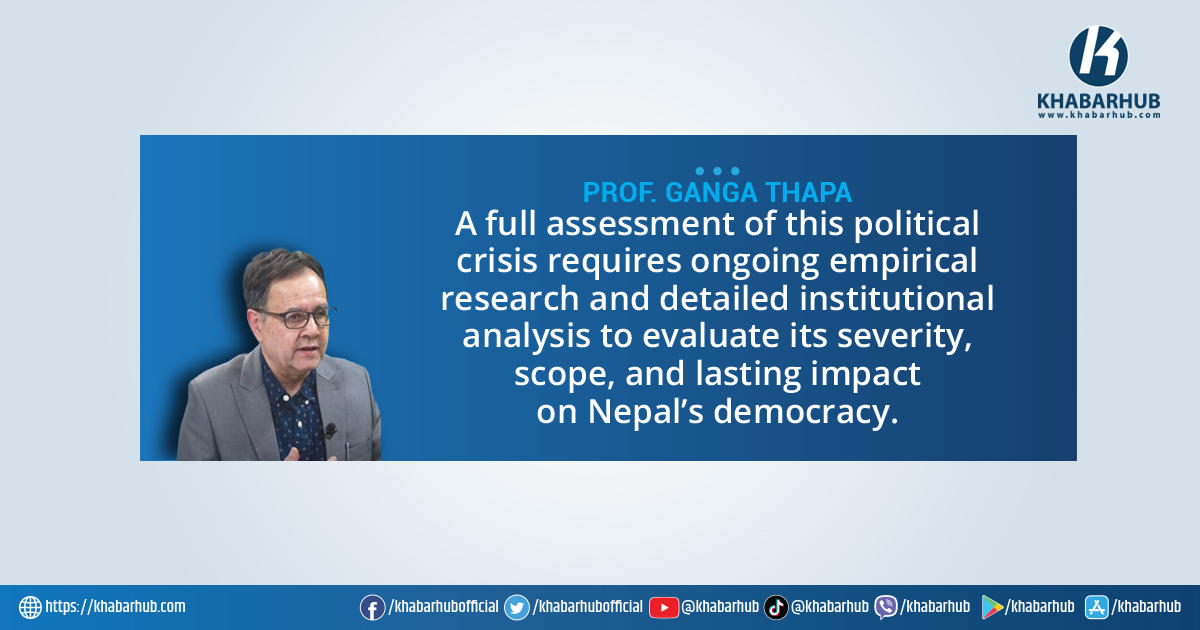
A full assessment of this political crisis requires ongoing empirical research and detailed institutional analysis to evaluate its severity, scope, and lasting impact on Nepal’s democracy. Ultimately, the main issue is a political culture that is overly praised and rarely criticized.
We can hope for the best, but honesty requires acknowledging that all branches of the Nepali state are currently corrupt. Future progress must involve more than replacing individuals; it must entail a fundamental shift in the country’s political ethos.
Although I am not a fan of the Nepali Congress, I view it as a credible political entity. Politics often defies simple labels, and accurate electoral forecasts are difficult. Ideally, officials should serve their full terms. However, in our current crisis, removing corrupt leaders is more urgent than adhering to the election schedule.
A potential political setup—where Gagan Thapa leads the government, Balen Shah is the main opposition, and figures like Rabi Lamichhane and Bishwa Prakash Sharma play key supporting roles—offers a realistic way forward. If these leaders act quickly and decisively, they could challenge deep-rooted elite dominance, restore public confidence in democratic institutions, and secure Nepal’s democratic future.






Comment