




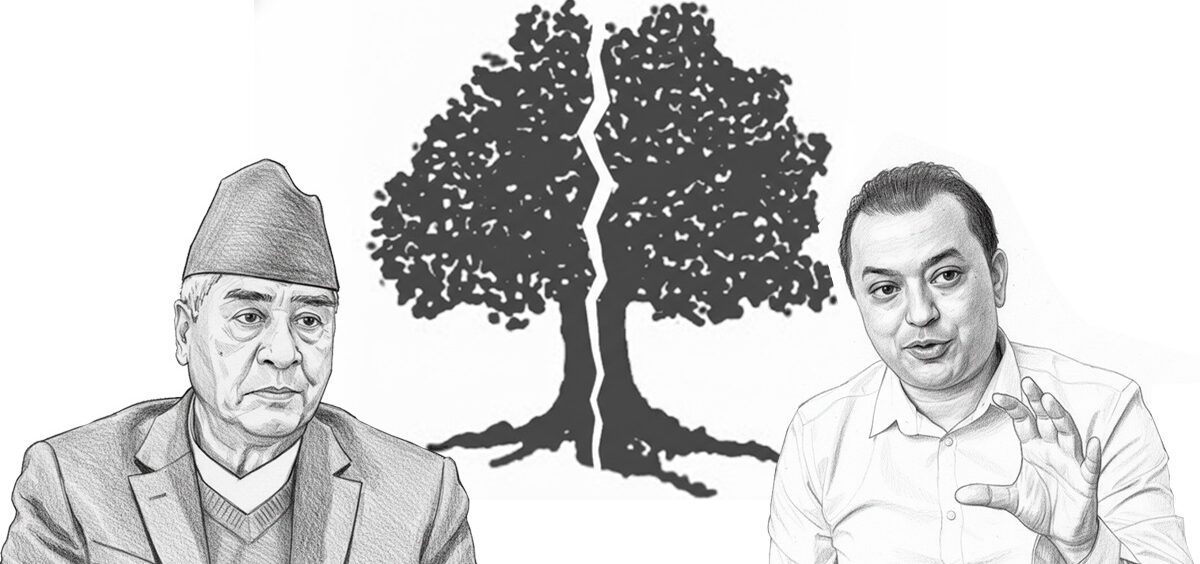
KATHMANDU: The history of the Nepali Congress is not merely a record of elections won and governments formed. It is also a chronicle of internal rivalries, ideological tensions, and deeply personal feuds that have shaped Nepal’s democratic experiment for more than seven decades.
From the towering figure of BP Koirala to the troubled leadership of Sher Bahadur Deuba today, the party’s story reveals how ambition, loyalty, money, and power have repeatedly collided within Nepal’s oldest democratic force.
When the Nepali Congress won a two-thirds majority in the 1959 parliamentary elections, it appeared that the country had finally entered a stable democratic era. Party lawmakers returned to Kathmandu with excitement and confidence, expecting a swift transition to civilian rule after decades of Rana and royal dominance.
Yet even at that historic moment, uncertainty loomed. King Mahendra delayed convening parliament and forming a government. Nepali Congress MPs, unsure of what was coming, spent their days in tea shops and under the pipal trees of New Road, discussing politics and rumors, waiting for a government that did not arrive.
At the heart of the delay was an intense power struggle inside the party itself. BP Koirala, the charismatic leader who had become the face of democratic politics, was widely expected to become prime minister. But Subarna Shamsher Rana, a key financier of the party and a powerful figure in his own right, also had strong claims. King Mahendra privately favored Subarna, who was not only politically useful to the palace but also a childhood friend of BP. This complicated triangle of palace, party, and personal relationships created a stalemate.
The rivalry became so bitter that it spilled into family life. BP’s wife, Sushila Koirala, fearing that Subarna’s ambitions would derail her husband’s leadership, launched a kind of protest inside their own home, urging Subarna to step aside.
BP, however, refused to compromise. Subarna, for his part, had poured enormous sums into the party. He had financed election campaigns and organizational work, and his sons openly questioned why a party built on their money should be led by someone else. In their blunt words: “We pay for the party, we win elections, and yet a Brahmin becomes prime minister?”
BP eventually confronted King Mahendra, asking why government formation was being delayed. If the palace preferred Subarna, BP said, then let him be made prime minister without further delay. The King responded with carefully chosen words, saying he had already “worked with Subarna” and found him ineffective, while BP, as a younger leader, represented the future of the country. It was a moment that revealed both the palace’s manipulation and BP’s precarious position.
Even as Nepali Congress leaders today proudly invoke the BP era as a golden age, the roots of internal conflict were already deep. Subarna had long argued that cooperation with the monarchy should be the party’s bottom line. BP initially rejected this, insisting on parliamentary sovereignty. But years later, when he felt unsafe in India and increasingly isolated, BP himself embraced reconciliation with the palace under the banner of national unity. History, in that sense, came full circle.
Money was another constant source of tension. In a 1958 letter to Subarna, BP openly acknowledged the party’s financial weakness. He wrote that if even one thousand people across the country could donate just Rs 100 a year, the central party could function effectively. It was a revealing admission: the Nepali Congress, even as it led a mass movement, remained dependent on a small circle of wealthy patrons.
Family rivalry added another layer of complexity. BP and his half-brother Matrika Prasad Koirala had grown up together, shared meals, and entered politics side by side. Yet once power came into reach, their relationship deteriorated sharply.
During the 1959 elections, Matrika actively worked to defeat BP, while BP’s sister Indira campaigned for him. Even their elderly mother was caught in the middle, casting her vote not for BP but for another candidate, much to Indira’s fury. Politics in Nepal, even at its highest levels, was deeply personal.
Corruption and favoritism also haunted the early Congress governments. Allegations that BP’s brother, Tarini Prasad Koirala, had taken bribes in police recruitment surfaced while BP was prime minister. Unlike many leaders who would have ignored such claims, BP removed his brother from the post immediately, signaling that ethical conduct mattered, at least in principle. Yet the very fact that such allegations arose reflected how fragile institutions already were.
After the 1951 revolution, Indian influence further complicated matters. Through its ambassador and socialist leaders like Jayaprakash Narayan, New Delhi played an active role in shaping Nepal’s leadership. At one point, BP was sidelined in favor of Matrika, only for Indian mediation to later restore BP as party president. This external intervention reinforced factionalism inside the Nepali Congress and left lasting scars.
Over time, a pattern emerged. Talented leaders were often sidelined, while those skilled in intrigue and alliance-building rose to the top. Figures such as Tanka Prasad Acharya, Dilli Raman Regmi, and later Harka Gurung brought intellectual depth and vision, yet many lost elections or were pushed aside. Nepali politics, especially within the Nepali Congress, rewarded street-level mobilization and factional loyalty more than expertise or long-term thinking.
This pattern continues today. Leaders like Krishna Prasad Bhattarai, who disagreed with BP on key issues such as going into exile, were nonetheless respected for their integrity and trusted with responsibility. In contrast, modern party culture increasingly rewards those who flatter the leadership. Advancement often depends less on competence than on proximity to power.
The later career of Sher Bahadur Deuba reflects this decline. Once seen as a pragmatic leader, Deuba has become a symbol of opportunism and internal decay. His repeated alliances with communist parties, especially after the trauma of the Maoist insurgency, alienated many Nepali Congress supporters who had suffered during the conflict. For them, voting for hammer-and-sickle symbols felt like a betrayal of their own pain.
The recent Gen-Z protests further exposed Deuba’s weakness. Aging, politically exhausted, and unable to control the ambitions of his own relatives, he presided over yet another split in the party. Instead of nurturing a new generation of leaders, he allowed the Nepali Congress to drift into a network of contractors, power brokers, and loyalists. In doing so, he added another chapter to the party’s long history of self-inflicted wounds.
Nepal’s wider political failures mirror this story. Time and again, the country has lacked leaders with both technical understanding and moral authority. Whether during droughts after the 1934 earthquake or during today’s governance crises, institutions have been hollowed out by incompetence and self-interest. Where earlier rulers at least used state resources, like fire engines, to serve farmers, modern governments often seem unable even to protect basic public goods.
Today, the Nepali Congress stands at a crossroads. It remains a party with a proud legacy, built by giants who believed in democracy, civil liberties, and social justice. But it is also weighed down by decades of factionalism, family rivalries, financial dependence, and opportunistic leadership. The distance between the ideals of BP Koirala and the reality of present-day Nepali Congress could hardly be wider.




Comment