




While I do not claim expertise in democratic consolidation, it is evident that genuine political transformation—especially through the careful crafting and contestation of narratives—requires not only time but sustained intellectual and moral energy. Deep, structural shifts in social attitudes and economic outcomes occur only when narratives are contested in public debate and when new alliances emerge across social divides.
Enduring political capital is not built through slogans or surface-level reforms, but through a coherent national project that binds citizens to a shared destiny. This project must be rooted in an inclusive, accountable political system—one that not only encourages responsible citizenship and respect for norms but also demands active participation and cultivates a culture of reasoned dissent.
Ideas matter, but they are only as powerful as the institutions and practices that give them life. While the public may instinctively prefer democracies over other forms of government, they often misunderstand democracy’s true complexity: it is not simply about elections, but about the ongoing, contested construction of fair rules, impartial institutions, and space for all voices.
Democratic states must not only shield citizens from disorder but also earn legitimacy by continuously representing, including, and listening to the people. Kathryn Sikkink, in Evidence for Hope (2017), rightly observes that democracy struggles to take root in societies with weak educational foundations or when born from violence and ideological purity. Sustainable democracy emerges from compromise, civic education, and a willingness to tolerate ambiguity and slow progress.
History has shown, time and again, that the failures of democracy are best remedied by more democracy—by deepening participation and reform, not by retreating into authoritarian nostalgia.
The globally hailed “Third Wave” of democratization swept across the globe with the force of a tsunami, but its aftermath has exposed deep fractures. Francis Fukuyama’s thesis of liberal democracy as the “end of history” underestimated the enduring power of identity, resentment, and unresolved historical injustices.
Nepal, like many post-transition societies, has struggled to translate democratic forms into meaningful substance—a process undermined by the lack of a shared civic ethos and persistent factionalism. The worldwide surge in populism, which thrives on polarization and manufactured crises, underlines the fragility of democratic gains.
Steven Levitsky’s analysis in The Myth of the Democratic Recession (2015) underscores that state failure—often triggered by elite impunity and institutional decay—rarely leads to genuine democratization. Nepal’s struggles are not isolated but symptomatic of broader trends in which democracy’s mere presence does not guarantee its consolidation.
A central flaw of democracy in much of the developing world is the tendency of political elites to conflate the pursuit of power with public virtue. In Nepal, this pathology is stark: over the past decade and a half, leaders such as Khadga Prasad Oli, Pushpa Kamal Dahal, Sher Bahadur Deuba, Madhav Kumar Nepal, and Baburam Bhattarai have repeatedly cloaked self-interest in the rhetoric of reform and patriotism.
Their actions, however, reveal a deeper malaise: politics is reduced to a zero-sum contest for spoils, with the public good an afterthought. The normalization of corruption, cynicism, and transactional alliances has eroded trust in democratic institutions and fostered widespread political apathy.
Nepal’s contemporary political landscape is increasingly shaped by figures whose authority stems not from moral leadership or vision but from transactional relationships, intimidation, and the manipulation of public perception. In this environment, skills, integrity, and merit are systematically devalued, while sycophancy and opportunism flourish.
The ascendancy of corrupt actors to the highest echelons of power has inflicted lasting damage on the fabric of society, much like a blight that quietly destroys a harvest from the inside out. For over a decade, there has been a dearth of leaders genuinely motivated by public service or a problem-solving ethos; instead, politics has become an arena for division, patronage, and self-preservation.
In Nepal, ideology frequently serves as a smokescreen for opportunism, with policymaking relegated to improvisation and short-term dealmaking. Government itself is less a vehicle for the public good than a currency traded among elites.
The relentless pursuit of expedient approval, whether from party bosses, coalition partners, or the volatile court of public opinion, creates a cycle of instability, abrupt policy reversals, and institutional atrophy. The net effect is a system that rewards short-term appeasement of powerful interests while neglecting the foundational work of building good governance and public trust.
Nepal’s predicament echoes an old Japanese proverb: vision without action is a daydream, but action without vision is a nightmare. The nation is abundant in ideas and talent, yet it suffers from a chronic disconnect between aspiration and execution.
Progress requires more than rhetoric—it demands the difficult alignment of principled vision with pragmatic action. As long as this divide persists, Nepali politics will continue to generate turbulence rather than transformation, movement without momentum, and noise instead of meaningful progress.
Against this backdrop, Nepal’s Generation Z stands at a crossroads: they could either inherit the cynicism of their predecessors or become the architects of democratic renewal. Their entry into politics will only be transformative if it is rooted in ethical conviction, civic education, and a refusal to be co-opted by clientelist networks.
By insisting on accountability, transparency, and policy grounded in evidence rather than patronage, Gen Z has the potential to reorient Nepali politics away from perpetual power struggles and toward a more substantive, credible democracy.
The gravest danger lies in normalizing toxicity under the guise of peace and stability—a practice that only breeds further violence and entrenches cycles of impunity. The Gen-Z mass street mobilization of September 8–9, 2025—when the unchecked exercise of power by Oli and his Nepali Congress allies resulted in the deaths of nearly eighty young people—exemplifies the catastrophic costs of such complacency.
Oli’s legacy is not just one of harm and shamelessness but of deepening public alienation and resentment. For ordinary Nepalis, UML politics have become a symbol of broken promises and lost hope, underscoring the need for a decisive, principled challenge to his continued leadership.
History teaches more through the slow accumulation of practical lessons than through the pronouncements of pundits. Oli’s continued dominance as UML president, despite the havoc wrought by his policies, reveals a disturbing pathology: the compulsion to cling to power, even if it means presiding over ruin.
This is the defining feature of our era—a time when leaders prefer to polarize, distract, and exhaust the public rather than govern with integrity or step aside for the common good. For such politicians, it is better to reign over ruins than to act with principle or humility, and this is the true tragedy of contemporary Nepali politics.
Five decades in political science have taught me one fundamental and unavoidable truth: true power is never exercised against the people; when it is, it signals not strength but illegitimacy and structural fragility.
A functioning democracy is not defined merely by the containment of disorder but by its active commitment to building trust, ensuring public safety, and creating the social, economic, and legal conditions in which individuals can meaningfully flourish. It is precisely this capacity to secure collective well-being that makes democracy indispensable—and its betrayal not only corrosive but profoundly dangerous.
As Mahua Moitra, a member of India’s Parliament, incisively observed, the critical question in political crises is not who started the fire, but who enabled the arsonist. To describe Khadga Oli as merely a product of corrosive clichés and entrenched stereotypes grossly understates the problem.
His re-election to a third term as UML party president is not just ludicrous but symptomatic of a political culture that rewards destructiveness, stifles dissent, and shrinks the space for meaningful reform. The real crisis lies in the system that enables such figures to thrive rather than in their individual flaws.
The real emergency is not Oli’s personal political fate but the collective willingness to empower leaders manifestly unfit for public trust. Each act of endorsement reflects a deeper cultural malaise: cynicism has supplanted principle, complicity is rewarded, and the vital norms of accountability are routinely abandoned for short-term gain.
My judgments now rely not on personalities, charisma, or rhetoric but on conscience, factual evidence, and lessons from history, which warn that unchecked hope can often lead to national disappointment.
It bears repeating: the monarchy—an anachronistic and fundamentally anti-modern institution—is gone for good. Yet Nepal’s republic, for all its promise, has thus far failed to deliver on its most basic obligations: equal rights, meaningful accountability, and the robust frameworks required for modernity and shared prosperity. The notion that a benevolent autocracy or a “humane” dictatorship could be a viable alternative is a dangerous illusion.
History has shown, time and again, that the failures of democracy are best remedied by more democracy—by deepening participation and reform, not by retreating into authoritarian nostalgia.
Nepal’s path forward depends on defending and renewing its democratic experiment—not as a matter of blind faith but through the hard work of building a shared civic rationale and a culture of accountability. Only by embedding fairness, opportunity, and civic virtue at every level of society can the country hope to overcome the entrenched patterns of self-interest and exclusion that have plagued its politics.
Nepal today is governed by manipulative demagogues—political actors who weaponize public morality to secure personal and electoral gain while sidelining the national interest. In this corrosive environment, skepticism toward new political alliances is not just natural but an essential civic duty, a safeguard against repeating past failures.
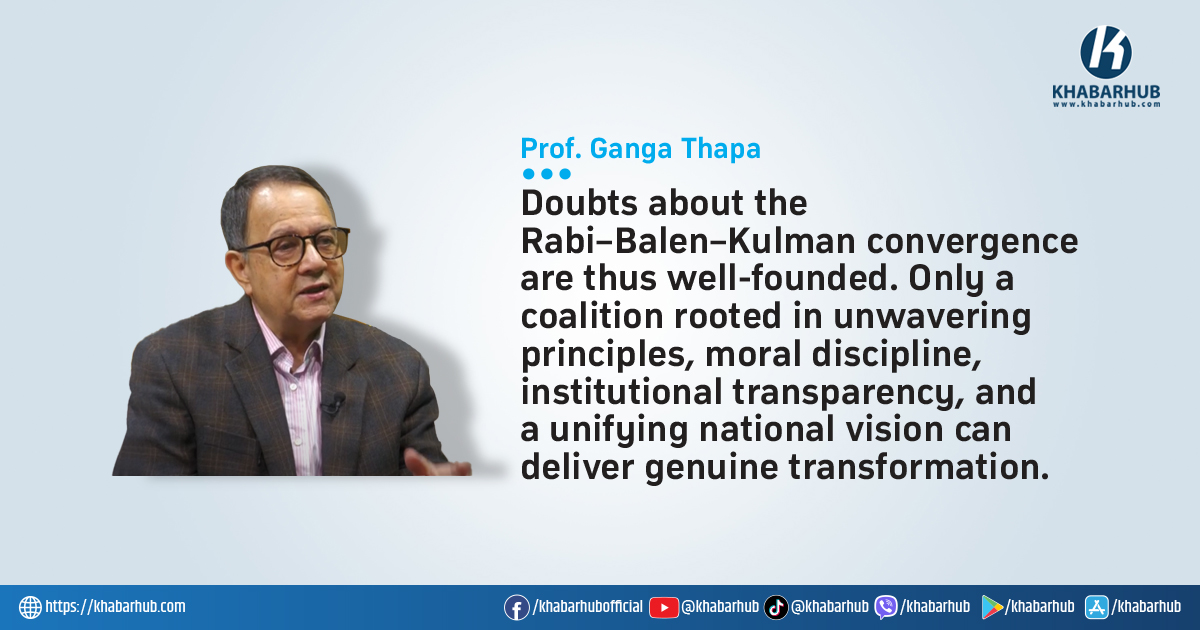
Doubts about the Rabi–Balen–Kulman convergence are thus well-founded. Only a coalition rooted in unwavering principles, moral discipline, institutional transparency, and a unifying national vision can deliver genuine transformation.
Otherwise, alliances merely recycle old dysfunctions under new banners. However, if driven by genuine reformist ambition, this emerging force could disrupt Nepal’s entrenched political inertia and spark the renewal the nation desperately needs.
By examining Nepal’s ongoing political cycles, I assess current events with cautious skepticism rooted in history. Past experiences have shown that trusting authority blindly—particularly when cloaked in populist rhetoric and moral displays—leads to institutional decline and public disillusionment.
My judgments now rely not on personalities, charisma, or rhetoric but on conscience, factual evidence, and lessons from history, which warn that unchecked hope can often lead to national disappointment.
Despite deep institutional decay, I remain convinced that progressive reform and the restoration of the rule of law are still attainable in Nepali society. History makes clear that no nation is condemned to permanent stagnation; periods of decline, however protracted, eventually yield to renewal when catalyzed by principled leadership and public resolve.






Comment