




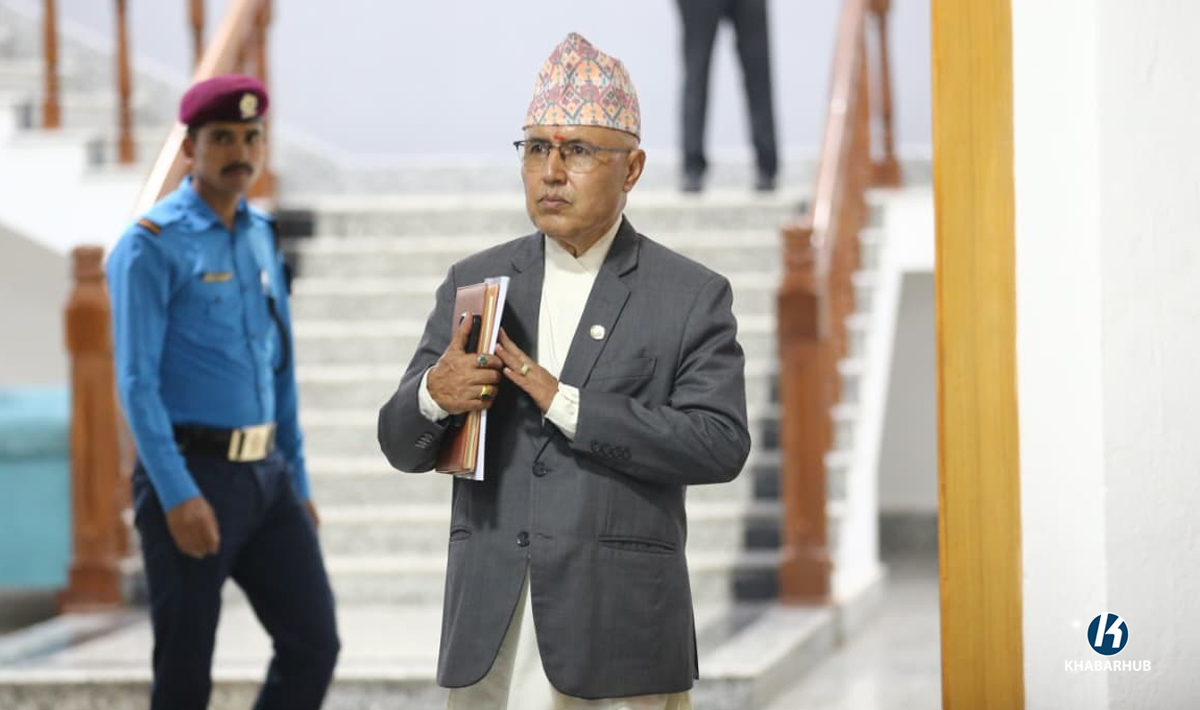
KATHMANDU: Finance Minister Rameshwor Prasad Khanal has said Nepal must undertake a serious self-assessment to understand why the country has repeatedly failed to achieve its expected economic growth rates.
Speaking at the 29th anniversary and awards ceremony of the Society of Economic Journalists–Nepal (SEJON), Minister Khanal said years of political dissatisfaction and instability have hindered development and economic activity. “Regardless of how political dissatisfaction manifests, everyone must understand that wealth created by anyone in this country ultimately belongs to Nepal,” he said.
Khanal stressed the growing need to understand the authority and impact of information in an era of rapid technological change. He warned that inaccurate or unverified reporting can harm international relations and Nepal’s investment climate, urging media institutions to play a responsible role. “Appropriate messaging and factual information build confidence in the private sector and strengthen investor morale. The sensitivity of information flow must be understood,” he added.
The finance minister said the government is increasing budget allocations for major infrastructure projects and is working to resolve long-standing issues in the capital market. He also noted that benefits and facilities for former constitutional officials are being standardized under a legal framework.
Khanal praised SEJON for its role in promoting responsible economic journalism during Nepal’s economic highs and lows.
Also speaking at the event, Minister for Industry, Commerce and Supplies Anil Kumar Sinha said the government’s upcoming priorities include economic empowerment, boosting domestic production, expanding productivity, and creating jobs.
“The government is committed to holding elections on time, improving governance and ensuring service delivery,” he said. Sinha added that the government views the private sector as its most important partner in accelerating economic activities and has been moving ahead with reforms inspired by the concerns raised during the Gen-Z protests.
He said the government is taking responsibility for families affected during the Gen-Z movement, emphasizing that good governance and corruption control remain the government’s central obligations.
Nepal Rastra Bank Governor Prof. Dr. Biswo Poudel said liquidity management is the biggest challenge currently facing Nepal’s economy. Despite sufficient liquidity and low interest rates in banking and financial institutions, investment in large infrastructure projects has not expanded as expected, a matter of concern, he noted.
Poudel said the monetary policy’s intended outcomes have not been achieved due to weak implementation. He urged banks to expand lending based on local needs, especially in agriculture, tourism, energy and productive sectors, which he said could significantly strengthen economic activity.
“When expanding credit, risk management must be balanced with local priorities. Productive sectors must be placed at the center,” he said.
He further advised banks not to rely solely on interest income but to focus on business expansion, improved services, and effective use of technology. Monetary and fiscal policies will become more flexible, he said, and financial institutions must be prepared to benefit from these changes.
Poudel emphasized that all sectors share responsibility for economic reform, adding that the government must increase capital expenditure to stimulate growth. “Economic activities are increasing—now we must prioritize all sectors to accelerate momentum,” he said.
Federation of Nepalese Chambers of Commerce and Industry (FNCCI) President Chandra Prasad Dhakal said misinformation circulating on social media and news platforms has undermined investor confidence and damaged Nepal’s investment environment.
Citing the recent Gen-Z protests, he said misleading narratives had caused major harm to the private sector. “We experienced firsthand during the Gen-Z movement how destructive misinformation can be,” he said.
Dhakal stressed the media’s crucial role in attracting both domestic and foreign investment, noting that good governance, corruption control, and streamlined service delivery were long-standing demands of the private sector. He added that negative perceptions, such as claims that “nothing ever gets done in Nepal”, must be countered through effective policy implementation. Outdated and unpredictable laws, he said, have also weakened the investment environment.
Confederation of Nepalese Industries (CNI) President Birendra Raj Pandey said the government must act urgently to revive investor morale. “External indicators are strong; banks have adequate liquidity; and interest rates have improved. Yet investment has not increased,” he said, calling for comprehensive solutions to all issues affecting the economy.
Pandey said good governance, corruption control, and an investment-friendly environment are indispensable for economic prosperity.
Nepal Chamber of Commerce President Kamlesh Kumar Agrawal said Nepal’s economy has not fully recovered from the COVID-19 shock and that industrial establishments are increasingly vulnerable from a security perspective.
He said the private sector’s confidence is steadily declining due to youth migration, entrepreneurs being blacklisted, slow credit disbursement and complex tax systems.
Agrawal proposed several immediate measures for the government: effective implementation of loan restructuring, scrapping the current working-capital credit directive, simplifying the VAT system by adopting multiple rates, reducing excise duties on all goods except those on the negative list, continuing export subsidies, and introducing a law to help resolve the ongoing cooperative sector crisis.





Comment