




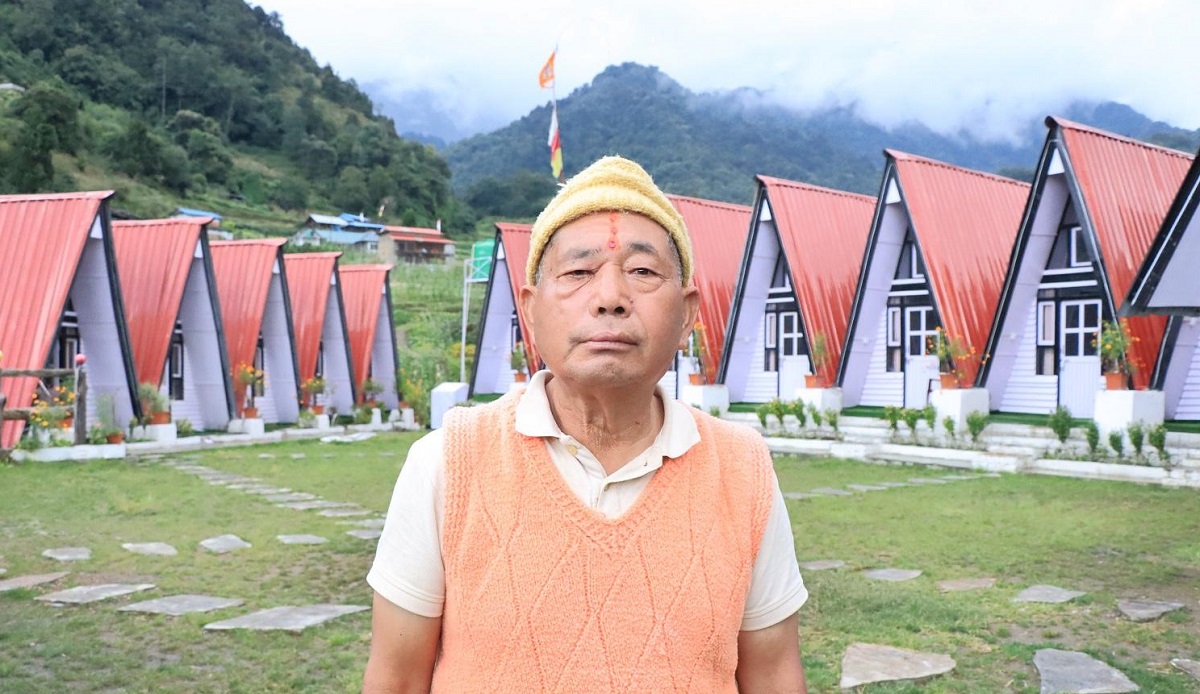
MYAGDI: For 68-year-old Bal Bahadur Tilija Pun, life in Pokhara had everything one could ask for, a comfortable home, financial stability, and a family settled around the world. Yet, the retired Indian Army captain decided to leave the bustling city behind and return permanently to his birthplace in Sik Swant, Purnagaun Rural Municipality-5, Myagdi.
Tilija, who had been living in Ram Bazaar, Pokhara, handed over his urban house to relatives and moved back to his ancestral village after 24 years. Accompanied by his wife Jyanmaya, eldest son Narayan, and daughter-in-law Krishna, he made the journey home with a renewed purpose.
“I realized that money alone cannot bring peace and happiness,” Tilija said. “In the city, even people living next door barely know each other. But in the village, there’s clean air, pure food, and a spirit of community that’s still alive. I brought my son and daughter-in-law back to start something meaningful here.”
That “something” turned out to be Pyramid Hotel, a distinctive lodge designed to blend traditional Nepali hospitality with architectural innovation. Built on two ropanis of terraced land at a cost of around Rs 18 million, the hotel features 13 pyramid-shaped cottages, each built with slanted roofs to prevent snow accumulation during winter.
“The idea was to give my children both a reason and a responsibility to stay in the village,” Tilija explained. “The hotel provides them with a livelihood, and an emotional connection to home.”
Opened last week, Pyramid Hotel stands out for its unique design inspired by homes in Shillong, India, and Switzerland. The cottages, constructed primarily of wood and roofed with corrugated sheets, are equipped with attached bathrooms and twin beds. Inside, insulation keeps the rooms warm in winter and cool in summer.
Apart from the four family members, the hotel employs one additional staff member. The Pun family personally handles everything, from guest reception and housekeeping to kitchen duties. The restaurant serves traditional delicacies such as nettle leaf curry, wild mushrooms, local chicken, goat meat, and millet or maize dhido.
Perched on the Annapurna Circuit trail between Tatopani and Ghorepani, Swanta offers panoramic views of the Dhaulagiri range. It’s an hour’s walk from Shikha village and just 20 minutes from the scenic Chhahare waterfall. The area sits at an elevation of 2,300 meters and is accessible via a network of rural roads. The hotel also offers internet access and hot water for guests.
Today, only about 25 to 30 of Swanta’s 70 households are permanently inhabited, as many families have relocated to Pokhara, Kathmandu, Chitwan, Butwal, or abroad. Yet, with electricity, internet, and water supply now reaching the village, locals see potential for revival through tourism and commercial farming. Swant is already known for its fertile soil, potato cultivation, and mustard seed production.
“I came back to show that a village once fading away can still hold promise,” Tilija said. “If my return inspires even a few others to come home, it will be worth it.”





Comment