





KATHMANDU: Economic Digest offers a concise yet comprehensive overview of significant business happenings in Nepal, presented in easily digestible summaries.
Nepal is navigating a complex period of economic and institutional transition marked by recovery efforts, policy reforms, and emerging challenges. The government’s push to promote offbeat tourism as a core economic driver reflects a strategic pivot to revitalize the sector after the Gen-Z protests, which severely impacted hospitality businesses, especially in Pokhara and during Dashain.
Simultaneously, the stock market rebounded amid capital market reforms, signaling restored investor confidence. However, deep-rooted inefficiencies persist—evidenced by the planned termination of 234 stalled infrastructure contracts and controversy over a high-level appointment defying a Supreme Court order.
On the economic front, targeted interventions like the Payroll Protection Scheme and financial relief for the private sector aim to safeguard employment and stabilize business operations. Meanwhile, external factors such as India’s GST 2.0 offer mixed outcomes—cheaper imports for consumers but increased pressure on local industries due to informal trade.
At the same time, climate change is emerging as a hidden driver of labor exploitation, particularly in vulnerable sectors. Together, these developments underscore a nation in flux, striving to balance governance reform, economic resilience, and social protection.
Prime Minister calls for promotion of offbeat tourism to drive growth
Prime Minister Sushila Karki, who also leads the Ministry of Culture, Tourism, and Civil Aviation, has stressed the need to promote lesser-known tourist destinations to revitalize Nepal’s tourism industry and economy. Speaking on the occasion of the 46th World Tourism Day, she emphasized tourism’s potential to generate foreign income, create jobs, and raise national revenue. While acknowledging the setbacks caused by the recent Gen-Z protests, she stated that recovery is in progress. The Prime Minister advocated for tourism to be recognized as a core pillar of sustainable national development.
Share market rebounds with 140-point surge after reform measures
The Nepal Stock Exchange (NEPSE) jumped 140.09 points last week, reflecting renewed investor confidence following government-led reforms in the capital market. The index rose from 2,511.91 on Sunday to close at 2,652 on Thursday, peaking at 2,689.67. Total turnover reached Rs 21.85 billion, while market capitalization climbed to Rs 4.433 trillion—translating into capital gains of Rs 234 billion, recovering from Rs 268 billion in losses the previous week. Him Star Urja led gains with a 46.36% rise, while Siddhartha Premier Insurance posted the sharpest decline at 9.24%.
Govt to cancel 234 stalled road and bridge contracts
The government is moving to terminate 234 dormant road and bridge contracts that have seen little or no progress for years. These projects—part of the Postal Highway, Mid-Hill Highway, and several federal road divisions—are classified as “sick” due to repeated delays despite deadline extensions. Energy, Water Resources, and Infrastructure Minister Kulman Ghising stated that scrapping these contracts is vital to tackle corruption, misuse of advance payments, and chronic inefficiencies. He warned that both negligent contractors and involved government officials could face legal scrutiny. Ghising called the move a major step toward institutional accountability and reform.
Finance Minister’s insurance board appointment defies supreme court ruling
Acting Finance Minister Rameshwor Khanal has ignited controversy by appointing Janak Raj Sharma as chairman of the Insurance Board, defying a Supreme Court order that barred new appointments. The Court had earlier reinstated former chair Sharad Ojha and instructed the government to maintain the status quo until a scheduled hearing on October 12. Official records confirm that the court’s decision was received by relevant offices on October 5, contradicting Khanal’s claims of being unaware. Legal experts have widely criticized the appointment as a violation of judicial authority and a potential contempt of court.
Payroll protection scheme launched to safeguard jobs amid protests
To cushion the blow of the Gen-Z movement on businesses and workers, the government has introduced a Payroll Protection Scheme. According to new directives issued by Nepal Rastra Bank (NRB), banks are required to provide loans at base rate plus a maximum premium of 0.5 percent. The government will subsidize 2 percent interest for up to six months. Affected businesses can apply for these loans—valid for up to one year or until operations resume—through banks by mid-January 2026 (end of Poush 2082). The move is aimed at ensuring employees continue receiving salaries during the recovery phase.
NRB announces financial relief for private sector post-protest
Nepal Rastra Bank has rolled out comprehensive relief packages for private sector entities affected by the Gen-Z protests. The central bank has instructed Class A, B, and C financial institutions to offer measures like loan restructuring, interest subsidies, and low-interest credit. Businesses can apply for loan rescheduling or restructuring until mid-January 2026 (end of Poush 2082). Borrowers must pay at least 5% interest to qualify. The scheme aims to stabilize businesses and retain jobs amid post-protest economic recovery efforts.
Dashain tourism hit hard by cancellations and property damage
The Gen-Z protests have crippled Nepal’s tourism sector just as Dashain, the peak travel season, begins. From Bandipur to Kathmandu, hotel bookings have dropped below 5% in some areas, with widespread cancellations. The Nepal Hotel Association estimates damages of up to Rs 25 billion, affecting major properties like Hyatt Regency, Hilton Kathmandu, and Chandragiri Cable Car. While the Nepal Tourism Board reports gradual improvement in tourist arrivals, CEO Deepak Raj Joshi said the sector remains in crisis mode and is still struggling to recover.
Pokhara tourism suffers Rs 2.5 billion loss as visitors stay away
Pokhara’s tourism sector is facing severe losses despite the clear autumn skies, as visitor numbers have plummeted. Hotel occupancy, usually at 70–80% during this season, has dropped to just 15–20%, with about 40% of bookings canceled in September, according to Hotel Association chair Laxman Subedi. Total losses are estimated at Rs 2.5 billion. With the tourism industry employing nearly 15,000 people and valued at Rs 800 billion, local officials are urging promotional campaigns like #IamInNepalNow to restore traveler confidence and revitalize the region.
India’s GST 2.0 makes imports cheaper for Nepal, but local industries raise concerns
India’s updated Goods and Services Tax (GST 2.0) has reduced duties on essential goods like food, electronics, and vehicles, making imports cheaper for Nepali consumers through the open border. Prices for items such as entry-level hatchbacks and packaged foods have already dropped. However, trade analysts warn the move could significantly increase informal cross-border trade, which already exceeds 50% of Nepal’s total trade volume. This poses a threat to domestic industries, jobs, and tax revenues. While Indian officials highlight opportunities for Nepali startups through lower input costs and greater export potential, Nepali stakeholders urge tighter customs checks and improved regulatory enforcement to protect local markets.
Climate change linked to rising child and forced labor in Nepal, study reveals
A new study by GoodWeave International and New ERA has found that climate shocks—such as floods, droughts, landslides, and heatwaves—are driving child and forced labor in Nepal’s brick kilns and carpet weaving industries. Drawing on 30 years of climate data and over 1,000 interviews, the report shows that 35% of workers entered hazardous labor due to climate-related disruptions, with 17% reporting severe impacts. The findings call for urgent interventions, including climate-resilient farming, diversified income sources, and improved education and labor protections, to prevent further exploitation as environmental pressures worsen.
Incomplete bridges on Tamor Corridor leave travelers stranded during floods
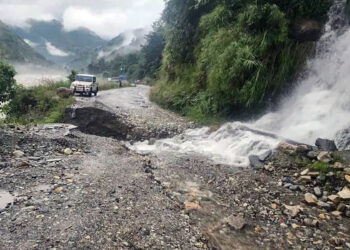
Travelers along Nepal’s 110-kilometer Tamor Corridor face severe monsoon disruptions due to delayed bridge construction. Although over half of the Mulghat–Ganeshchowk section is blacktopped, key rivers like Henwa, Nawa, Lakhwa, and Chharuwa still lack bridges. Vehicles often become stranded during sudden floods. Progress on several bridges, including the vital 165-meter Chharuwa bridge—the longest in the corridor—remains between 15% and 50% due to funding delays and slow contractor work. Around Rs 40 million is still pending from the previous fiscal year. Local residents are urging authorities to expedite construction to ensure safer travel and connectivity.
Govt mandates green-mark system to ensure safe goat meat for Dashain
Ahead of Dashain, Nepal’s Department of Livestock Services has implemented a green-marking system to guarantee the safety of goat meat sold in the market. Goats deemed healthy after veterinary inspection are marked with green paint on their horns, while unfit animals receive red markings and are prohibited from sale. Ten livestock checkpoints have been established across the Kathmandu Valley, staffed by 58 veterinary professionals. As of Saturday morning, over 14,100 goats and 324 buffaloes had been inspected, with no major diseases detected. Authorities encourage consumers to purchase only green-marked livestock during the festival season.
US introduces $1 fee for DV lottery applications from Nepal
Starting with the DV-2027 program in October 2025, Nepali applicants for the US Diversity Visa lottery will be required to pay a $1 application fee. Previously free, the new charge is designed to deter fraudulent entries and cover administrative costs. The core eligibility requirements remain the same, including a valid passport and a separate $330 visa fee if selected. Payments must be made online through official US government platforms, using Visa, MasterCard, American Express, or PayPal. In Nepal, domestic Visa and MasterCard debit/credit cards are the most reliable options. Further instructions on payment procedures are expected to be issued soon.





Comment