




KATHMANDU: Former Prime Minister KP Oli was fiddling with his iPad in Baluwatar at midnight. Suddenly, protestors barged into his bedroom.
Oli pleaded with them.
“You may burn everything else I own,” he said. “But under no circumstances will I give you my iPad.”
The protestors asked, “What’s in that iPad that we can’t have?”
Oli said, “It contains political wisdom. From Marx, Lenin, and Maoism to formulas for social transformation. It has a roadmap for economic prosperity. It stores the pledges my party made during elections. It holds crafty tricks to manipulate the people. It contains strategies to capture power indefinitely.”
Before Oli could finish his explanation, the protestors slapped him twice so hard his cheeks turned yellow like mustard flowers. He objected to being struck without reason.
But the youths seeking change spoke fearlessly, “Political commitment isn’t something stored in an iPad, but something lived in practice. On this agenda, you are immature. Our teachers didn’t preserve wisdom in notebooks but in their hearts, and they inspired us to act upon it. Those who keep their so-called knowledge in devices and only preach from it are frauds. That’s why you are worthy of insult.”
Despite being surrounded by hundreds of security personnel, Oli’s uninvited tutor left the room unharmed.
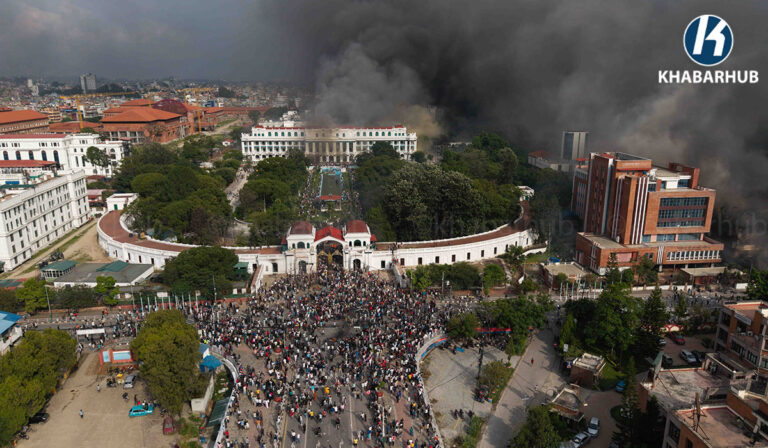
Though fictional, this scene is a truthful allegory for Nepali politics today. It captures the spirit carried by the recent protests. Protestors poured flames of such magnitude that no government fire engine, accustomed to making excuses only after the blaze, could contain it.
Leaders who think one thing, say another, and do something entirely different have mangled their own histories. Every head of government has turned into a joker shouting like a street vendor in Ratna Park because of the entrenched culture of irresponsible governance.
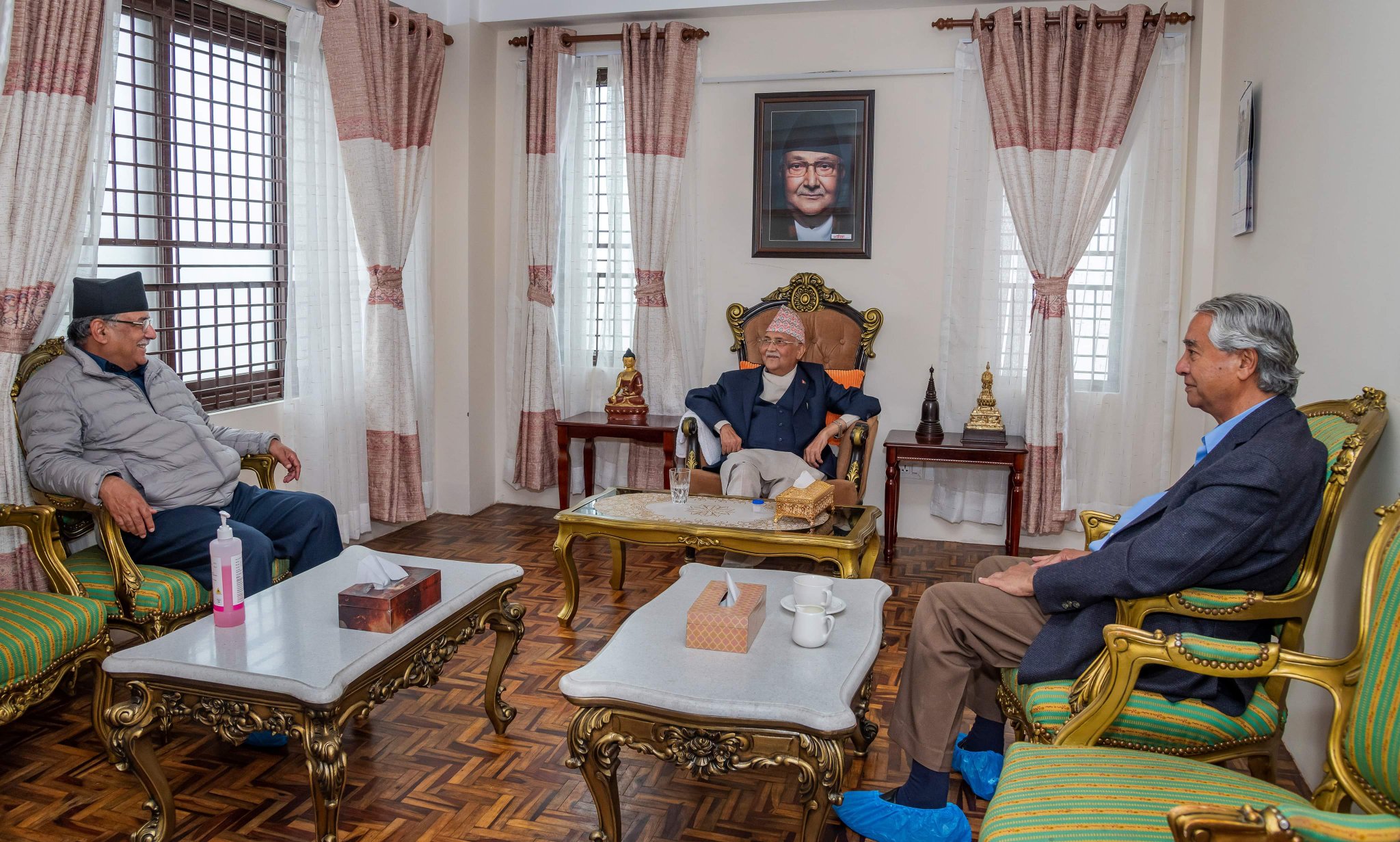
Oli, Dahal, and Deuba are not just names but political tendencies. Once, King Gyanendra thought his throne was unshakable until the very eve of its downfall. Prachanda, who had bravely challenged the state with his missile politics, was rattled in his very first innings by the mere Katuwal controversy. Who could have imagined the all-powerful royal family, shielded by four regiments, would collapse into a pool of blood?
To blame Dipendra’s marriage for the massacre is nothing more than a sentimental subplot conjured by a clever screenwriter. Neither overwhelming public support, nor intricate maneuvering, nor divine blessings can permanently privatize the seat of power. With leaders fluent in jargon but ignorant of the economics of daily life, Nepalis have spun in a purposeless cycle like the endless loop of a mill belt for decades.
From grandfather to grandson, generations of Nepalis have lived with the empty-bellied sorrow of poverty. Ethiopia, once the archetype of famine, now grows turmeric that colors Nepali vegetables. Ethiopia, which now records double-digit growth, may soon host Nepalis in search of survival, and that day is not far.
The famed oil mills of Khokana, once a symbol of local ingenuity, now rely on imported mustard seeds from Russia, Ukraine, and Australia. Bhaktapur’s juju dhau yogurt limps along, while the market thirsts for imports from Spain.
America, the world’s biggest arms dealer, has pushed nearly 1.7 million kilos of soybeans into Nepali kitchens. What political course does such dependency represent for Nepal? Argentina doesn’t just display footballing artistry, it sends garlic that perfectly fits the teeth of Nepalis.
For years, slogans have promised prosperity, but not an inch has changed in the working style. A development project gets blamed for not depositing dowry money into the engineer’s daughter’s wedding account in time. Such knots are the obstacles to good governance.
Governments born of movements must absorb these unseen yet persistent pains. In Westminster democracy, the Prime Minister’s word is law. Yet in Nepal, the Prime Minister’s Office often turns into a playground for bureaucrats whom even ministers don’t trust.
Who will bear the responsibility of strengthening such an important institution in mind, word, and deed? Erasing the precedent of the national chatterbox face that every new government wears must be the first and last duty of this government. Federalism, too, has multiplied outposts of rulers instead of expanding the reach of servants. The arrogance of the powerful has reduced the country to a skeleton.
The champions of lootocracy arranged air-conditioned homes and shiny cars for their children in the cities, but they gave no culture of patriotism. That’s why households are producing not responsible citizens but metaphorical suicide bombers. Patriotism aches not in the heart but on Facebook timelines. Nepalis who have forgotten how to laugh in their homeland vow to find happiness abroad.
Ask a refugee what a country means. Ask the Dalai Lama what life lacks when everything is at hand except soil of one’s own. Ask a thirsty soul in the desert what a glass of water is worth. Human life is a process of coming and going, but standing alone against death is an illusion. Mistakes are natural, but repeating mistakes is unforgivable. Nepal has already piled up too many mistakes. Experiment after experiment has left the nation full of holes.
Political science says, “The people are never wrong.” Yet an odd culture is rising where even the people seem disoriented. Everyone envies one another. Pollution from outside the political ring has rusted the very gears of politics. From migrant workers in the Gulf and Europe to street sweepers at home, all thirst for Singha Durbar. Even after federalism has created new structures, officials show no love for their positions, only for salutes.
Current representatives must correct the failed doctrine that becoming a minister means even an upright electric pole will obey their order. Fields lie barren. Both ropes and mustard seeds are abroad, while expatriates shower sentimental love for Nepal from afar. The same citizens, frustrated, have burned down their own ward offices, the very institutions keeping their birth records. Is it fitting for patriots to torch public property they themselves funded with taxes? That is nothing but foolishness, burning down one’s own house to make ash.
Corruption has reached the point where even registering documents requires bribes. Nepal may be the only country where one needs a middleman to pay taxes. Citizens don’t know officials, they know brokers. From frightening King Tribhuvan into exile and enthroning a four-year-old boy, to the dramatic rise and fall of Prachanda’s “divine” avatar, the same culture has been at play.
Those who attain power treat state institutions as personal estates, and that mindset has turned us into beggars for chatter. True democracy is the one that leaves people with as few grievances as possible in the process of governance.
Taking advantage of weak leaders, opportunists have multiplied Nepal’s security forces into the hundreds of thousands, while civil service numbers have already shrunk below seventy thousand. Despite all this political upheaval, our leaders still fail to grasp that to fatten up is not the same as to grow strong.
In 1980, Nepal’s per capita income was $265, while China’s was $250. Today, Nepalis rely on cheap Chinese blankets that barely cover their bodies, while China and India sign trade deals worth over $200 billion. Wouldn’t it be useful if our leaders, before threatening India on Facebook with China’s card, at least knew this fact?
So long as those in power treat state machinery as private estates, we will remain beggars of rhetoric. True democracy is that which gives citizens the least reason to complain about their rulers.



Comment