




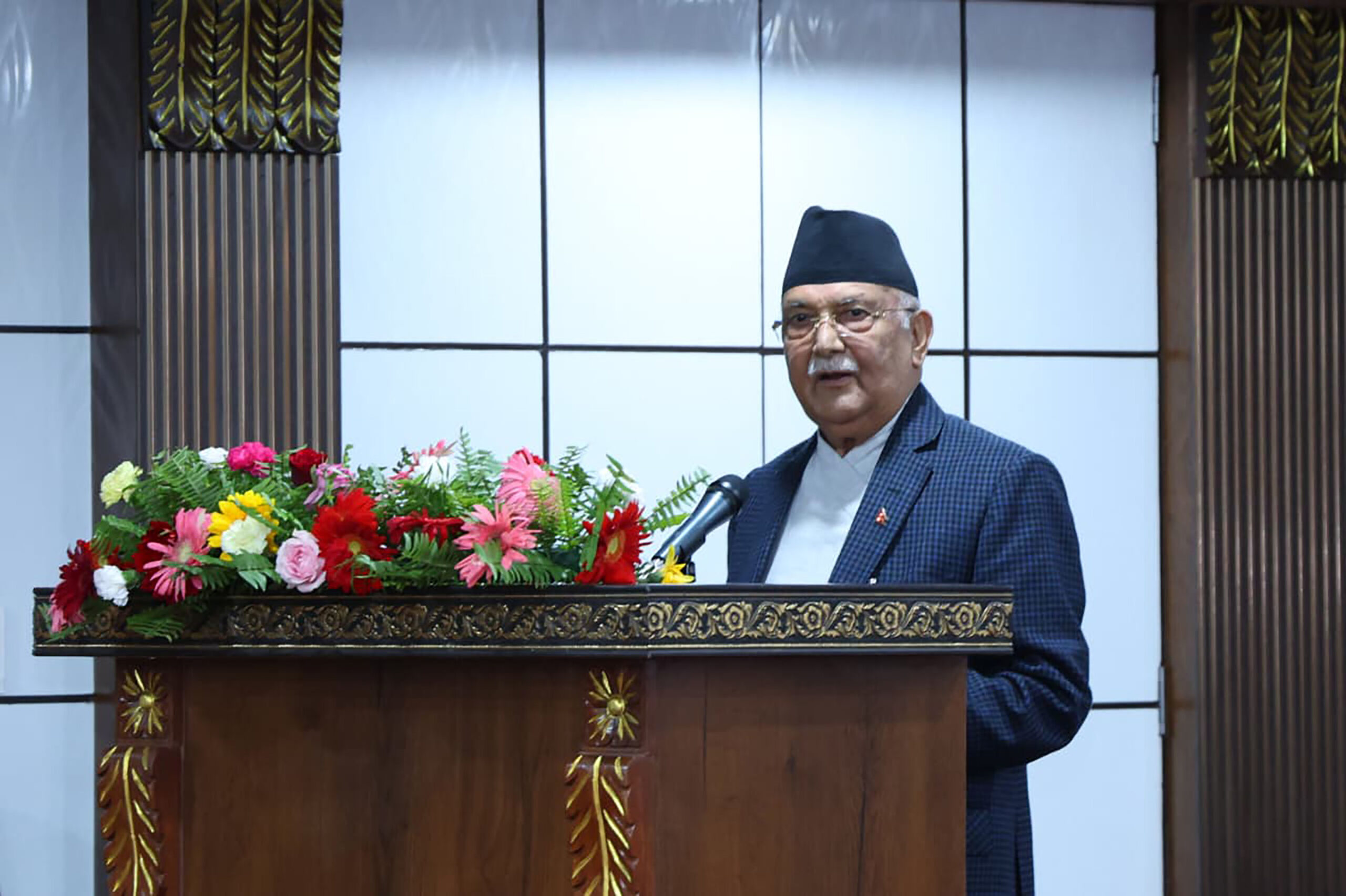
KATHMANDU: Prime Minister KP Sharma Oli has firmly stated that no regressive laws, including those recognizing polygamy, can be introduced under Nepal’s democratic republic.
Addressing a program organized by the Ministry of Law, Justice and Parliamentary Affairs on the occasion of Muluki Sanhita (Civil Code) Day 2082, Prime Minister Oli stressed that the Constitution and laws must be implemented in line with the principle of checks and balances and separation of powers.
“We are introducing new laws and amending existing ones based on implementation and experience. Several bills have already been presented in this parliamentary session, and this process will continue,” Oli said. “We stand for a complete democracy, not just a political one, where inequality, discrimination, and oppression have no place.”
Dismissing public speculation, he clarified: “Some are spreading rumors that laws to legalize polygamy are being prepared. Such a notion is unthinkable in today’s society. No regressive laws will be introduced in a democratic republic. Our focus must be on delivering timely and fair justice to the people.”
He further underlined the importance of judicial independence, noting that respect for the judiciary should go beyond ceremonial praise. Instead, laws must be interpreted and implemented in a principled and impartial manner, he said.
Chief Justice Prakashman Singh Raut, speaking at the event, stressed that all state organs must work to uphold the rule of law and build a just society.
Law Minister Ajay Kumar Chaurasiya chaired the program, while Attorney General Ramesh Badal highlighted ongoing reforms to the Civil Code. Nepal Bar Association President Prof. Dr. Bijay Prasad Mishra remarked that the Civil Code remains a cornerstone for ensuring the rule of law in the country.
The Civil Code was passed by Parliament in 2017 and has been in effect since August 17, 2018 (Bhadra 1, 2075 BS).





Comment