




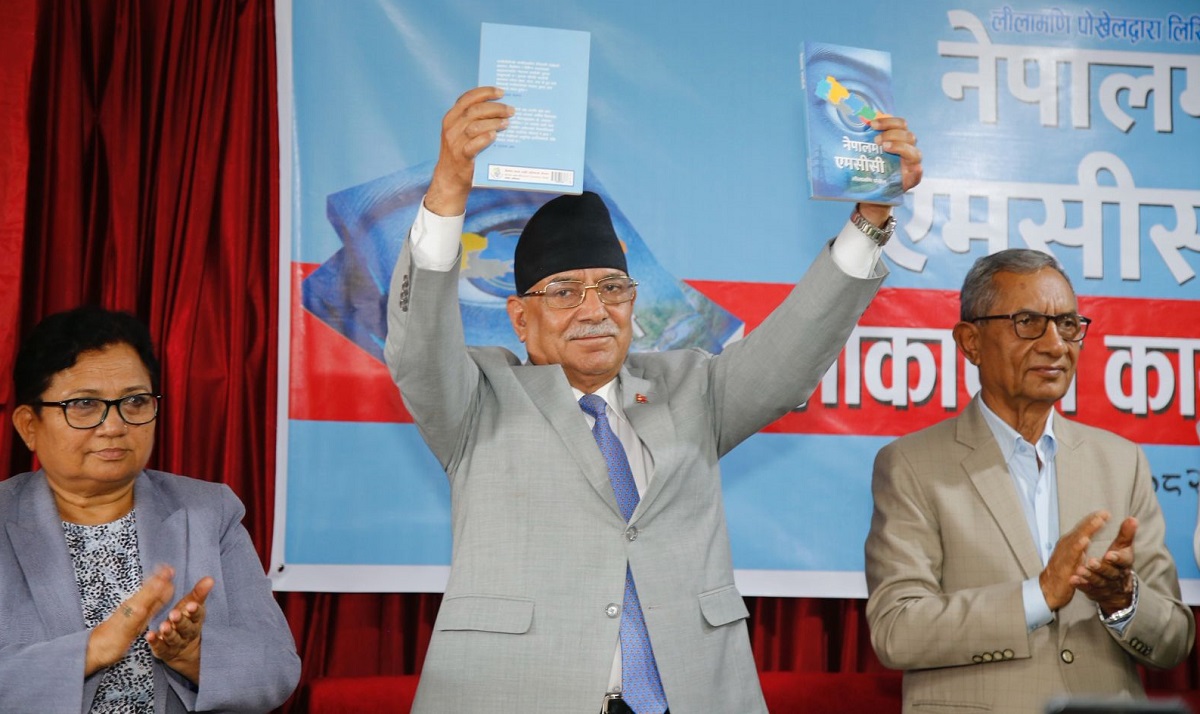
KATHMANDU: CPN (Maoist Centre) chair Pushpa Kamal Dahal ‘Prachanda’ has claimed that the Millennium Challenge Corporation (MCC) compact with the United States was only endorsed by Parliament with an interpretive declaration because of strong pressure from his party. Without their protests, he said, the agreement would have been passed in its original form.
Speaking at the launch of the book “MCC in Nepal” written by Maoist leader Lilamani Pokhrel, Prachanda said the Maoist party had consistently studied, debated, and evaluated the MCC agreement from the very beginning. He recalled that during the unified Nepal Communist Party (NCP) period, the task force formed under his leadership had concluded that the MCC should not be endorsed.
Prachanda added that the task force’s report had been discussed in the party’s Standing Committee and that the government’s engagement with the U.S. had exposed Nepal’s involvement in the Indo-Pacific Strategy (IPS). He accused the then Foreign Minister of misleading both the party and the public by denying this linkage, while official statements from the U.S. confirmed Nepal’s participation in the IPS.
He further alleged that both the Nepali Congress and CPN-UML had pushed for MCC approval in its original form, with former Prime Minister KP Sharma Oli being even more rigid than the Congress in refusing to accept any amendments. “While Congress strongly backed the compact, Oli and the UML leadership were adamant that not even a comma should be changed,” said Prachanda.
According to him, this unyielding stance from both major parties left no room for amendment, leading the Maoist Centre to stage protests. He claimed that if UML had been willing, the Maoists were even ready to let them lead the government to ensure changes to the agreement.
Prachanda stated that with no scope for revision, the Maoist Centre proposed an interpretive declaration as the only viable safeguard. He emphasized that this declaration would serve as a reference point to counter any future misuse of the MCC compact.
He reiterated that the Maoist Centre took the clearest and most principled stand against both the MCC and the Indo-Pacific Strategy. While the party ultimately agreed to the deal with interpretive conditions, Prachanda justified the decision as a strategic move amid the geopolitical pressures Nepal faces.





Comment