




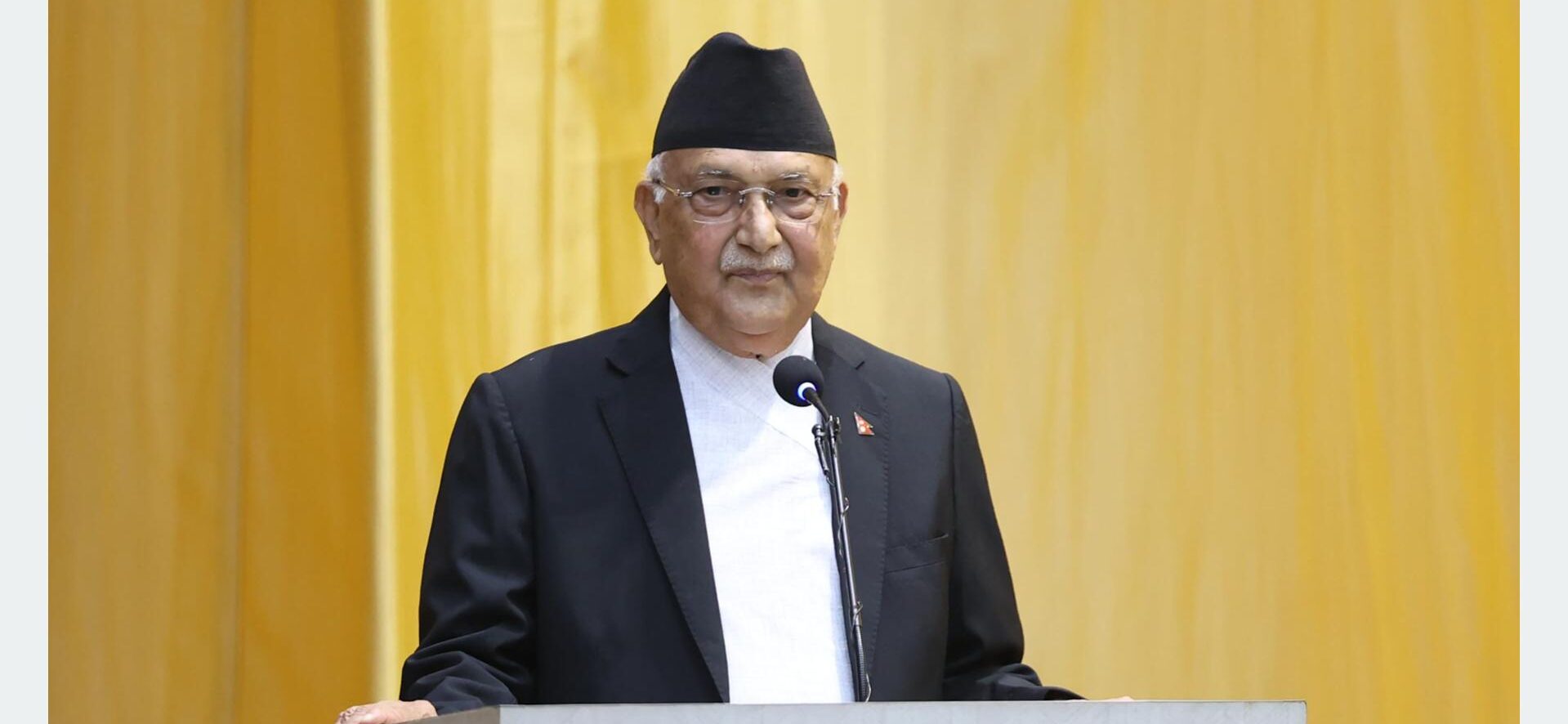
KATHMANDU: Prime Minister and CPN-UML Chair KP Sharma Oli has expre’ssed concern over what he described as growing instability and factionalism within Nepal’s communist parties.
Speaking at a program organized at the CPN-UML central office in Chyasal to mark the 28th memorial of Tulsi Lal Amatya, Oli recalled that Pushpa Lal Shrestha, one of the founding leaders of the communist movement in Nepal, was denied party leadership back in 1951 (2008 BS). According to Oli, Pushpa Lal’s failure to become general secretary led to operational challenges within the party.
“In the first general convention in 1953 (2010 BS), Pushpa Lal was not elected as general secretary, not officially, but internally, he was defeated as early as 1951,” said Oli. “Manmohan Adhikari became the general secretary instead. Such political maneuverings prevented the communist movement from progressing in an orderly manner.”
Despite internal challenges, Oli emphasized that the movement had managed to preserve its existence and strength over time. He acknowledged the contributions of various leaders in the formation of CPN-UML, specifically highlighting Tulsi Lal Amatya’s influence and clear ideological stance.
“Tulsi Lal was a towering personality with a distinct ideological contribution,” Oli said. “That’s why we remember and honor him today.”
Oli stressed the importance of learning from senior leaders and drawing inspiration from their ideals. Citing historical policy positions held by leaders like Pushpa Lal, such as the advocacy for joint people’s movements and the restoration of the dissolved parliament, Oli noted how these ideas eventually materialized in later political developments.
“Pushpa Lal’s idea of a joint people’s movement was implemented by our party under the leadership of Madan Bhandari in 1990 (2046 BS),” he said. “The reestablishment of the dissolved parliament, the idea of a Constituent Assembly voiced as early as 1957 (2014 BS), was finally realized in 2015 (2072 BS).”
He added, “Back then, Tulsi Lal said the king should transfer power to the people. That became a reality in 2006/07 (2062/63 BS). Their dreams weren’t baseless, they had extraordinary vision about political and economic transformation.”
Oli concluded by stating that while some of the founding leaders’ dreams were realized posthumously, it is now the responsibility of the present generation to fulfill the remaining aspirations.




Comment