




The global order in the 21st century is no longer a binary contest between two ideological blocs. Instead, it is increasingly characterized by multipolarity, where emerging powers assert agency to advance their own interests while engaging with diverse and often competing partners.
In this dynamic environment, India exemplifies the art of multi-alignment—balancing relationships with the USA and its Western allies, Russia, China and its Eastern partners, and its own neighborhood in South Asia.
India’s strategy reflects neither submission to the US-led order nor acquiescence to the China-Russia-North Korea-Iran alternative—signaling non-alignment with any bloc, West or East—but rather approaching through soft power diplomacy to lead the Global South.
India’s multi-alignment strategy is a balancing act that pursues a carefully calibrated path of strategic autonomy, economic opportunity, issue-based partnerships, and regional leadership, enabling it to engage with diverse global powers based on mutual interests.
This approach can be examined across three axes: its deepening ties with the West, its pragmatic cooperation with the East, and its regional initiatives, all set against China’s competing vision of global governance.
India and the West: Strategic Convergence Without Formal Alliance
Since the turn of the century and the end of the Cold War, India’s ties with the US and its allies have grown remarkably. The strategic convergence is rooted in shared concerns over Chinese assertiveness, economic enhancement, terrorism, secure sea lanes, and the need for diversified supply chains. But it also reflects India’s ambition to harness Western capital, technology, and markets to propel its domestic development.
Nepal has begun exporting electricity to Bangladesh through Indian transmission infrastructure, marking the first instance of Nepal trading power with a third country—an example of trilateral energy connectivity. These initiatives promote regional integration and counterbalance China’s deepening presence in Bangladesh, the Maldives, Nepal, and Sri Lanka.
One of the most visible manifestations of this partnership is the Quadrilateral Security Dialogue (QUAD), established in 2007—an informal grouping of Australia, India, Japan, and the US aimed at promoting a free, open, and inclusive Indo-Pacific. While not a formal military alliance, QUAD enables India to strengthen its maritime posture, enhance interoperability with advanced navies, and signal resolve to counter Chinese aggression. It is also termed by the Chinese as the “NATO of the East.”
India has also been a regular participant in G7 outreach summits, reflecting its growing stature as a bridge between advanced economies and the Global South.
In September 2023, India hosted the G20, attempting to position itself as the voice of the developing world and advocating for inclusive global economic governance.
The announcement of the India-Middle East-Europe Economic Corridor (IMEC) also underscores India’s ambition to create new trade and connectivity routes, linking South Asia to Europe via the Middle East, bypassing both China’s BRI and the troubled Suez Canal route.
IMEC is a fallout of the G7-endorsed Build Back Better World (B3W) initiative in June 2021 and also the Partnership for Global Infrastructure and Investment (PGII) launched in June 2022.
Beyond high-level summits, India has signed several foundational defense agreements with the US—Logistics Exchange Memorandum of Agreement (LEMOA) in August 2016, Communications Compatibility and Security Agreement (COMCASA) in September 2018, and Basic Exchange and Cooperation Agreement for Geospatial Intelligence (BECA) in October 2020—enhancing its access to advanced technologies, secure communications, and logistics support.
Innovative coalitions like India-Israel-UAE-US (I2U2), agreed in September 2023 between the US Department of State and the US-UAE Business Council, the UAE-Israel Business Council, and the UAE-India Business Council, exemplify India’s willingness to explore issue-based partnerships focusing on food security, water, energy, and technology in the Middle East and South Asia.
Similarly, India’s collaboration with Japan on the Asia-Africa Growth Corridor (AAGC) in 2017 aims to connect India and Japan to Africa’s east coast, particularly Tanzania, starting from the ports of Yokohama, Tokyo, and Mumbai.
This is intended to offer an alternative to China’s Belt and Road Initiative (BRI), initiated in 2013, by promoting transparent, sustainable infrastructure in Africa.
While these initiatives reflect strong alignment with Western interests, India remains careful not to formalize any alliance or compromise its strategic autonomy. It selectively engages where interests converge, while maintaining independent positions on contentious global issues like the Russia-Ukraine war or the Gaza War.
India and the East: Cooperation with Russia and China—on India’s Terms
Simultaneously, India sustains robust ties with Russia and participates actively in China- and Russia-led platforms. This is partly historical—Russia remains a key defense supplier and diplomatic partner—and partly strategic, as India seeks to prevent a China-Russia-Pakistan axis from marginalizing its interests in Eurasia.
India is a founding member of Brazil, Russia, India, China, South Africa (BRICS), established in July 2014, and supports its expansion into BRICS Plus in August 2023, which seeks to reform global governance and amplify the voice of emerging economies. BRICS Plus provides India with a platform to champion a multipolar world while avoiding overdependence on the West.
In the Shanghai Cooperation Organization (SCO), founded in June 2002 and originating from the “Shanghai Five” (China, Kazakhstan, Kyrgyzstan, Russia, Tajikistan), formalized in 2001 with Uzbekistan’s inclusion, India engages with China, Pakistan, Russia, and Central Asian states on counter-terrorism, connectivity, and regional security through joint military exercises.
Despite tensions with China and Pakistan, India sees value in maintaining a seat at the table to influence regional discourse.
The older Russia-India-China (RIC) dialogue, though overshadowed by BRICS, still symbolizes India’s commitment to dialogue and balance in Eurasia. RIC originated in the 1990s with the end of the Cold War and was recently revitalized in July 2025.
India also actively participates in development finance initiatives like the Asian Infrastructure Investment Bank (AIIB), which was signed in June 2015 with USD 100 billion in Beijing by 50 of the 57 prospective founding members. India is the second-largest shareholder after China and promotes alternative connectivity projects to counterbalance BRI.
Another such platform is the New Development Bank (NDB), formerly the BRICS Development Bank, established in 2014 with an authorized capital of USD 100 billion. It focuses on mobilizing resources for financing infrastructure and sustainable development projects in BRICS and other emerging economies and developing countries.
Notable among these is the International North-South Transport Corridor (INSTC), founded in May 2002 by Russia, Iran, and India. This agreement aims to establish a multi-modal transportation route connecting India, Russia, Iran, Europe, and Central Asia.
The Chennai–Vladivostok Eastern Maritime Corridor (EMC), signed in September 2019 during the Eastern Economic Forum in Vladivostok, aims to enhance maritime connectivity between the Indian port of Chennai and the Russian port of Vladivostok. India also shows growing interest in the Northern Sea Route (NSR), an Arctic shipping lane.
The NSR doesn’t have a single “date signed” like a formal treaty but is governed by evolving Russian regulations. The route began opening up with the 1990 Regulations, and its usage declined after the Soviet Union’s collapse. Russia initiated the “Plan for Development of the Infrastructure of the NSR” in 2019, to run through 2035.
Navigation rules were adopted in 2020, and a 2022 law now requires foreign warships to seek permission to enter NSR internal waters. In 2024, Rosatom and a Chinese company signed an agreement to organize year-round international transportation along the NSR. Its development remains ongoing.
These engagements enable India to sustain vital energy imports, diversify trade routes, and maintain relevance in Eurasian geopolitics. Importantly, India engages selectively—cooperating where interests align and competing where necessary, particularly in the Indian Ocean and South Asia, where Chinese influence directly threatens Indian primacy.
India’s Regional Leadership in South Asia
Beyond its global engagements, India remains deeply invested in shaping its immediate neighborhood through its “First Neighbor” policy. Historically the dominant power in South Asia, India seeks to retain its influence in the face of Chinese encroachment through BRI and the growing Pakistan-China “All-Weather” strategic alignment.
In the South Asian Association for Regional Cooperation (SAARC), India has faced challenges due to persistent tensions with Pakistan. As a result, it has shifted focus to alternative regional groupings. The Bay of Bengal Initiative for Multi-Sectoral Technical and Economic Cooperation (BIMSTEC) is central to South Asia (excluding Afghanistan and Pakistan), aligning with India’s “Act East” policy.
The Bangladesh-Bhutan-India-Nepal Motor Vehicles Agreement (BBIN MVA) is being enhanced as a sub-regional connectivity initiative in Eastern South Asia, with the objective of linking to Southeast Asia via Myanmar.
India’s balancing act is further challenged by China’s systematic efforts to reshape the global order in line with its interests. Under President Xi Jinping, China has launched several global initiatives, offering alternatives to Western-led systems.
Nepal has begun exporting electricity to Bangladesh through Indian transmission infrastructure, marking the first instance of Nepal trading power with a third country—an example of trilateral energy connectivity. These initiatives promote regional integration and counterbalance China’s deepening presence in Bangladesh, the Maldives, Nepal, and Sri Lanka.
China’s Competing Vision of Global Governance
Global geopolitics is now shaped by the ongoing rivalry between China and the US. During the Cold War, ideological conflict between capitalism and socialism dominated the world order. Following its conclusion, socialism declined, and the US championed “liberty, democracy, human rights, and market capitalism” as universal values.
Today, the ideological contest between China and the US is framed as one between two visions: Xi Jinping’s concept of “a global community of shared future,” introduced in 2013, and the US-led narrative of “democracy versus authoritarianism” (DvA).
China has increasingly asserted its presence in global governance, participating actively in international organizations like the UN, WTO, and IMF. It holds key leadership positions in several UN bodies and is pushing for reforms that reflect its interests and those of the Global South. China advocates a “multipolar world order,” challenging the post–Cold War dominance of Western liberal democracies.
It has also helped establish new institutions and platforms as alternatives to Western-led norms in monetary, security, political, and connectivity domains—such as the AIIB, NDB, and SCO—to export its governance model, centered on non-interference and state-led development.
Military modernization is also driven by political objectives. China’s expanding military power—especially in the Indo-Pacific, including the South China Sea, Taiwan Strait, and Indian Ocean—is used to influence regional alignments.
India’s strategic posture and foreign policy stand as a testament to the possibilities of multi-alignment in a multipolar world. By deepening ties with the West, maintaining pragmatic engagement with Russia and China, and asserting leadership in its neighborhood, India maximizes its strategic options while retaining autonomy.
The People’s Liberation Army (PLA) supports China’s territorial claims and deters regional balancing by US allies. Its naval diplomacy and arms sales further extend its influence in Africa and Southeast Asia.
India’s balancing act is further challenged by China’s systematic efforts to reshape the global order in line with its interests. Under President Xi Jinping, China has launched several global initiatives, offering alternatives to Western-led systems.
These include the Belt and Road Initiative (BRI), introduced in 2013; the Global Development Initiative (GDI) in 2021; the Global Security Initiative (GSI) in 2022; and the Global Civilization Initiative (GCI) in 2023. These programs combine infrastructure financing, diplomatic outreach, and value promotion to expand China’s footprint in Asia, Africa, Latin America, and beyond.
While some of China’s principles, like multipolarity and sovereignty, resonate with India’s stance, China’s methods—including debt diplomacy, territorial encroachment, and military presence in the Indian Ocean—often threaten Indian interests.
Assessment: India’s Position in the Emerging World Order
India’s approach in the evolving global landscape presents several strengths.
First, it maintains strategic autonomy and avoids dependency on any single bloc or entering formal alliances.
Second, it leverages relationships with both the East and the West for economic, technological, and security gains.
Third, it positions itself as a credible voice for the Global South and an indispensable interlocutor in global governance within a polarized world.
Fourth, it counters China’s influence by offering alternative development models and connectivity initiatives through engagements with the US-led Western alliance, AAGC, IMEC, and BBIN MVA.
Fifth, it builds redundancy in supply chains and connectivity routes, including INSTC, IMEC, and EMC.
However, challenges and risks remain: First, managing simultaneous cooperation in multilateral platforms and competition with China—particularly on the border and in the Indian Ocean.
Second, sustaining defense ties with Russia amid increasing dependence on Western technology and arms, along with rising expectations from the West.
Third, competing with China’s scale, speed, and resources in global infrastructure and finance through platforms like BRI, AIIB, and NDB.
Fourth, balancing global expectations on contentious issues such as the war in Ukraine, the Israel-Gaza conflict, and human rights—while safeguarding domestic interests.
Diplomatically, China continues to expand its global footprint through the UN, BRI, BRICS Plus, SCO, and G77. Over two-thirds of countries participating in the BRI represent 75% of the global population and more than 50% of global GDP.
Lastly, maintaining regional leadership in South Asia amid growing instability and the deepening strategic rivalry between the US and China.
Conclusion: A Balancing Act for the Multipolar Age
India’s strategic posture and foreign policy stand as a testament to the possibilities of multi-alignment in a multipolar world. By deepening ties with the West, maintaining pragmatic engagement with Russia and China, and asserting leadership in its neighborhood, India maximizes its strategic options while retaining autonomy.
With the West: India has achieved strategic convergence on issues related to the Indo-Pacific, economy, technology, and counter-terrorism.
With the East: It continues cooperation in Eurasia, development finance, and advocates multipolarity.
Regionally: India exercises proactive leadership through intergovernmental and minilateral connectivity, emphasizing its “First Neighbor” policy.
Unlike during the Cold War, India no longer faces a binary choice. It does not seek to become a junior partner of the US-led order, nor a client of the China-Russia axis in an imminent Cold War 2.0 or the so-called New Cold War.
Instead, it has become an active shaper of the international order—offering and leveraging alternatives to both US and Chinese dominance, bridging divides between developed and developing nations, and expanding its independent capabilities, while still facing considerable challenges in catching up to China economically and militarily.
This nuanced balancing act allows India to shape global governance, pursue development goals, counter Chinese assertiveness, and avoid entanglement in great power conflicts.
Meanwhile, China’s political influence is expanding through a multifaceted strategy that blends economic statecraft, strategic diplomacy, and institutional engagement as soft power tools to frame the global narrative.
It has invested heavily in global media (CGTN, Xinhua), Confucius Institutes, and public diplomacy to shape international perceptions. Initiatives such as the GDI, GSI, and GCI present China as a leader of a non-Western global order.
China’s strategic partnerships and influence in mediation have contributed to regional peace and cooperation—for instance, the 2023 Iran–Saudi Arabia rapprochement, engagement with Taliban-led Afghanistan, and high-level forums with Global South leaders.
These diplomatic efforts reflect Beijing’s ambition to reshape global diplomacy on its own terms, emphasizing non-alignment, mutual benefit, and sovereignty over Western-style liberal interventionism.
Here’s a breakdown of the main vectors of rising political power globally:
Economically, China remains the world’s second-largest economy with a GDP of USD 18.744 trillion in 2024 (World Bank), projected to grow to USD 19.53 trillion in 2025, contributing approximately 17.6% of global GDP. It leverages its vast manufacturing base, advanced infrastructure, and technological prowess.
India ranks as the fifth-largest economy, growing from USD 2.1 trillion in 2015 to nearly USD 4.3 trillion by 2025—nearly doubling in a decade. It is currently the fastest-growing major economy, expanding at 6.5–7.4 percent, compared to China’s estimated 5 percent.
Militarily, China’s defense spending reached approximately USD 314 billion in 2024—the world’s second highest after the US—accounting for around 1.7% of GDP and 12% of global military expenditure.
As the global order continues to evolve, India’s balancing act may well become a template for other emerging powers navigating the turbulent waters of the multipolar age.
India, in comparison, spent about USD 86.1 billion, ranking fifth globally, representing 2.3% of its GDP and around 3.2% of global defense spending. India’s FY2025–26 defense budget stands at approximately USD 83 billion, with capital outlays comprising 0.49% of GDP and 26% of total defense spending.
Diplomatically, China continues to expand its global footprint through the UN, BRI, BRICS Plus, SCO, and G77. Over two-thirds of countries participating in the BRI represent 75% of the global population and more than 50% of global GDP.
In the first half of 2025 alone, Chinese firms signed USD 24 billion in BRI contracts, bringing total commitments to around USD 1.3 trillion, particularly focused on Africa, Central Asia, and Southeast Asia.
India, by contrast, advances a strategy grounded in strategic autonomy. It strengthens leadership by offering competitive development and cooperation models rooted in democratic values and inclusivity.
India is actively involved in groupings such as QUAD, G7, G20, G77, IMEC, BRICS Plus, SCO, AIIB, RIC, INSTC, EMC, NSR, and regional platforms like BIMSTEC and BBIN MVA—while SAARC remains largely stalled.
India’s approach is not without risks: managing great-power rivalries, sustaining regional primacy, and resisting coercive pressures will require constant recalibration and deft diplomacy. Yet, if successful, India could emerge as a pillar of stability, development, and multipolarity in the 21st century.
Despite China’s global reach, its political influence faces constraints such as accusations of debt-trap diplomacy, deteriorating relations with the West, growing suspicion in Africa and Southeast Asia over neo-colonial behavior, and internal economic and demographic pressures.
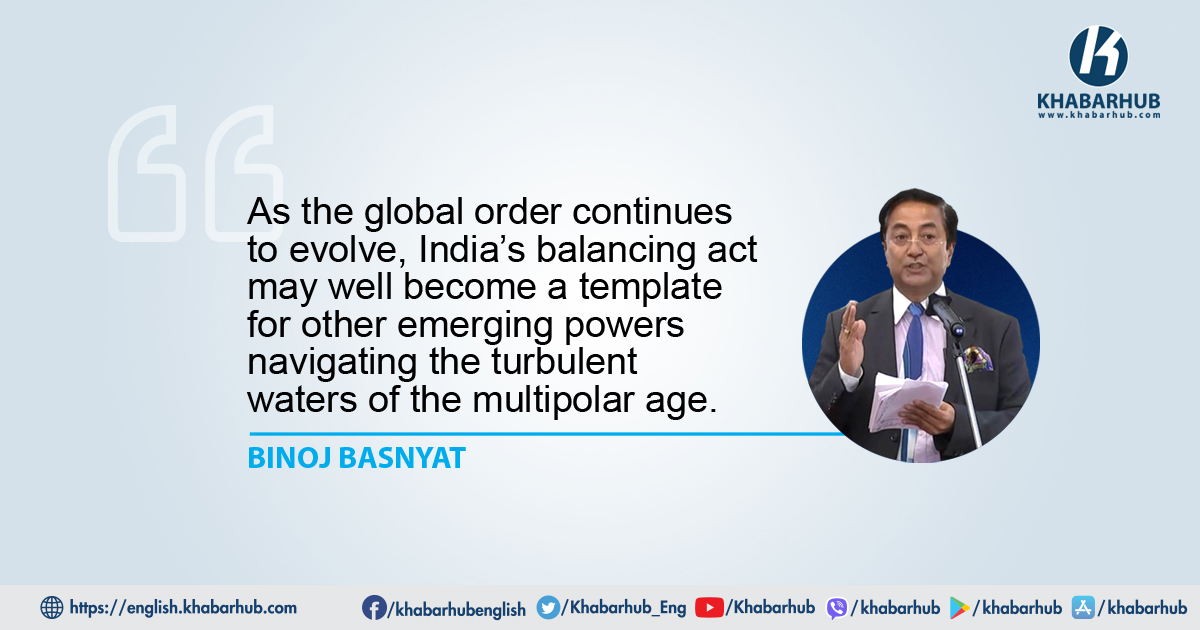
As the global order continues to evolve, India’s balancing act may well become a template for other emerging powers navigating the turbulent waters of the multipolar age.
(The author is a Strategic Analyst, Major General (Retd) of the Nepali Army, and is associated with Rangsit University, Thailand.)
(Views expressed in this opinion are the writer’s and do not necessarily reflect the editorial stance of Khabarhub)



Comment