



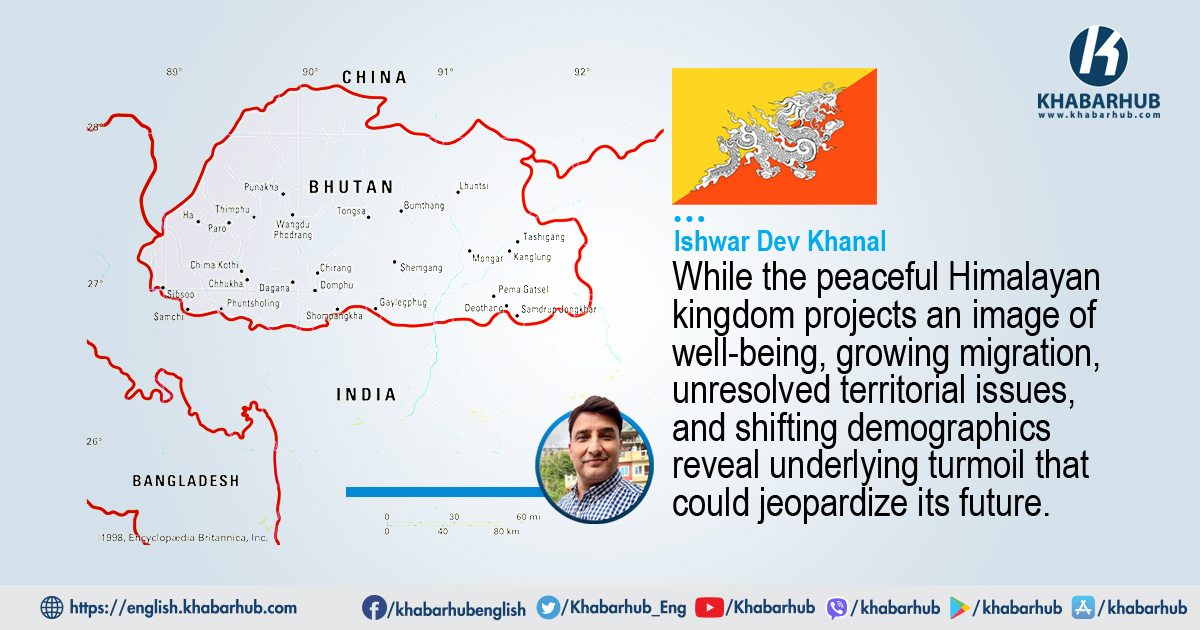
KATHMANDU: Despite its global image as the land of Gross National Happiness (GNH), Bhutan appears to be facing an increasingly serious existential crisis—one that threatens its demographic future, territorial integrity, and socio-political stability.
While the serene Himalayan kingdom continues to brand itself as a beacon of well-being, rising migration, territorial uncertainties, and demographic shifts point toward a deeper turmoil threatening its future.
Reports suggest that Bhutan faces an alarming youth migration with almost 64,000 young people leaving the country in search of better educational and employment opportunities. This trend, as reports suggest, is worrying given the size of the country’s population, which is just over 750,000.
According to Balaram Paudel, the exiled President of the Bhutan People’s Party currently living in Nepal, Bhutan’s internal condition is far more fragile than the serene image it projects to the world.
Speaking to Khabarhub, Paudel warned that the country is not only bleeding its youth to mass outmigration but also facing potential threats to its territorial sovereignty. “A country cannot exist without its people,” Paudel said. “A crown on a throne is not enough to build a nation.”
He further cautioned that if the King of Bhutan does not initiate national reconciliation and allow the return of Bhutanese refugees scattered across the globe—including in the United States, Canada, and Australia—Bhutan’s survival as a sovereign and unified state could be in jeopardy.
More than 120,000 Bhutanese refugees, mostly ethnic Lhotshampas, remain scattered around the globe. Many were expelled or fled during political unrest in the late 1980s and 1990s. Paudel insists that unless they are allowed to return with dignity, Bhutan’s survival is at stake.
Paudel painted a stark picture: without immediate and concrete action, China could push south to claim the northern parts of Bhutan, while India may continue to entrench its dominance in the south.
Meanwhile, Bhutanese authorities have not shied away from acknowledging the crisis. Prime Minister Tshering Tobgay, responding to a lawmaker’s question in Bhutan’s National Assembly recently, openly described the situation as an “existential crisis”.
He pointed to the falling fertility rate, now at 1.7 children per woman—below the replacement level of 2.1—as a reflection of changing societal norms, a rapidly aging population, and the growing reluctance of youth working abroad to start families.
Bhutan’s state-owned newspaper Kuensel and several global agencies, including the World Bank, have echoed these concerns. According to the World Bank’s Bhutan Development Update, the number of Bhutanese leaving the country via Paro International Airport jumped from under 500 per month before the COVID-19 pandemic to over 5,000 per month by early 2023. The Bhutanese diaspora in Australia alone has doubled, from 12,000 in 2020 to over 25,000 in 2024.
A Bhutanese youth, whom this scribe talked to in Jhapa echoed the concern. “The situation there is alarming. Even the government is worried. Recent graduates like me see no future at home,” he said, requesting anonymity. “People aren’t leaving out of greed—they’re leaving out of necessity.”
However, while migration has bolstered remittance inflows—preventing an estimated 24,000 Bhutanese from falling into poverty—the long-term impact is worrying. Bhutan’s skilled workforce is being hollowed out, severely affecting key sectors such as education, healthcare, and public administration.
Paudel describes this trend as “a painful truth,” adding that Bhutan is losing its brightest minds at a rate it can no longer afford.
According to the World Bank survey, over 77% of aspiring migrants and 63% of current migrants would consider returning to Bhutan if job quality and working conditions improve. Interestingly, many are even willing to return for lower salaries than what they earn abroad.
Paudel agrees, emphasizing that with the restoration of human rights, better employment opportunities, and a conducive political climate, a significant portion of exiled or emigrant Bhutanese would be willing to return.
The Bhutanese government has, meanwhile, pinned hopes on long-term visionary projects such as the Gelephu Mindfulness City, which aims to serve as an economic and cultural hub.
During his visit to Australia in October 2024, King Jigme Khesar Namgyel Wangchuck presented this ambitious project to over 20,000 Bhutanese residents there, appealing for their eventual return.
However, observers say such projects will take years to materialize. In the meantime, more immediate steps—like wage hikes, employment generation, and political openness—are essential to reversing the migration trend. Many exiled Bhutanese leaders, including Paudel, argue that policy reform must precede infrastructure dreams.
Paudel also raised concerns about territorial losses, claiming that Bhutan’s official land area has decreased from 46,500 to 38,000 square kilometers in recent decades. “Where did those 8,100 square kilometers go?” he asked, suggesting incursions from China in the north.
He particularly cited the Doklam plateau, a contentious region near Bhutan’s Haa district. Paudel claims that the area, rich in uranium deposits, belongs to Bhutan and not China.
Bhutanese officials, including the Prime Minister, have acknowledged the gravity of the challenges. But as Paudel sees it, unless the King of Bhutan takes bold steps for national reconciliation, returns exiled citizens, and asserts sovereignty over its territories, Bhutan risks unraveling.
He believes that Bhutan’s silence in the face of Indian and Chinese strategic interest is deeply worrying. “There have already been 25 rounds of border talks, but the dispute remains unresolved,” he noted.
More than 120,000 Bhutanese refugees, mostly ethnic Lhotshampas, remain scattered around the globe. Many were expelled or fled during political unrest in the late 1980s and 1990s. Paudel insists that unless they are allowed to return with dignity, Bhutan’s survival is at stake.
“If the monarchy collapses, Bhutan will be torn in two,” he warned. “To survive, Bhutan needs its monarchy, but also its people.”
Paudel says that he and others who once lived in Bhutan saw a thriving land that exported rice, oranges, and cardamom. Today, he laments, those very products are being imported from India, while Bhutan celebrates Gross National Happiness.
“Yes, education is free in Bhutan,” he says. “But is it accessible? Can a child in a remote village reach a school if there’s no road? Can a patient get to a clinic without infrastructure?”
While Bhutan remains carbon-negative and admired for its cultural integrity and environmental consciousness, these alone may not be enough to ensure its future.
Bhutanese officials, including the Prime Minister, have acknowledged the gravity of the challenges. But as Paudel sees it, unless the King of Bhutan takes bold steps for national reconciliation, returns exiled citizens, and asserts sovereignty over its territories, Bhutan risks unraveling.
“This is a moment of truth,” he said. “The King must act now—not years from now. Bhutan cannot survive without its people. And Bhutan’s people are waiting.”
(The writer can be reached at [email protected])






Comment