




You have probably seen posts on LinkedIn or Facebook like, “If you are nervous speaking in meetings, it’s because your school failed you. But we will fix that.” Or, “Struggling to speak in public? Your teachers never trained you to be confident. But we are here to help you.”
You must have seen a dozen versions of these messages, packaged neatly into ads, Instagram reels, or workshop promos. On the surface, they seem harmless—even helpful. But if you dig deeper, these aren’t just sales pitches. They are subtle attacks on schools and teachers. They whisper, “Schools have failed you. Schools don’t teach you real skills.” And it’s just a matter of time before most people start to believe this narrative.
These messages work because they follow a powerful emotional formula:
1. Identify a struggle (fear of public speaking)
2. Offer a cause (your school or your teacher)
3. Provide a solution (don’t worry, our course or workshop will fix this problem)
This formula looks neat. It is satisfying. But it’s full of fallacies.
In this article, we will highlight the fallacies present in such statements, explain the dangers of them in the context of education, and discuss what can be done to mitigate these challenges.
Fallacy of False Cause: Blaming the school and teachers, ignoring the contexts
The first fallacy present in such statements that shifts the blame solely to either schools or teachers is false cause, or post hoc fallacy. It simply says because your teacher did not teach you to be confident, you became nervous and unable to speak in meetings. Many other factors could cause nervousness; however, it only looks at a singular cause of someone becoming nervous or anxious.
False Dilemma Fallacy: Either your school and teachers teach you public speaking, or they failed you
False dilemma is the second fallacy present in the argument. This assumes that the school or the teacher is solely responsible for teaching children public speaking or confidence. It ignores the roles of parents, relatives, friends, government, and social organizations. Furthermore, it also turns a blind eye to factors such as personal traits, genetic attributes, experiences, influences, and others.
Emotional Appeal: We are your savior; we will rescue you
The third fallacy is emotional appeal. The majority of people accept solutions when negative emotions such as fear or nervousness are attached. Insurance agencies use the same approach to sell their policies. They focus on the uncertainty of life and use the threat of death to sell their products.
So, what are the dangers of making schools or teachers the scapegoat for all the chaos in education? This creates a mindset among the general public that schools are not important and teachers are useless.
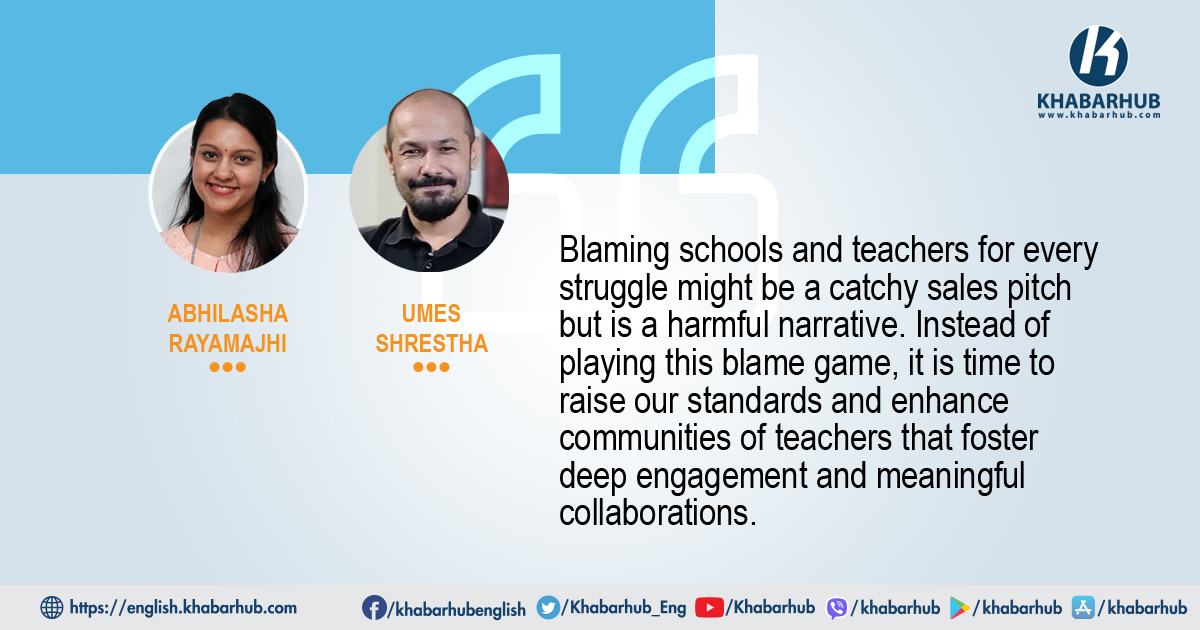
Blaming schools and teachers for every struggle might be a catchy sales pitch but is a harmful narrative. Instead of playing this blame game, it is time to raise our standards and enhance communities of teachers that foster deep engagement and meaningful collaborations. Let’s build and grow empowered and reflective teachers and learners.
Especially with the advent of Artificial Intelligence (AI), most people think there is no need to focus on learning, which can be catastrophic. Moreover, people who lack knowledge or critical thinking skills will be easily fooled into purchasing products or services they will never use, wasting their hard-earned money and time.
Rather than blaming schools or teachers for every flaw in the system, the focus can shift toward teacher development and student engagement in this process. We believe that quality education, which largely depends on teaching and learning, can make a positive impact on both teachers and students.
Organizing faculty development workshops and monthly sharing platforms for teachers’ personal and professional development is crucial for academic institutions. We usually blame students for not being critical thinkers or for not writing well, but what about teachers’ writing and thinking? Institutions must invest in sessions for teachers that make them think deeply about teaching and learning. There have to be sessions where teachers share their journey as educators, their research interests, and passion projects.
In such events, students must also be involved so they can experience what goes into crafting lesson plans, conducting classes, and doing post-class work. At our institutions, we have started monthly sharing and faculty development sessions for two years, where students regularly participate. We have launched a volunteer program for undergraduate and graduate students, where they engage as emcees and presenters.
Some of these students are already teachers at school and plus two levels, while others aspire to be teachers or trainers. Every student who has attended one of these sessions has said they respect the profession more after witnessing the journey of teachers through featured presentations or the mental work that goes into teaching during thinking sessions. Teachers who participate in these sessions reflect on their learning and share their reflections with us in person as well as through the growing WhatsApp community.
One regular participant of Empower Hours, a monthly sharing session for teachers, Shreejana Maharjan, shared, “I’m delighted to be part of this critical thinking community which has guided me in the most difficult times during my teaching career. The first session on ‘How learning happens’ had such a profound impact on me that I felt I had finally found the treasure I was searching for in all the professional development teacher training sessions, where, for some reason, its critical essence was always missing.”
Blaming schools and teachers for every struggle might be a catchy sales pitch but is a harmful narrative. Instead of playing this blame game, it is time to raise our standards and enhance communities of teachers that foster deep engagement and meaningful collaborations. Let’s build and grow empowered and reflective teachers and learners.
(Umes Shrestha is the Head of Center for Innovative Pedagogy and Learning (CIPL) at King’s College. Abhilasha Rayamajhi is Assistant Professor and Writing Center Lead at King’s College)






Comment