




KATHMANDU: At 3 a.m. on Tuesday, a devastating flood from the Lhende River—originating at the border of Gosainkunda Rural Municipality-1 in Rasuwa and the Tibet Autonomous Region (Xichang), China—caused significant destruction in Nepal.
The flood, triggered by the bursting of a glacier-fed debris dam (known locally as Himot), unleashed a torrent of soil, sand, rocks, and vegetation from the Tibetan side into Nepal via the Bhotekoshi River.
The floodwaters from the Lhende and Kerung rivers intensified as they reached Bhotekoshi, destroying the Nepal–China Miteri Bridge. Twenty-five cargo containers waiting at the Rasuwa Customs Office were washed away.
Dozens of electric vehicles, cargo drivers, and at least 18 people—including three police officers—are missing. Seven bodies had been recovered by Tuesday afternoon, according to Dhruba Prasad Adhikari, Assistant Chief District Officer of Rasuwa. Rescuers managed to save 55 individuals, including Nepalis, Indians, and Chinese nationals.
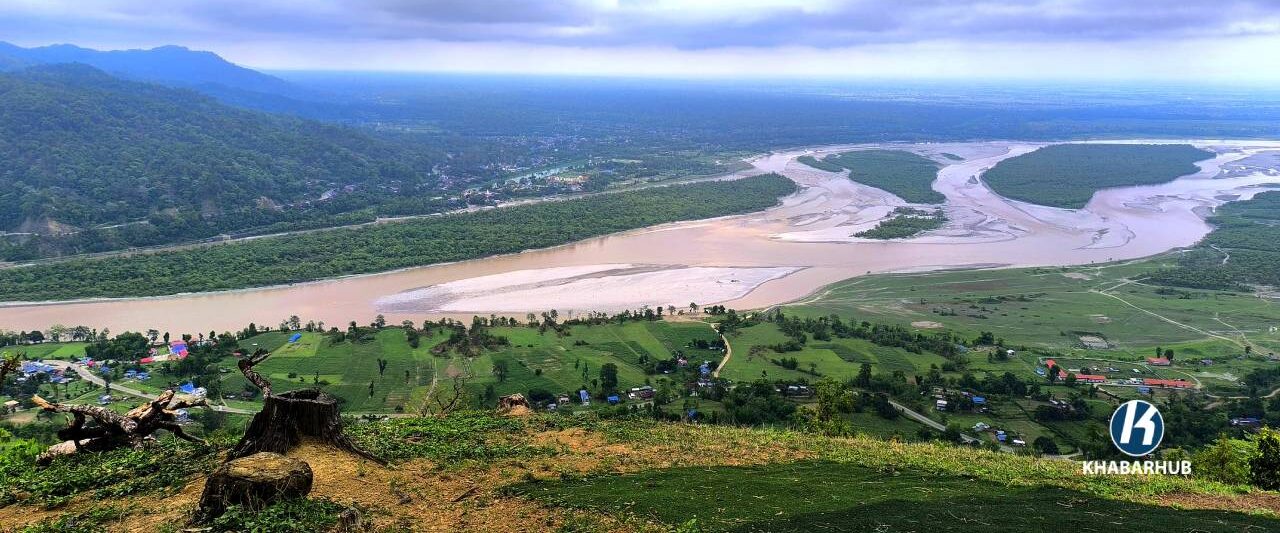
The Lhende and Kerung rivers mark the international boundary at Rasuwagadhi. After crossing the Miteri Bridge into Nepal, the river is known as Bhotekoshi. This river merges with the Chilime Khola above Syaprubesi, and later with the Langtang Khola.
Downstream, it joins the Trishuli River near Dhunche, then continues through Narayani and eventually flows into the Ganges via the Gandak canal in India.
It is important to note that there is another river also called Bhotekoshi that enters Nepal through Khasa (Tatopani) in Sindhupalchowk and ultimately joins the Saptakoshi via the Sunkoshi. However, the Bhotekoshi that caused Tuesday’s devastation in Rasuwa is a tributary of the Narayani, not the Saptakoshi.
Earlier, Chinese authorities warned Nepal’s District Administration Office in Sindhupalchowk of possible flooding in the Bhotekoshi River due to expected heavy rainfall in Tibet. Although flooding did occur in the Sindhupalchowk section of Bhotekoshi, it was not as severe as the disaster in Rasuwa.
The Saptakoshi River system comprises seven major Himalayan tributaries: Sunkoshi, Bhotekoshi, Dudhkoshi, Tamakoshi, Arun, Tamor, and Indrawati. Among these, Sunkoshi is the principal stream, with sources in both Nepal (Sindhupalchowk) and China (Nyalam County). The Bhotekoshi River in Sindhupalchowk also originates in Tibet and merges with the Sunkoshi at Balefi, later joining the main Saptakoshi at Dolalghat.
Because most tributaries of the Koshi originate in Tibet, the risk of sudden flooding remains constant during the monsoon season, according to meteorologists.
A legacy of fear
Concerns about Koshi flooding are not new. The 1954 Nepal-India Koshi Agreement begins with India’s commitment to constructing a dam and associated works, including flood control infrastructure and embankments, roughly three miles upstream of Hanumannagar. This project aimed to prevent soil erosion, manage flooding, and enable irrigation and hydropower.
However, the Indian government is responsible only for constructing and maintaining the eastern embankment on the right bank of the Koshi. Since the completion of the Koshi Barrage in 1962., the river has repeatedly caused significant damage to Nepali territory—especially in areas protected by that embankment.
Instead of building a durable flood defense system, India has relied on temporary measures like sandbags, bamboo reinforcements (trikhutti), and recently, concrete tetrapods. Critics argue that these superficial efforts reflect negligence, leaving Nepali communities along the Koshi vulnerable to flooding every year.
The recurring devastation—exacerbated by climate change, poor coordination, and weak infrastructure—underscores the urgent need for both Nepal and India to reassess flood preparedness, improve communication, and invest in long-term river management solutions.
Koshi River: A History of Embankment Failures and Persistent Flood Risks
Following the Nepal-India Koshi Agreement, it was clearly stipulated that the Government of Bihar would be responsible for the maintenance and upkeep of the Nepali territory extending 32 kilometers north of the Koshi Barrage.
In line with this, the Bihar government has carried out routine seasonal maintenance of embankments and spurs under the Koshi Project. However, the failure to construct permanent embankments has left the region vulnerable to severe flood damage over the past 60 years.
The eastern embankment of the Koshi River has a long history of failures, with catastrophic breaches even before the most devastating collapse on Bhadra 2, 2065 BS (August 18, 2008) at Kushaha. Prior to this, embankment breaches occurred in 1963, 1968, 1971, 1980, 1984, 1987, and 1991. Due to the Indian government’s lack of commitment to building a permanent structure, these breaches continued, exposing communities to recurring devastation.
Engineer and Koshi researcher Dinesh Kumar Mishra, a civil society activist from Bihar, attributes these repeated failures to the river’s strong erosive force, insufficient maintenance, and the presence of hidden crevices that can even trap animals.
The 2008 Koshi Disaster and Beyond
The most catastrophic embankment collapse in recent memory occurred in 2008, when the Koshi River broke through its eastern embankment north of the barrage and inundated large parts of Sunsari district. Entire VDCs including West Kushaha, Shreepurjabdi, and Haripur were submerged, with Laukahi VDC partially affected. According to government data, 42,765 people from 7,563 households were displaced by the flood.
Historically, major floods have been recorded in fiscal years 1990, 2011, 2022, 2024, 2025, 2038, 2040, 2042, 2045, 2065, 2079, and 2081 BS, causing loss of lives and significant property damage.
In 2073, 2076, 2079, and 2081 BS, floods in the Udayapur section of the Koshi River displaced over 20,000 people. In 2079 BS, the river reclaimed a path it had abandoned in 2045 BS, entering Dumribote in Belka Municipality-8 and flooding Wards 1, 2, 3, 8, and 9.
The flood also submerged Sri Lanka Tappu, located in Wards 6 and 9 of Barahakshetra Municipality, and affected districts including Udayapur, Saptari, and Sunsari. In 2081 BS, the river again entered human settlements, and the Udayapur District Administration Office relocated 127 people from Belka-3 to safety.
Ongoing Threats and Local Frustrations
Despite decades of flood disasters, the Bihar government continues to apply temporary measures such as sandbags, trikhutti (bamboo supports), and, most recently, tetrapods, rather than constructing a durable flood protection system. These stopgap solutions are insufficient in the face of rising monsoon flows and riverbank erosion.
Local residents express deep frustration. Deepak Gautam, a resident of the area, remarked, “The Indian government seems unwilling to build a permanent embankment. Every year the monsoon floods take away a huge budget, and the same temporary repairs are repeated the next year.”
Spurs along the eastern embankment—including points 25:57, 25:25, 26:00, 26:40, and 26:88—experience high water pressure and are particularly vulnerable during peak flows. While Indian technicians monitor the area and have installed temporary dams, the Rajabas stretch (24:10 to 27:88) remains highly at risk.
A Brief Respite in Sri Lanka Tappu
Residents of Chiliya and Garaiya in Sri Lanka Tappu, Barahakshetra Municipality, who have lived in fear of floods for years, currently report no immediate threat. Local resident Badri Rai says, “The Koshi seems calm for now. It is nearly two kilometers away from Chilia, and the water level has not risen significantly.”
According to Omal Chandrabanshi of Tappu, paddy planting is underway and there are no visible signs of imminent flooding. “The river is probably 2–3 kilometers away. There’s no immediate danger,” he stated, though he added that minor bank erosion has been observed in Garaiya.





Comment