




WASHINGTON, Jan 11: An ancient species of great ape was likely driven to extinction when climate change put their favorite fruits out of reach during dry seasons, scientists reported Wednesday.
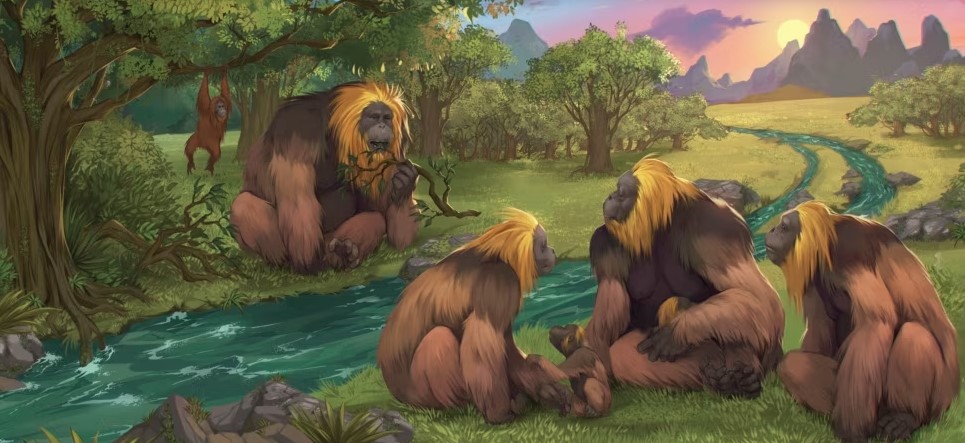
The species Gigantopithecus blacki, which once lived in southern China, represents the largest great ape known to scientists — standing 10 feet tall and weighing up to 650 pounds.
But its size may also have been a weakness.
“It’s just a massive animal – just really, really big,” said Renaud Joannes-Boyau, a researcher at Australia’s Southern Cross University and co-author of the study published in the journal Nature. “When food starts to be scarce, it’s so big it can’t climb trees to explore new food sources.”
The giant apes, which likely resembled modern orangutans, survived for around 2 million years on the forested plains of China’s Guangxi region. They ate vegetarian diets, munching on fruits and flowers in tropical forests, until the environment began to change.
The researchers analyzed pollen and sediment samples preserved in Guangxi’s caves, as well as fossil teeth, to unravel how forests produced fewer fruits starting around 600,000 years ago, as the region experienced more dry seasons.
The giant apes didn’t vanish quickly, but likely went extinct sometime between 215,000 and 295,000 years ago, the researchers found.
While smaller apes may have been able to climb trees to search for different food, the researchers’ analysis shows the giant apes ate more tree bark, reeds and other non-nutritious food.
“When the forest changed, there was not enough food preferred by the species,” said co-author Zhang Yingqi of China’s Institute of Vertebrate Paleontology and Paleoanthropology.
Most of what scientists know about the extinct great apes comes from studying fossil teeth and four large lower jaw bones, all found in southern China. No complete skeletons have been found.
Between around 2 and 22 million years ago, several dozen species of great apes inhabited Africa, Europe and Asia, fossil records show. Today, only gorillas, chimpanzees, bonobos, orangutans and humans remain.
While the first humans emerged in Africa, scientists don’t know on which continent the great ape family first arose, said Rick Potts, who directs the Human Origins Program at the Smithsonian’s National Museum of Natural History and was not involved in the study.
VOA






Comment