




The recent floods are not simply a disaster. They are a warning that climate, geography, infrastructure and security are converging—and Nepal must respond accordingly.
The recent 26 August flash floods are not simply a natural disaster but a strategic warning. Nature is reminding the region that the Himalayas are not static mountains but a dynamic and increasingly fragile system. The immediate destruction can be measured in lives lost, communities displaced, bridges and roads destroyed, hydropower disrupted and livelihoods shattered. But the consequences extend much further—to water, energy, connectivity, economic resilience and regional security.
The recent catastrophe along the Nepal–China border, where an ice-rock avalanche or glacier collapse triggered a devastating flood, demonstrates the speed with which a high-altitude event can become a national and transboundary crisis. As of August 30, Nepal had reported 734 deaths and 2,498 people missing, while China had reported additional casualties in Tibet. More than 90,000 people were reportedly affected. The scale of the tragedy should compel us to look beyond immediate rescue and relief toward a larger question: What does a changing Himalayan environment mean for Nepal’s national security and regional stability?
Defence diplomacy in the 21st century cannot be only about preparing for war; increasingly, it must also be about preparing to save lives when nature becomes the adversary.
Nepal has experienced such warnings before. The Dig Tsho glacial lake outburst flood (GLOF) of 1985 destroyed the nearly completed Namche Small Hydel facility and caused destruction many kilometres downstream. The Melamchi disaster of 2021 demonstrated how extreme rainfall, unstable terrain, sediment and river systems can combine into a cascading disaster. More recently, the Thame GLOF of August 2024 destroyed homes and public infrastructure in the Everest region. The International Centre for Integrated Mountain Development (ICIMOD) notes that Nepal has experienced more than 90 GLOFs since the early 1920s, while the Everest region alone has experienced five significant events in less than five decades.
The question is no longer simply how Nepal responds when disaster strikes. It is whether Nepal can anticipate, prepare for and reduce the consequences of the next one. These are not isolated incidents. They are warnings from a changing cryosphere.
The Hindu Kush Himalaya contains more than 63,700 glaciers, storing an enormous volume of ice and feeding at least 10 major Asian river systems that support the food, water, energy and livelihood security of around two billion people. Glacier retreat is accelerating, while changing snow and ice conditions, expanding glacial lakes, unstable slopes and extreme precipitation can produce cascading hazards. The danger is therefore not simply the loss of ice. It is the transformation of the entire mountain-risk system. ICIMOD’s latest assessments show that glacier ice loss has accelerated sharply, with glaciers losing ice at nearly twice the rate since 2000 and up to 27 metres of ice thickness lost since 1975 in some areas.
The danger is not simply that glaciers are disappearing. A changing cryosphere can alter the entire mountain-risk system. Glacier retreat can create or enlarge glacial lakes; unstable ice and rock can trigger avalanches; landslides can block rivers; sudden lake breaches can produce GLOFs; and extreme rainfall can amplify these processes. The result can be a cascade of hazards in which one event triggers another.
For Nepal, this vulnerability is particularly acute. The Koshi, Gandaki and Karnali systems connect the high-altitude cryosphere with downstream settlements, hydropower, roads, bridges, tourism and agriculture. The 2024 Thame disaster demonstrated that a relatively small glacial lake can produce destructive consequences downstream. Research into the event found successive breaching of glacial lakes and highlighted the need for real-time monitoring, early-warning systems, resilient infrastructure and integrated risk management. A landslide can destroy a highway. A glacial outburst can damage a hydropower project. A destroyed bridge can interrupt trade and tourism. A sudden change in an upstream river system can have consequences far beyond Nepal’s borders.
The Himalayas are therefore becoming a shared security space where climate change, glacial instability, water, infrastructure, energy, connectivity and human security increasingly intersect. A landslide in a mountain valley can destroy a highway. A glacial outburst can damage a hydropower project. A destroyed bridge can interrupt trade and tourism. A disruption in an upstream river system can have consequences far beyond Nepal’s borders.
This changes the meaning of security itself.
For too long, climate and disaster management have been treated largely as environmental or humanitarian issues, separate from national strategy. That distinction is becoming obsolete. When a disaster can destroy critical infrastructure, interrupt energy production, close international borders, disrupt trade, displace populations and create cross-border consequences, resilience becomes a component of national power.
International experience offers valuable lessons. Bangladesh demonstrates that extreme geographical vulnerability does not necessarily have to produce extreme human losses. Early-warning systems, evacuation planning, cyclone shelters and community preparedness have transformed its disaster resilience. Japan has developed a culture in which technology, early warning, public awareness, resilient infrastructure and institutional discipline operate together. The Netherlands has demonstrated the value of long-term planning around geographical vulnerability rather than attempting to defeat nature. Switzerland’s experience in the Alps shows the importance of mountain-risk monitoring and timely evacuation.
The lesson for Nepal and the region, particularly China and India, is not to copy any one model, but to develop an anticipatory resilience system suited to the Himalayas.
But resilience must also be viewed through the lens of climate justice. Nepal and other Himalayan countries are among those most exposed to the consequences of a changing climate, while their historical contribution to global greenhouse-gas emissions is extremely small. The glaciers and rivers of the Himalayas provide environmental services far beyond Nepal’s borders, supporting water, food, energy and ecological security across Asia. The international community therefore has a responsibility not only to reduce emissions but also to support vulnerable mountain countries through climate finance, technology transfer, scientific cooperation, adaptation and loss-and-damage mechanisms.
Climate justice, however, should not mean viewing Nepal simply as a victim seeking assistance. Nepal should seek to become a regional leader in Himalayan climate resilience. Its geography gives it both vulnerability and strategic responsibility. Nepal can provide the diplomatic platform for bringing together Himalayan countries, development partners, scientific institutions and international organisations around a common agenda of mountain resilience.
This requires a fundamental shift—from disaster response to disaster preparedness; from fragmented institutional responsibility to integrated risk governance; and from treating climate change as an environmental issue to recognising it as a national-security, regional-security and global-justice issue.
It also requires recognising that Himalayan risks do not respect political boundaries. An extreme event or glacial outburst on the Tibetan Plateau can have cascading consequences in Nepal and potentially downstream in India. The rivers, mountains and ecological systems that divide national territories also connect them.
Strategically, therefore, Nepal–India–China relations should not be viewed only through the familiar lens of geopolitical competition. They should also be understood through a shared Himalayan risk system.
China occupies the Tibetan Plateau and important headwater regions. Nepal lies at the heart of the Himalayan mountain system, with its glaciers, rivers, hydropower and vulnerable settlements. India is downstream of many Himalayan river systems and has enormous interests in water, energy, infrastructure and regional stability.
This creates an opportunity for Himalayan disaster diplomacy and, more ambitiously, a structured Nepal–India–China Himalayan Resilience Mechanism. Such a mechanism could focus on areas where cooperation is in the shared interest: glacial and hydrological monitoring, satellite observation, early-warning systems, scientific research, emergency communications, disaster information-sharing, and humanitarian assistance and disaster relief.
Cooperation on disaster risk does not require agreement on every geopolitical issue. Indeed, disaster resilience could become one of the practical areas where strategic competition and functional cooperation coexist.
A trilateral mechanism should not be conceived as a geopolitical alliance or as an attempt to resolve wider strategic differences. Its value would lie precisely in keeping cooperation focused on shared risks and practical outcomes. It could establish protocols for sharing early warnings, coordinate scientific assessments, develop common standards for vulnerable infrastructure and facilitate rapid communication during emergencies.
Nepal should take the initiative. Rather than waiting for regional powers to design mechanisms around it, Kathmandu can use its position at the centre of the Himalayan system to convene, coordinate and lead.
At the wider regional level, the Bay of Bengal Initiative for Multi-Sectoral Technical and Economic Cooperation (BIMSTEC) could provide an institutional platform for a broader climate and disaster-resilience mechanism, linking the Himalayan upstream with the Bay of Bengal downstream. Nepal could take the initiative in proposing a BIMSTEC Himalayan–Bay of Bengal Resilience Framework focused on early-warning systems, hydrological and meteorological data-sharing, glacial and flood-risk monitoring, resilient infrastructure, disaster-response coordination and climate adaptation. Such a mechanism would recognise that risks originating in the Himalayas can travel through river systems toward the Bay of Bengal, making mountain resilience and downstream security part of the same regional equation. It would also give Nepal an opportunity to move beyond being a recipient of climate assistance and become a regional convenor and agenda-setter, connecting its Himalayan climate concerns with the wider BIMSTEC priorities of connectivity, energy, disaster management and human security. In this sense, BIMSTEC could complement a more focused Nepal–India–China mechanism, creating multiple layers of cooperation rather than a single institutional arrangement.
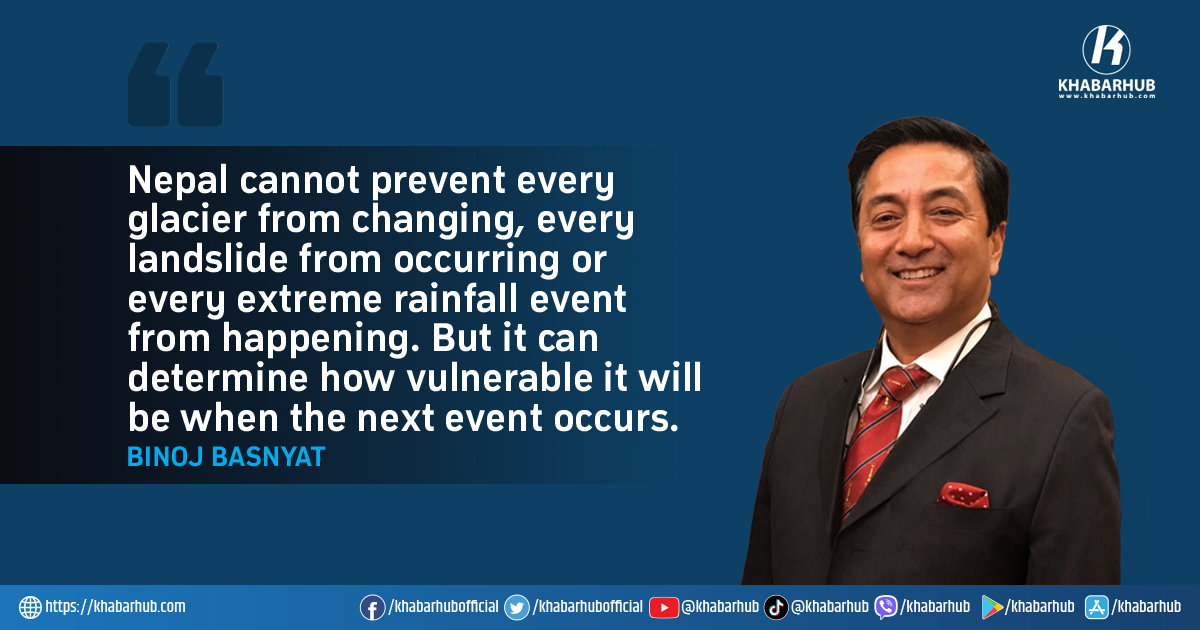
Nepal cannot prevent every glacier from changing, every landslide from occurring or every extreme rainfall event from happening. But it can determine how vulnerable it will be when the next event occurs.
Defence diplomacy has a role here as well. The professionalism of the Nepali Army in rescue and relief operations has once again demonstrated the importance of military capability in national resilience. Joint HADR exercises with the Indian Army, People’s Liberation Army, and other partner forces provide opportunities to share best practices, engineering capabilities, logistics, medical support, mountain rescue and emergency coordination.
Defence diplomacy in the 21st century cannot be only about preparing for war; increasingly, it must also be about preparing to save lives when nature becomes the adversary.
Technology will be central to this transformation. Nepal needs greater capability in satellite observation, drones, artificial intelligence-assisted risk assessment, hydrological monitoring, digital communications and early-warning systems. But technology alone is insufficient. Monitoring systems can have blind spots, and some mountain events can develop faster than conventional warning mechanisms can respond. Technology must therefore be combined with local knowledge, institutional coordination, evacuation planning and resilient infrastructure.
This is where national strategic confidence becomes essential.
Nepal’s strategic confidence cannot be built merely through diplomatic declarations. It must rest on political stability, good governance, economic resilience, institutional credibility, technological capacity and a shared national purpose. A state that cannot anticipate environmental shocks, protect critical infrastructure or coordinate an emergency response will struggle to exercise strategic autonomy in an increasingly uncertain world.
National resilience is national power.
Nepal must also rethink how it builds infrastructure. Roads, bridges, hydropower projects, settlements and connectivity corridors cannot be evaluated only in terms of economic return and construction cost. They must be assessed against long-term climate, geological and hydrological risks. Infrastructure that is cheap to build but repeatedly destroyed may ultimately be the most expensive infrastructure.
This becomes particularly important as Nepal seeks to expand hydropower exports, tourism, connectivity and economic integration with both India and China. Connectivity creates opportunity, but connectivity through fragile terrain also creates vulnerability. The objective should therefore be to build infrastructure that does not merely connect Nepal in normal times, but keeps Nepal connected when the mountains become unstable.
Nepal should not wait for others to define this agenda. It can lead a new regional conversation—linking climate justice, national resilience, disaster diplomacy and strategic cooperation.
There is also a broader geopolitical message. Nepal cannot change its geography, but it can change how effectively it manages that geography.
Geopolitics can be an opportunity for a state capable of managing it; otherwise, it can become a trap. Nepal risks becoming a playground for competing interests if it lacks institutional capacity and strategic confidence. But with resilience, capability and strategic clarity, it can become a player that uses its geography to advance its own national interests.
The same principle applies to Himalayan climate security.
Nepal cannot prevent every glacier from changing, every landslide from occurring or every extreme rainfall event from happening. But it can determine how vulnerable it will be when the next event occurs.
The recent floods should therefore be remembered not only for their destruction but also for the warning they carry.
The Himalayas are changing. Our understanding of security must change with them.
For Nepal, India and China, the choice is increasingly clear: continue responding to disasters after they happen, or build a shared architecture capable of anticipating and managing Himalayan risks before they become catastrophes. For the wider international community, there is an equally important responsibility: climate justice must mean protecting the countries and communities that are experiencing some of the most severe consequences of a crisis they did little to create.
Nepal should not wait for others to define this agenda. It can lead a new regional conversation—linking climate justice, national resilience, disaster diplomacy and strategic cooperation.
The mountains do not recognise political boundaries. Neither do glaciers, rivers, floods or climate change.
The Himalayas are becoming a shared security space. The strategic question is whether we will recognise the warning—and whether Nepal will have the strategic confidence to lead the response through a trilateral Nepal–India–China Himalayan Resilience Mechanism and regionalism through a BIMSTEC Himalayan–Bay of Bengal Resilience Framework.
(Basnyat is a Maj. Gen. (Retd.) of the Nepali Army and writes on international affairs and geopolitical strategy. He is also a researcher affiliated with Rangsit University in Thailand.)




Comment