




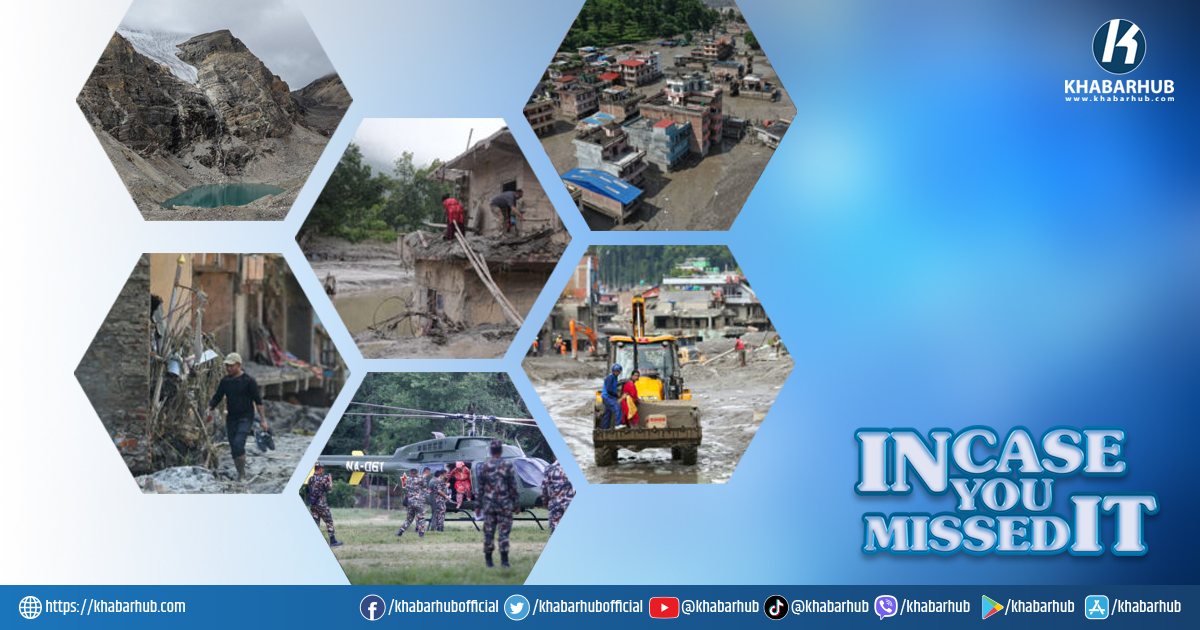
KATHMANDU: The events of the past week have shown, with devastating clarity, how quickly a disaster in Nepal’s high Himalayas can become a national humanitarian, economic and security crisis.
On August 26, a catastrophic flash flood struck Rasuwa after a massive collapse of rock, ice and debris near the Nepal-China border sent a powerful surge into the Lhende Khola and the Bhote Koshi River. Within minutes, the force of the flood overwhelmed settlements, roads, bridges and infrastructure along the river corridor.
What followed over the next several days was not simply a flood. It became a cascading disaster involving destroyed connectivity, damaged hydropower projects, stranded communities, missing people, difficult tunnel rescues, renewed flood threats and an unprecedented mobilisation of Nepal’s security forces and international partners.
The events of the week should therefore be viewed not only as a humanitarian tragedy but also as a strategic warning.
August 26: The First Shock
The catastrophe began in the morning of August 26 in the northern part of Rasuwa. A huge mass of rock and glacial material collapsed near the Nepal-China border, sending water and debris into the river system with extraordinary speed.
The exact scientific mechanism behind the collapse remains subject to investigation, but the event demonstrated the vulnerability of the Himalayan environment to sudden, compound hazards. A high-altitude collapse can rapidly transform into a destructive flood, carrying enormous quantities of mud, rocks and debris downstream.
The United States, United Kingdom, Australia, South Korea, Japan, the European Union and other international partners offered assistance, while United Nations agencies and international humanitarian organisations have supported relief efforts.
Timure and the Rasuwagadhi area were among the first places hit. The flood destroyed critical infrastructure and disrupted the Nepal-China border connection. Bridges and sections of the Pasang Lhamu Highway were swept away, leaving communities isolated and making rescue and relief operations extremely difficult.
The disaster immediately exposed the vulnerability of Nepal’s northern connectivity. The same roads and bridges that normally facilitate trade, tourism and movement became the first casualties of the disaster.
August 27: The Disaster Moves Downstream
By August 27, the crisis had spread far beyond Rasuwa.
The Bhote Koshi and Trishuli river systems carried the flood southward, affecting Nuwakot, Dhading and other downstream districts. The river became a conveyor of destruction, transporting debris and, tragically, victims hundreds of kilometres from the original disaster zone.
The scale of infrastructure destruction also became clearer. Bridges disappeared, roads were damaged and settlements along the riverbanks were devastated. Hydropower projects located along the corridor suffered serious damage, with tunnels, powerhouses and other structures inundated or buried under debris.
This created a second emergency: people trapped in areas that could no longer be reached by road.
Helicopters became essential not only for evacuating survivors but also for transporting food, medical supplies, rescue personnel and heavy equipment.
The Hydropower Rescue Challenge
Among the most difficult rescue operations were those involving workers trapped inside hydropower tunnels.
The combination of mud, debris, water and damaged infrastructure made conventional rescue extremely difficult. Nepal’s security forces and technical teams had to work in dangerous conditions while attempting to locate tunnel entrances and create access routes.
The rescue operation also demonstrated the importance of specialised international assistance. Nepal requested technical support from neighbouring countries, including India and China, particularly for difficult tunnel-rescue operations.
This was an important moment for Nepal.
Seeking foreign expertise during a disaster should not be viewed as a weakness. No country can maintain every specialised capability required for every possible catastrophe. The responsible approach is to use domestic capabilities where they are strongest and obtain outside expertise where it can save lives.
August 28: A Second Threat Emerges
As the immediate floodwaters began to recede in some areas, another danger emerged.
The enormous quantity of debris deposited in the river system created blockages and raised concerns about unstable water bodies forming upstream. Authorities had to monitor the possibility that accumulated water could suddenly break through and create another destructive surge.
This was a reminder that Himalayan disasters rarely follow a simple sequence of “event, rescue and recovery.”
One event can create another.
A landslide can block a river. A blocked river can create a temporary lake. The lake can overflow or collapse. A secondary flood can then travel downstream, potentially causing another round of destruction.
The events of August 28 therefore highlighted the urgent need for continuous monitoring even after the apparent end of the initial disaster.
August 29: Nepal Turns to International Support
As the scale of the emergency became clearer, international assistance increased.
India provided emergency relief supplies and specialised technical assistance, including personnel involved in tunnel rescue and forensic support for identifying victims. China also mobilised relief and rescue support, while other countries and international organisations began extending humanitarian assistance.
The international response was significant because the disaster affected not only Nepali citizens but also foreign nationals, including people connected with hydropower projects and travellers in the affected areas.
International assistance also reflected the unique geography of the disaster. Nepal’s two giant neighbours share the Himalayan system with Nepal, making cooperation particularly important.
The flood demonstrated that Himalayan disasters cannot be managed entirely within national boundaries.
August 30: The Human Cost Becomes Clear
By Sunday, the human cost had reached a horrifying scale.
Government figures reported hundreds of recovered bodies and thousands of people still missing. Bodies were recovered not only in the districts immediately affected by the flood but also far downstream, illustrating the extraordinary force and reach of the river.
The missing included hydropower workers, foreign nationals, Nepalis travelling with them and members of the security forces.
Hospitals and authorities faced the difficult task of identifying recovered bodies and reconnecting survivors with their families. For many families, the disaster remained an agonising search for information about loved ones whose whereabouts were unknown.
At the same time, thousands of security personnel continued search, rescue and relief operations across affected districts.
The Rescue Operation Becomes a National Effort
The response during the week has demonstrated the importance of Nepal’s security institutions in national disaster management.
The Nepali Army, Nepal Police and Armed Police Force mobilised thousands of personnel. Helicopters became the lifeline for communities cut off by destroyed roads and bridges.
Food and essential supplies were flown into isolated areas. Survivors were evacuated from remote settlements. Rescue teams were sent toward damaged hydropower facilities and tunnels.
The operation has also involved engineers, medical personnel, local governments, volunteers and ordinary citizens.
This is perhaps the most positive story to emerge from an otherwise devastating week: when the scale of the disaster became apparent, the response became a collective national effort.
India’s Technical and Humanitarian Assistance
India played an important role in Nepal’s response.
Indian assistance has included relief materials as well as specialist personnel. Technical experts have been involved in supporting difficult rescue operations, while forensic specialists have assisted with the identification of victims.
Such cooperation demonstrates that disaster management can become an important area of practical Nepal-India relations.
Political disagreements may exist between neighbouring countries, but rivers, mountains and disasters do not wait for diplomatic disagreements to disappear.
China’s Major Relief Response
China’s support became particularly visible on Sunday, when two Chinese Y-20 military transport aircraft arrived in Kathmandu carrying emergency relief supplies.
The aircraft transported approximately 50 tonnes of assistance, including tents, blankets, sleeping bags, food and first-aid materials. Chinese rescue specialists also arrived to support Nepal’s difficult tunnel-rescue operations. China’s assistance is significant beyond the quantity of relief material.
Nepal, India and China share the Himalayan risk environment. Glacier monitoring, satellite observation, hydrological data-sharing, early-warning systems, scientific research and emergency response are areas where cooperation can serve everyone’s interests.
The disaster occurred near the Nepal-China border and disrupted one of Nepal’s important northern trade routes. The response therefore demonstrated the practical importance of Nepal-China cooperation in dealing with emergencies in the Himalayas.
Support From the Wider World
The response has not been limited to Nepal’s neighbours.
The United States, United Kingdom, Australia, South Korea, Japan, the European Union and other international partners offered assistance, while United Nations agencies and international humanitarian organisations have supported relief efforts.
This international solidarity is important, but Nepal’s needs will extend well beyond the immediate emergency.
Emergency supplies can help families survive the first days. Rebuilding roads, bridges, hydropower facilities, homes and communities will require years of effort and substantial financial resources.
The international community should therefore be prepared to support Nepal through both emergency relief and long-term reconstruction.
The Week’s Most Important Lesson
The most important lesson from the past week may be that Nepal’s disaster risks are changing.
This was not simply a conventional flood caused by heavy rainfall. It involved the interaction of high-altitude geology, ice, water, debris, rivers, infrastructure and human settlements.
That means traditional disaster planning is no longer enough.
Nepal needs better monitoring of glaciers, glacial lakes, unstable slopes and river systems. It needs faster early-warning mechanisms and stronger communications networks. It needs infrastructure designed for extreme events rather than average conditions.
Most importantly, disaster management must become part of national planning rather than something activated only after catastrophe strikes.
From Disaster Response to Disaster Resilience
The destruction of the past week should not lead Nepal simply to rebuild what was lost.
It should lead Nepal to rebuild differently.
A bridge that has been swept away should be reconstructed after reassessing the river’s behaviour. A road destroyed by a landslide should not automatically be rebuilt along the same vulnerable alignment. Hydropower projects should be assessed against the possibility of extreme floods, debris flows and changing mountain conditions.
Nepal’s future economic ambitions depend heavily on infrastructure. Hydropower, tourism, trade and connectivity will remain essential to development.
Nepal cannot prevent every glacier collapse, landslide or extreme flood. But it can determine how prepared it will be for the next one. The response of the past week has shown Nepal’s capacity for courage, solidarity and international cooperation. The challenge now is to transform that emergency response into permanent resilience.
But infrastructure that repeatedly fails during extreme events can undermine the very development it was designed to support.
A Strategic Opportunity
The events of the past week also offer Nepal an opportunity to strengthen regional cooperation.
Nepal, India and China share the Himalayan risk environment. Glacier monitoring, satellite observation, hydrological data-sharing, early-warning systems, scientific research and emergency response are areas where cooperation can serve everyone’s interests.
Nepal could take the initiative in developing a practical Himalayan disaster-resilience mechanism with its neighbours. BIMSTEC could also provide a wider platform connecting Himalayan disaster risks with downstream communities toward the Bay of Bengal.
This would allow Nepal to move beyond being a recipient of emergency assistance and become a regional leader in disaster resilience.
The Warning of August 26
The past week will be remembered for its terrible human cost. But it should also be remembered as a warning.
The Himalayas are dynamic. The risks facing communities, infrastructure and economies are changing. A disaster that begins in an isolated mountain valley can, within hours, disrupt international borders, destroy strategic infrastructure, affect energy production and send consequences hundreds of kilometres downstream.
Nepal cannot prevent every glacier collapse, landslide or extreme flood. But it can determine how prepared it will be for the next one. The response of the past week has shown Nepal’s capacity for courage, solidarity and international cooperation. The challenge now is to transform that emergency response into permanent resilience.
The lesson of August 26 should therefore not end with reconstruction. Nepal must ensure that the next warning is heard before the next flood arrives.




Comment