




Nepal is no longer merely passing through a routine democratic cycle. The country is entering a deeper phase of political transition in which public expectations are shifting from symbolic republicanism toward demands for state effectiveness, institutional reform, accountability, and executive delivery, with the emerging risk of another political emergency.
The electoral rise of reform-oriented political forces such as the Rastriya Swatantra Party (RSP) reflects not simply dissatisfaction with governance, but growing public fatigue with the political-security architecture that emerged after 2006, in addition to frustration over the decade-long Maoist insurgency against the democratic system.
Yet Nepal’s evolving political landscape now reveals a fundamental tension between electoral mandate and institutional continuity.
While reformist forces increasingly command political legitimacy, with 182 seats — almost two-thirds of the 275-member House of Representatives — significant elements of state authority remain embedded within institutions shaped by the earlier consensus-era order.
The National Assembly, segments of the judiciary, entrenched bureaucratic networks, and legacy party structures continue to exercise substantial influence over policy approval, interpretation, implementation, and political pacing. The resulting friction is not accidental. It is characteristic of transitional political systems worldwide.
In contrast, other transitional leaders struggled because symbolic politics increasingly overwhelmed institutional governance.
Comparative politics literature describes such institutions as “veto structures” within transitional democracies. Their formal purpose is to ensure stability, continuity, and checks against impulsive majoritarianism. But during periods of rapid societal change, those same institutions are increasingly perceived by reformist constituencies as obstacles to transformation.
This is where the political behavior of Prime Minister Balendra Shah — widely known as Balen — becomes politically significant.
Much commentary has interpreted his unconventional executive style as merely personal temperament or political immaturity. That interpretation misses the broader comparative context.
Political science and political psychology studies suggest that leaders emerging during transitional periods often intentionally distance themselves from older political culture through symbolism, behavioral contrast, and visible rejection of established procedural norms.
Such behavior is rarely accidental.
Across transitional systems, anti-establishment leaders frequently seek legitimacy not through institutional conformity, but through symbolic rupture. This includes unconventional dress, rejection of ceremonial etiquette, public confrontation with legacy elites, informal executive conduct, abrupt disengagement from formal rituals, and direct appeals to “the people” over institutional hierarchy.
These acts are political signals.
When leaders appear deliberately informal at state events, bypass protocol, or visibly distance themselves from ceremonial culture, analysts often interpret such actions as manifestations of deeper structural frustration: impatience with institutional inertia, rejection of elite consensus politics, and attempts to redefine executive legitimacy around direct public mandate rather than inherited political hierarchy.
This phenomenon has numerous international parallels. Narendra Modi, during his early tenure in 2014, emphasized a deliberate break from traditional Delhi political culture through centralized executive symbolism and direct public communication. A major component of this strategy was political symbolism.
Modi cultivated the image of an outsider to the established Lutyens’ Delhi political ecosystem, positioning himself not as a continuation of the old governing order, but as a disruptive reformist figure capable of challenging entrenched political, bureaucratic, and institutional networks.
Public messaging consistently framed his leadership as a corrective to perceived policy paralysis, corruption scandals, bureaucratic inertia, and fragmented coalition politics associated with previous administrations.
Boris Yeltsin embodied rupture during the post-Soviet transition. The defining image of Yeltsin standing atop a tank during the 1991 Soviet coup attempt became a powerful symbol of resistance against the old order and accelerated the collapse of Soviet authority.
Under his leadership, Russia moved rapidly toward political pluralism and market reforms, but the speed of transformation also produced institutional instability, economic dislocation, oligarchic power concentration, and governance fragmentation.
Yeltsin therefore embodied both the energy of revolutionary political transition and the risks that emerge when institutional adaptation struggles to keep pace with systemic change.
Hugo Chávez built legitimacy through direct anti-establishment confrontation beginning in 1992. His leadership relied heavily on symbolism, public spectacle, and anti-elite narratives that resonated with widespread frustration over inequality, corruption, and institutional decline.
Through televised addresses, public campaigns, and centralized executive messaging, Chávez transformed politics into a continuous struggle between “the people” and entrenched power structures. While this approach generated strong popular support and reshaped Venezuela’s political landscape, it also intensified institutional polarization by weakening traditional checks and balances and concentrating political authority around executive leadership.
More recently, Javier Milei rose to prominence in 2023 by channeling deep public frustration with Argentina’s economic decline, political stagnation, and entrenched party structures into an aggressively anti-establishment political movement.
Presenting himself as an outsider challenging the country’s traditional political class, Milei used confrontational rhetoric, unconventional public behavior, and highly personalized communication to portray existing institutions as responsible for chronic inflation, fiscal instability, and governance failure.
Nayib Bukele similarly used unconventional political behavior in 2020 to signal conflict with entrenched systems. He built his political legitimacy by presenting himself as a disruptive outsider challenging El Salvador’s traditional political establishment, which many citizens associated with corruption, inefficiency, and chronic insecurity. Through highly centralized leadership, direct public communication, and extensive use of social media, Bukele cultivated an image of decisive executive authority capable of delivering rapid results where conventional political institutions had failed.
However, comparative political history also shows that transitional leadership can produce sharply different outcomes depending on whether symbolic rupture is eventually converted into institutional reform.
Some leaders succeeded because they combined anti-establishment legitimacy with state restructuring, institutional adaptation, and economic delivery.
Lee Kuan Yew transformed Singapore from a fragile post-colonial city-state into a highly institutionalized developmental state by combining executive discipline with long-term bureaucratic modernization.
Deng Xiaoping successfully redirected China away from ideological paralysis through gradual but decisive economic restructuring while maintaining state coherence.
Franklin D. Roosevelt used crisis-era executive activism during the Great Depression to fundamentally reshape the American state through the New Deal while preserving institutional legitimacy.
Nelson Mandela managed one of history’s most delicate political transitions by balancing transformational legitimacy with institutional reconciliation, preventing South Africa from descending into large-scale instability after apartheid.
Even Narendra Modi, despite criticism regarding centralization, succeeded politically because symbolic rupture was accompanied by sustained administrative consolidation, infrastructure expansion, welfare digitization, and executive coherence that reinforced his mandate among large sections of the electorate.
In contrast, other transitional leaders struggled because symbolic politics increasingly overwhelmed institutional governance.
Hugo Chávez initially mobilized genuine anti-elite frustration and expanded social inclusion, but excessive personalization of power, weakening of institutions, and economic mismanagement contributed to long-term national crisis. Boris Yeltsin succeeded in dismantling the Soviet political order but failed to establish stable institutional legitimacy during the transition, contributing to oligarchic concentration, economic turmoil, and state fragmentation during the 1990s.
A growing segment of society now believes that post-conflict institutions designed for consensus and balance are struggling to adapt to a new political environment driven by demands for delivery, accountability, and state modernization.
Mohamed Morsi emerged from revolutionary democratic momentum after the Arab Spring but struggled to manage institutional resistance, elite fragmentation, and civil-military tensions, ultimately leading to political collapse.
The distinction is important.
Successful transitional leaders ultimately institutionalize change. Failed transitional leaders personalize it.
The former create durable systems that survive beyond their individual charisma. The latter become trapped in permanent confrontation with institutions, gradually weakening both governance and democratic legitimacy.
Nepal’s current political transition increasingly reflects elements of this same global pattern.
The emerging divide is no longer simply ideological. It is structural, generational, and increasingly institutional.
On one side stands the post-2006 consensus framework — designed primarily to preserve political balance after conflict and manage coalition coexistence. On the other side is a growing mandate-oriented political culture demanding rapid governance reform, institutional efficiency, anti-corruption measures, and executive responsiveness.
This explains why criticism of the National Assembly has intensified. Reformist narratives increasingly portray the upper house not as a stabilizing democratic institution, but as a continuity mechanism through which older party networks preserve influence despite declining public trust.
Critics argue that indirectly elected structures slow adaptation, dilute reform mandates, and reproduce elite bargaining politics at a time when citizens increasingly demand decisive governance outcomes.
At the same time, increasing public scrutiny is also directed toward sections of the judiciary whenever courts are perceived as delaying, diluting, or obstructing reform-oriented executive action. In transitional systems, the judiciary carries enormous responsibility because it is expected to balance constitutional restraint with societal adaptation. However, when courts are increasingly perceived not as neutral arbiters but as institutional defenders of an exhausted political order, legitimacy tensions deepen rapidly.
This is where Nepal faces a potentially dangerous political trajectory.
If reform-oriented public sentiment continues to grow while key institutions are simultaneously perceived as obstructing transformation, Nepal may gradually enter a legitimacy crisis rather than merely a political disagreement. Political science literature shows that crises often emerge not simply because institutions resist change, but because societies begin to perceive institutional resistance itself as illegitimate.
In such conditions, several destabilizing trends typically emerge simultaneously:
• declining public trust in institutional neutrality,
• increasing executive frustration,
• street-level polarization,
• growing personalization of politics,
• and pressure to bypass constitutional procedures in the name of efficiency or national transformation.
Comparative political history demonstrates that transitional deadlocks between elected mandates and entrenched institutional structures can escalate quickly if adaptation mechanisms fail.
In parts of Latin America, prolonged confrontation between reformist executives and legacy institutions intensified polarization and constitutional instability. In several post-Soviet states, unresolved tensions between elected leaders and inherited institutional structures eventually weakened democratic consolidation. During the Arab Spring transitions, institutional rigidity combined with political impatience contributed to governance breakdowns in multiple states.
Political systems that resist adaptation often unintentionally strengthen anti-establishment narratives.
Nepal is not yet at that stage. But the warning signs are increasingly visible within public discourse.
A growing segment of society now believes that post-conflict institutions designed for consensus and balance are struggling to adapt to a new political environment driven by demands for delivery, accountability, and state modernization. If those institutions are seen as continuously blocking transformation without offering credible alternatives, public frustration may increasingly shift from dissatisfaction with politicians toward dissatisfaction with the institutional system itself.
That is the point at which political crises become more likely.
The danger for Nepal is therefore twofold.
If legacy institutions refuse adaptation entirely, anti-system politics will intensify further, potentially weakening faith in constitutional processes themselves. But if reformist leadership attempts to bypass institutional checks altogether, the country risks executive overcentralization and democratic erosion.
This is therefore not a simple contest between reform and obstruction.
It is a deeper struggle over the future philosophy of the Nepali state itself.
Should Nepal continue operating through consensus-era institutional pacing designed for post-conflict stabilization? Or must its institutions now evolve toward a more mandate-responsive and transformation-oriented model of governance?
From Stagecraft to Statecraft: An Institutional Test
A deeper dimension of Nepal’s current transition lies in the growing tension between stagecraft and statecraft. Modern political leadership is no longer judged solely by administrative performance or institutional management. Increasingly, leaders are evaluated through symbolism, political messaging, public gestures, and their ability to project change. In transitional political environments, stagecraft often becomes the language of disruption.
Balen Shah’s political behavior can partly be understood through this lens. Symbolic gestures, unconventional communication styles, public confrontation with entrenched systems, and visible resistance to traditional political culture are not merely personality traits; they are political signals aimed at communicating a break from the post-2006 establishment order. Similar patterns have been observed globally where reform-oriented leaders sought to distance themselves from older political structures through deliberate public symbolism and centralized executive messaging.
However, history also demonstrates that stagecraft alone cannot transform states. Sustainable national transformation ultimately depends on statecraft — the difficult process of institutional reform, coalition management, economic governance, bureaucratic restructuring, legal adaptation, and strategic consensus-building. Political momentum created through symbolism must eventually translate into institutional capability.
This is where Nepal’s current transition faces its greatest challenge. If reformist political energy collides with institutions that continue to function as protectors of the old equilibrium rather than facilitators of adaptation, the likelihood of political confrontation increases. The obstruction of reform through parliamentary deadlock, bureaucratic resistance, judicial activism, or upper-house protectionism may gradually transform political disagreement into a broader legitimacy crisis.
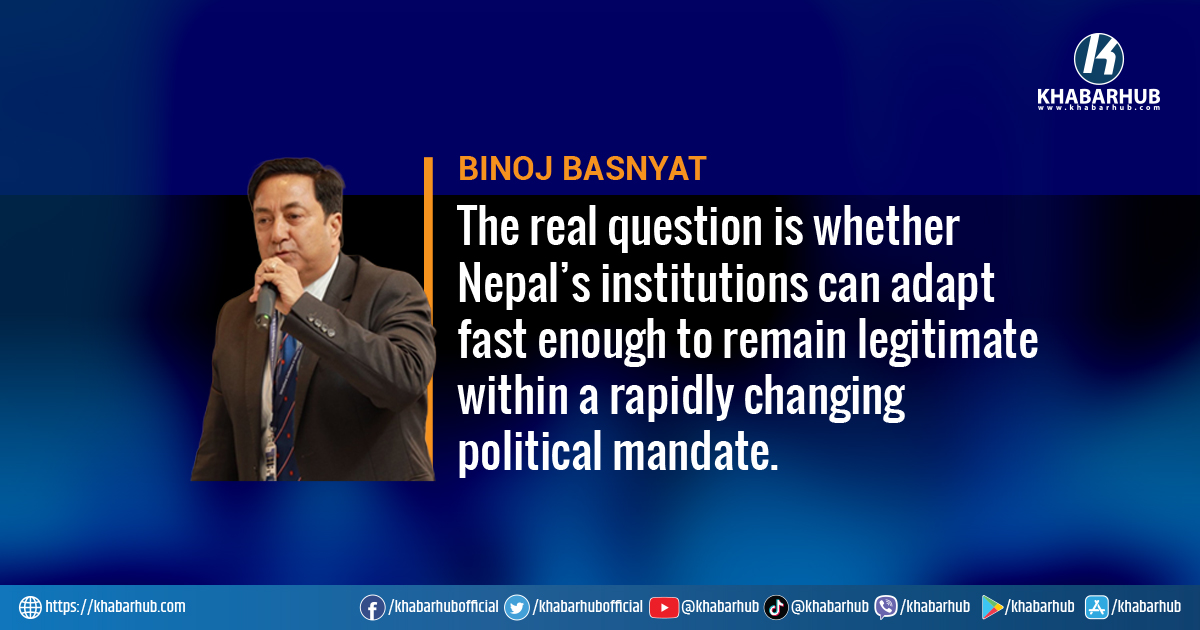
The real question is whether Nepal’s institutions can adapt fast enough to remain legitimate within a rapidly changing political mandate.
In many historical transitions, entrenched institutions failed not because reform pressures emerged, but because they underestimated the scale of public demand for structural change. Political systems that resist adaptation often unintentionally strengthen anti-establishment narratives. Conversely, institutions that successfully absorb reform pressures through negotiated transformation tend to preserve long-term stability.
Nepal therefore stands at a delicate strategic moment. The challenge is no longer simply whether change should occur, but whether the state’s political and institutional architecture can evolve fast enough to accommodate the transformation already unfolding within public consciousness. Stagecraft may mobilize the transition, but only statecraft can stabilize it.
That question increasingly defines Nepal’s present transition.
In this context, Balen’s symbolic behavior acquires broader political meaning. Whether intentional or instinctive, his conduct reflects a growing political sentiment that traditional elite procedures no longer adequately represent public expectations. His leadership style resonates precisely because many citizens increasingly perceive institutional culture itself — not merely individual politicians — as part of the governance problem.
But symbolism alone cannot sustain transformation.
History shows that transitional leadership succeeds only when symbolic rupture evolves into durable institutional reform. Without administrative capacity, policy coherence, bureaucratic compliance, constitutional adaptation, and institutional legitimacy, performative disruption eventually risks degenerating into polarization, governance paralysis, or executive personalization.
Nepal therefore stands at a delicate threshold.
The central political question is no longer whether change is coming. The public has already signaled that demand clearly.
The real question is whether Nepal’s institutions can adapt fast enough to remain legitimate within a rapidly changing political mandate.
That may ultimately determine whether Nepal experiences democratic transformation — or democratic confrontation — in the years ahead.
(Basnyat is a Maj. Gen. (Retd.) of the Nepali Army and a strategic affairs analyst. He is also a researcher affiliated with Rangsit University in Thailand. Views are personal)





Comment