




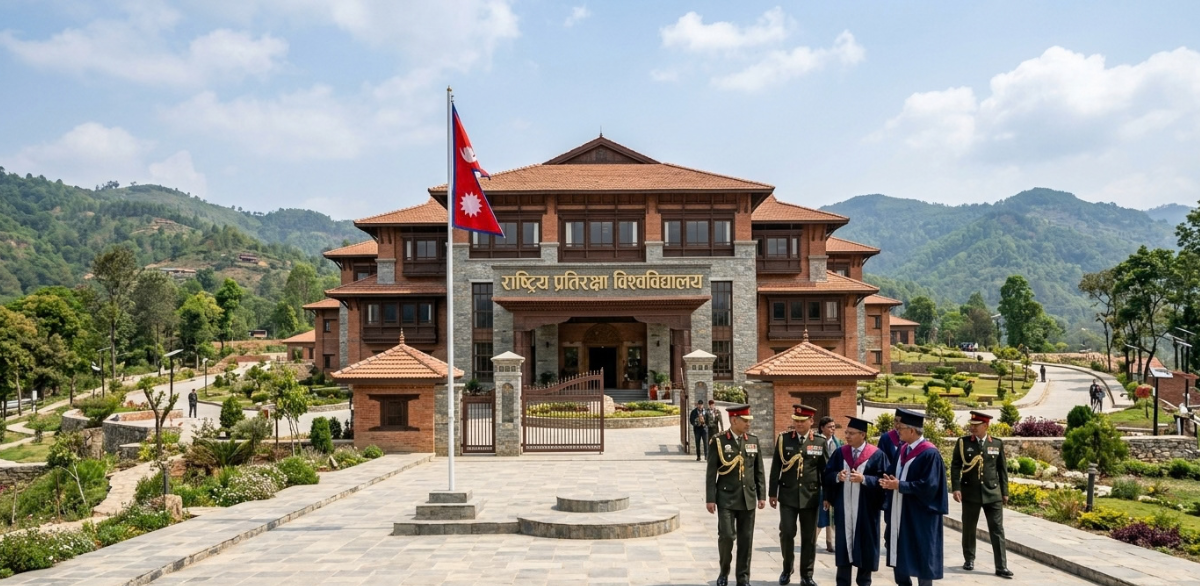
KATHMANDU: The House of Representatives has unanimously approved a proposal seeking consideration of the National Defence University Bill, 2083, during its meeting on Tuesday.
The proposal, presented by Minister for Law, Justice and Parliamentary Affairs Sobita Gautam on behalf of Prime Minister and Defence Minister Balendra Shah, was unanimously approved by the House.
Responding to issues raised during the discussion on the bill, Minister Gautam said the legislation was necessary to give priority to strategic areas such as border and national security, foreign policy, intelligence studies and cybersecurity.
According to the bill, the university is proposed as a specialised academic centre for higher-level education, teaching and research in national security, defence, international relations and strategic studies.
The university’s central office will be located at Perungedanda in Banepa Municipality, Kavrepalanchok. It will have the status of a legal entity and operate as an autonomous, self-governing and organised institution with perpetual succession.
Under the proposed organisational structure, the university will have an Assembly, Academic Council, Executive Council, Institute of Defence Studies, National Defence College, affiliated educational institutions and a Centre for Strategic Studies and Research.
The Assembly will be the university’s highest governing body, with the prime minister serving as its chairperson. The defence minister will serve as vice-chairperson. The chairperson of the University Grants Commission, chief secretary, chief of the Army Staff, the National Planning Commission member responsible for defence, secretaries of various ministries and nominated experts will serve as members. The Assembly will meet at least once a year.
The bill also proposes an Academic Council chaired by the vice-chancellor to oversee the university’s academic activities and an Executive Council to manage its administrative and executive functions.
The Institute of Defence Studies will be established under the university to provide higher-level education. The National Defence College will operate as an affiliated educational institution under the institute and conduct academic courses and training in national security, defence and strategic studies.
The college will be headed by a commandant appointed by the government from among serving major generals of the Nepali Army on the recommendation of the Chief of the Army Staff.
Similarly, a Centre for Strategic Studies and Research will be established as a think tank to conduct in-depth research on national security and strategic issues and provide strategic advice and recommendations to the government and stakeholders.
The bill also opens the way for educational institutions under security agencies, including the Nepali Army Command and Staff College, Nepali Army War College, Armed Police Force Command and Staff College and Nepal Police Staff College, to become affiliated with the university.
The prime minister will serve as the chancellor and the vice-chancellor as the university’s executive chief. To qualify for the post of vice-chancellor, a candidate must hold at least a master’s degree from a recognised university and have at least 20 years of experience in the security, defence or strategic sectors.
A three-member recommendation committee chaired by the Chief of the Army Staff will be formed to recommend candidates for the posts of vice-chancellor and registrar, who will serve as the university’s chief administrator.
The vice-chancellor, registrar, deans and centre heads will serve three-year terms and may be reappointed once.
The bill allows employees of the Nepali Army, civil service and other government services to be deputed to the university. It also allows special positions to be filled on a contractual basis.
A separate fund will be established to operate the university. The fund will receive money from the Government of Nepal, the University Grants Commission, fees and other forms of assistance.
The Office of the Comptroller General will conduct the internal audit of the fund, while the Office of the Auditor General will carry out the final audit.
The bill also includes transitional provisions to repeal the National Defence University Infrastructure Development Committee (Formation) Order, 2076, and transfer all movable and immovable property and liabilities held in the name of the development committee to the university.





Comment