




Prime Minister Balendra Shah’s address to the 81st Session of the United Nations General Assembly (UNGA) should be read as Nepal’s response to a devastating Himalayan disaster, or the Himalayan tsunami, as well as an attempt to reposition Nepal’s voice in international affairs. The speech began with the experience of a vulnerable Himalayan country, but it did not end there. It progressively widened the frame—from Nepal to South Asia, from climate change to human security, from disaster assistance to climate justice, and from vulnerability to strategic agency. That progression is important.
Small states rarely possess the material capabilities to shape the international system in the same manner as major powers. Their influence often comes from converting geography, experience, institutions, norms and diplomatic credibility into political relevance. Shah’s UNGA81 address can therefore be understood as an effort to do precisely that: transform Nepal’s exposure to global problems into an argument for a greater role in shaping responses to them.
The August 2026 Bhote Koshi–Trishuli disaster provided the immediate context. But the speech sought to make the disaster politically larger than itself. Nepal’s tragedy became a lens through which to question how South Asia manages shared vulnerabilities, how the Himalayas can become a space for cooperation, how security should be defined, and whether the international system distributes the costs of global crises fairly.
The strategic trajectory of the speech can therefore be understood as: Himalayan tragedy → South Asian solidarity → Himalayan cooperation → human security → climate justice → strategic agency → civilizational diplomacy.
From Nepal’s disaster to a South Asian narrative
The first important move was to prevent Nepal’s disaster from becoming an exclusively national story. By referring to Bangladesh, Bhutan, India, Maldives, Pakistan and Sri Lanka, Shah situated Nepal’s experience within a broader South Asian predicament. Climate vulnerability, food and energy insecurity, disrupted connectivity and the spillover effects of conflicts beyond the region do not stop at national borders. This regionalization of Nepal’s experience has strategic significance.
Nepal cannot determine the global climate regime, reshape the international financial system or resolve great-power competition. But strategic agency does not require great-power capabilities. It requires identifying areas where a country’s experience, geography and diplomatic credibility give it something meaningful to contribute. Nepal possesses such space.
South Asia is often discussed through the vocabulary of rivalry, borders, security dilemmas and great-power competition. Shah introduced another vocabulary: shared vulnerability. That does not eliminate geopolitical differences among South Asian states, but it identifies areas where their interests overlap.
The argument is particularly relevant because climate disruption increasingly affects the foundations of regional stability. Floods can damage roads and bridges; drought can affect food production; energy disruptions can affect industry; disasters can interrupt trade and migration; and damage to infrastructure in one country can have consequences beyond its borders.
Nepal therefore has an opportunity to move beyond speaking only about its own vulnerability. It can speak from its experience about vulnerabilities shared by the region. This is a subtle but important change in diplomatic positioning. Nepal is not merely asking South Asia to recognize Nepal’s problem. It is suggesting that Nepal’s experience can contribute to a wider understanding of the region’s future.
From geopolitical geography to Himalayan cooperation
The second strategic movement is from geography as vulnerability to geography as an instrument of cooperation. The Himalayas are normally understood through territorial boundaries and strategic competition. Yet the physical systems that define the region—glaciers, rivers, glacial lakes, watersheds and downstream floodplains—do not follow political boundaries.
“Climate change does not recognize borders” is therefore more than a climate statement. It is a geopolitical proposition. Nepal’s proposal for a Nepal–India–China Himalayan Climate Resilience Mechanism illustrates this possibility. Sharing satellite information and technical expertise, monitoring glacial lakes, improving early-warning systems and coordinating disaster response are practical areas in which common interests can exist even when broader strategic interests diverge. This is where Nepal’s geography can acquire a new strategic meaning.
Nepal lies between two major powers whose relationship is characterized by both cooperation and competition. It cannot remove that structural reality. Nor should it attempt to turn climate cooperation into a substitute for wider diplomacy. But it can create functional spaces of cooperation in which a shared Himalayan environment generates common interests. That is a different conception of buffer-state geography.
Instead of viewing the Himalayas primarily as a frontier separating strategic interests, Nepal can help frame them as a shared ecological system requiring shared knowledge, shared preparedness and shared responsibility. The strategic objective is not to overcome geopolitical competition. It is to create practical cooperation despite it.
From climate policy to human security
The third movement is from climate diplomacy to the security of people. Shah’s observation that the world has developed “flawless logistics for war and broken logistics for food” captured this argument in unusually direct language.
The point was not simply that food systems need improvement. It was a challenge to the hierarchy through which security is commonly understood. Traditional security thinking places military threats, territorial integrity and state survival at the centre. Human security begins elsewhere: with whether people have food, energy, employment, livelihoods, infrastructure, health and protection from catastrophic disruption.
For Nepal and much of South Asia, these dimensions are inseparable. A destroyed bridge is not merely a development problem if it cuts off communities and disrupts supply chains. A damaged hydropower facility is not merely an economic loss if it affects energy security. A failed agricultural system is not simply a rural problem if it generates food insecurity and migration. Climate change therefore creates a convergence between development and security.
This also changes the meaning of resilience. Resilience is not simply the ability of a government to respond after a disaster. It is the capacity of societies, institutions and infrastructure to absorb shocks without repeatedly losing years of development. The implication is strategic: national security must increasingly include the resilience of the systems on which human life depends.
From climate assistance to climate justice
The fourth movement is from the language of assistance to the politics of responsibility. Nepal contributes very little to global greenhouse-gas emissions while facing disproportionate exposure to climate-related risks. Shah’s emphasis on climate justice, Loss and Damage and grant-based financing therefore moved beyond an appeal for humanitarian generosity.
It raised a structural question: Who pays for the consequences of a crisis that vulnerable countries did little to create? This distinction matters. If repeated disasters destroy infrastructure and development gains, vulnerable countries may be forced to borrow simply to rebuild what they have already built. If climate finance is slow, difficult to access or heavily loan-based, the financial architecture intended to increase resilience can itself contribute to vulnerability.
The issue is therefore not only the volume of climate finance. It is the architecture of climate finance—its accessibility, terms, speed, predictability and relationship to Loss and Damage. Shah’s formulation of “Relief. Rehabilitation. Reconstruction. Responsibility. Reparation. Resilience.” captures this transition particularly well.
The first three belong to the conventional disaster-response cycle. The latter three ask a different set of questions. Who bears responsibility? How should unavoidable loss and damage be addressed? And how can countries avoid repeatedly returning to the same cycle of destruction?
That takes the debate from disaster management toward the restructuring of vulnerability. For Nepal, this has direct policy implications: stronger early-warning systems, climate-resilient infrastructure, glacial monitoring, disaster insurance, resilient energy systems, local preparedness and institutions capable of acting before rather than after catastrophe.
From recipient to contributor
This is where the speech acquires its strongest strategic significance. There is a fundamental difference between a country that says, “Help us because we are vulnerable,” and one that says, “Our experience demonstrates why the international system must change, and here are mechanisms through which we can contribute to that change.” The latter is the language of agency.
The strategic value lies precisely in its universality. Peace, compassion, coexistence and human welfare are not exclusive geopolitical positions. They can provide Nepal with a language that connects its national identity to wider international concerns.
Nepal cannot determine the global climate regime, reshape the international financial system or resolve great-power competition. But strategic agency does not require great-power capabilities. It requires identifying areas where a country’s experience, geography and diplomatic credibility give it something meaningful to contribute. Nepal possesses such space.
Its Himalayan experience gives it an interest in mountain resilience. Its location gives it an interest in transboundary disaster cooperation. Its exposure to climate impacts gives it standing in debates over climate justice. Its position within South Asia gives it a regional perspective. And its identity as a small developing state gives it a natural constituency among countries facing similar structural constraints.
This creates a potential progression: Vulnerability → resilience → knowledge → convening power → strategic agency. The objective is therefore not to turn Nepal into a major power. It is to make Nepal more consequential than its material size would suggest. That is the essence of small-state statecraft.
From geopolitical location to civilizational diplomacy
The final movement in the speech was from contemporary geopolitics to civilizational identity.
Shah’s closing invocation—“भगवान पशुपतिनाथले विश्वको कल्याण गरुन्। यो विश्व बुद्धले देखाएको बाटोमा हिंड्न सकोस्।” —was not simply a cultural or religious conclusion.
In the context of the speech, it provided a normative frame for Nepal’s international identity. Pashupatinath and Buddha represent two dimensions of a civilizational vocabulary associated with Nepal: spiritual traditions, peace, compassion, coexistence and human welfare. Used carefully, such identity need not compete with pragmatic foreign policy. It can complement it.
For a country located between major powers, strategic identity cannot be reduced to geography. Nepal is certainly situated between China and India. But Nepal is not merely between two powers. It is also connected to the wider South Asian, Himalayan and civilizational spaces that have shaped its history.
The deeper significance of Shah’s UNGA81 speech is therefore not simply that Nepal spoke loudly about climate change. It is that Nepal attempted to change the position from which it speaks.
This creates room for what may be called civilizational diplomacy: using cultural and normative traditions not as instruments of political exclusion, but as sources of soft power and international contribution.
The strategic value lies precisely in its universality. Peace, compassion, coexistence and human welfare are not exclusive geopolitical positions. They can provide Nepal with a language that connects its national identity to wider international concerns.
In this sense, the closing invocation completed the journey begun with the Himalayan disaster. The speech began with suffering and ended with an idea of human welfare.
The emerging strategic message
Taken together, these elements suggest that the significance of the UNGA81 address lies less in any individual sentence than in the diplomatic architecture connecting them. The speech moved from a national disaster to a regional challenge; from regional vulnerability to Himalayan cooperation; from climate change to human security; from assistance to climate justice; from recipient to contributor; and from geopolitical location to civilizational diplomacy.
That progression from disaster diplomacy represents a broader conception of Nepal’s foreign policy.
Nepal need not choose between being a Himalayan state, a South Asian state, a developing country or a country situated between major powers. These identities can reinforce one another if they are connected through strategy.
The Himalayan experience can provide diplomatic legitimacy. South Asian solidarity can provide regional relevance. Climate cooperation can provide practical strategic space. Human security can provide a broader conception of national interest. Climate justice can provide a normative platform. And civilizational identity can provide soft power.
From Himalayan tragedy to South Asian solidarity; from solidarity to cooperation; from vulnerability to resilience; and from resilience to strategic agency.
The challenge now is to convert rhetoric into institutions, initiatives and sustained diplomacy. The proposed Himalayan Climate Resilience Mechanism would need to move from an idea to a workable mechanism. Climate diplomacy would need to become a sustained national priority rather than an occasional international theme. Disaster resilience would need to be embedded in national planning and foreign policy. And Nepal would need to use its diplomatic networks to connect Himalayan concerns with the wider agenda of the Global South.
That is where the real test of strategic agency begins.
Conclusion: Geography can constrain, but strategy can reposition
The deeper significance of Shah’s UNGA81 speech is therefore not simply that Nepal spoke loudly about climate change. It is that Nepal attempted to change the position from which it speaks.
Not merely as a vulnerable Himalayan country seeking assistance, but as a South Asian voice articulating shared regional concerns; not merely as a country caught between major powers, but as a potential facilitator of functional Himalayan cooperation; not merely as a recipient of climate finance, but as a contributor to the debate over how resilience should be built and financed; and not merely as a geographically located state, but as a country capable of drawing upon civilizational traditions to contribute to a wider conversation about human welfare. This is the difference between vulnerability and agency.
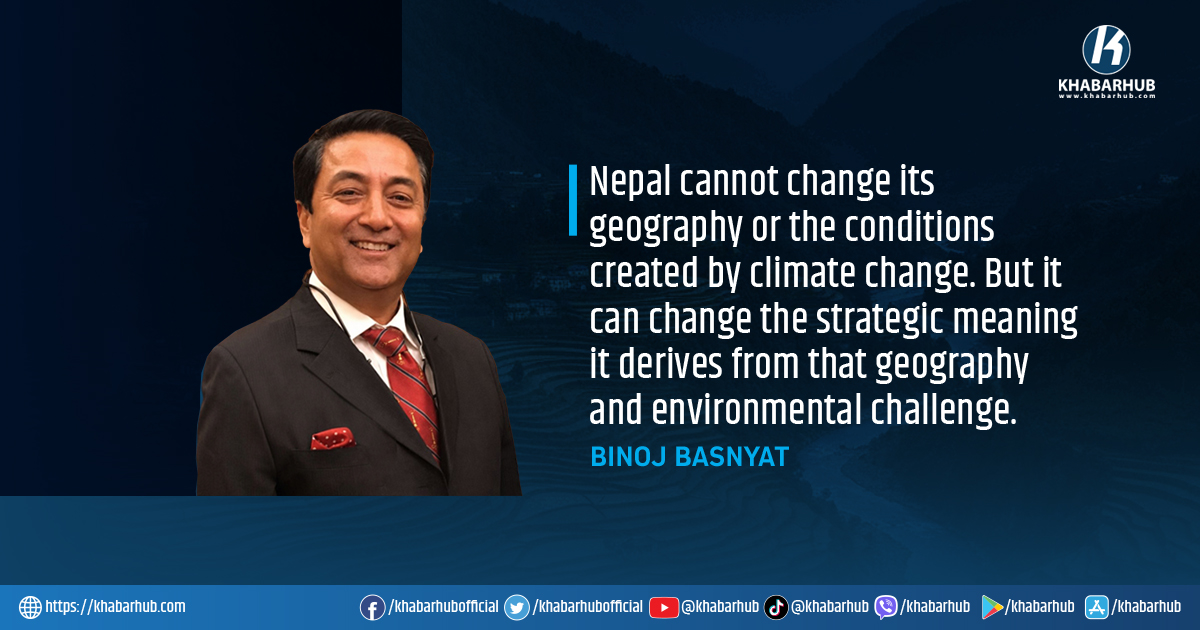
Nepal cannot change its geography or the conditions created by climate change. But it can change the strategic meaning it derives from that geography and environmental challenge.
The Himalayas can be presented not only as a zone of exposure, but as a zone of ecological interdependence. South Asia can be approached not only as a theatre of rivalry, but also as a community of shared vulnerabilities. Climate diplomacy can move beyond appeals for assistance toward questions of responsibility and institutional reform. And Nepal’s civilizational heritage can become a source of normative influence without compromising strategic pragmatism.
The strategic message emerging from UNGA81 can therefore be expressed simply: Nepal’s vulnerability can become resilience; resilience can become knowledge; knowledge can create convening power; and convening power can create strategic agency.
That is a more ambitious diplomatic proposition than asking the world merely to understand Nepal’s predicament. It is an attempt to make Nepal’s experience relevant to the way the region—and ultimately the international system—responds to the defining challenges of the twenty-first century.
From Himalayan tragedy to South Asian solidarity; from solidarity to cooperation; from vulnerability to resilience; and from resilience to strategic agency.
That is the larger message Nepal carried from the Himalayas to the world.
(Basnyat is a retired Major General of the Nepali Army and a strategic affairs analyst focusing on international relations, geopolitics, national security, and evolving regional power dynamics. His writings examine the strategic forces shaping regional security, statecraft, foreign policy, and the changing geopolitical order.)




Comment