




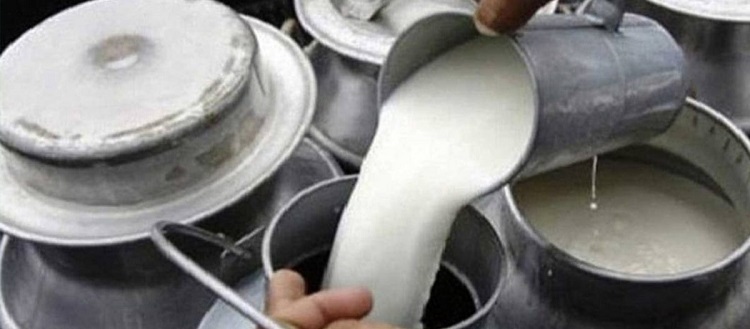
KASKI: Dairy farmers in Kaski district have demanded that the minimum price of milk be fixed at Rs 80 per litre, citing rising production costs and stagnant farm-gate prices that have increasingly squeezed their earnings.
Farmers say the costs of animal feed, bran, fodder, medicines, labour and transportation have continued to rise, while the prices they receive for milk have not been adjusted accordingly.
At a press conference organised in Pokhara, the Saptagandaki Milk Producers Cooperative said farmers were currently receiving between Rs 68 and Rs 71 per litre, depending on milk quality. The cooperative argued that the existing rates were insufficient to cover production expenses and compensate farmers for their labour.
According to cooperative chairperson Nawaraj Baral, cooperatives in Kaski collect and distribute around 28,000 litres of milk daily, while private farms and dairies produce approximately 70,000 litres. The district’s total daily milk production is estimated at around 100,000 litres.
Baral stressed that milk production is closely linked not only to farmers’ livelihoods but also to the rural economy and the country’s overall economic development. He warned that failure to adjust milk prices in line with rising production costs could force farmers to abandon dairy farming, ultimately affecting national milk production.
He said milk prices should be determined by considering geographical conditions, the availability and cost of animal feed, labour expenses, transportation distances and livestock management practices.
The cooperative has urged the government to ensure that farmers receive at least Rs 80 per litre, while taking consumer interests and prevailing market conditions into account. The Central Milk Producers Cooperative Organisation has also been pressing the government to increase the price of milk, but its demand has yet to be addressed.
In addition to a price adjustment, farmers have called for timely payments for milk supplied to dairies, improved animal healthcare and vaccination services, subsidies on animal feed and production-based financial support. They have also demanded free artificial insemination services for livestock.
Trilochan Lamichhane, a dairy farmer from Pokhara-Lekhnath, said milk prices had remained unchanged for the past three years despite a rise of more than 25 per cent in the cost of grain and bran.
“The price of grain and bran increases by Rs 10 to Rs 15 every month, but the price of the milk we produce has remained unchanged for three years. If this situation continues, how can farmers sustain themselves? We may have no option but to leave animal husbandry,” Lamichhane said.
Similarly, Krishna Prasad Adhikari of Lahachowk, Machhapuchhre Rural Municipality-4, said farmers had been waiting for a milk price revision for three years despite the continuous rise in the prices of other essential commodities.
He pointed out the disparity between the prices paid by consumers and the amounts received by producers, arguing that farmers were not receiving a fair share of the market price.
“Consumers have to pay a high price for milk in the market, yet farmers receive an amount that does not even cover their production costs. Why are the concerns of producers not being considered when determining milk prices?” Adhikari questioned.


Comment