




WASHINGTON DC: Nepali poet, author, and international development professional Homraj Acharya has contributed Rs 150,000 to Nepal’s Prime Minister’s Disaster Relief Fund from proceeds generated through the sale of his English-language poetry collection, Farmers of Blue Smoke.
The contribution, deposited in three installments, is intended to support communities affected by the ice-rock collapse and subsequent flooding in Rasuwa District, Bagmati Province, Nepal, including settlements along the Bhote Koshi river corridor.
The fundraising initiative was supported by two poetry and public engagement events held at American University and Johns Hopkins University’s School of Advanced International Studies (SAIS) in Washington, D.C., on October 6 and October 12, 2026, respectively, as well as contributions from generous donors who purchased copies of Farmers of Blue Smoke and supported the initiative.
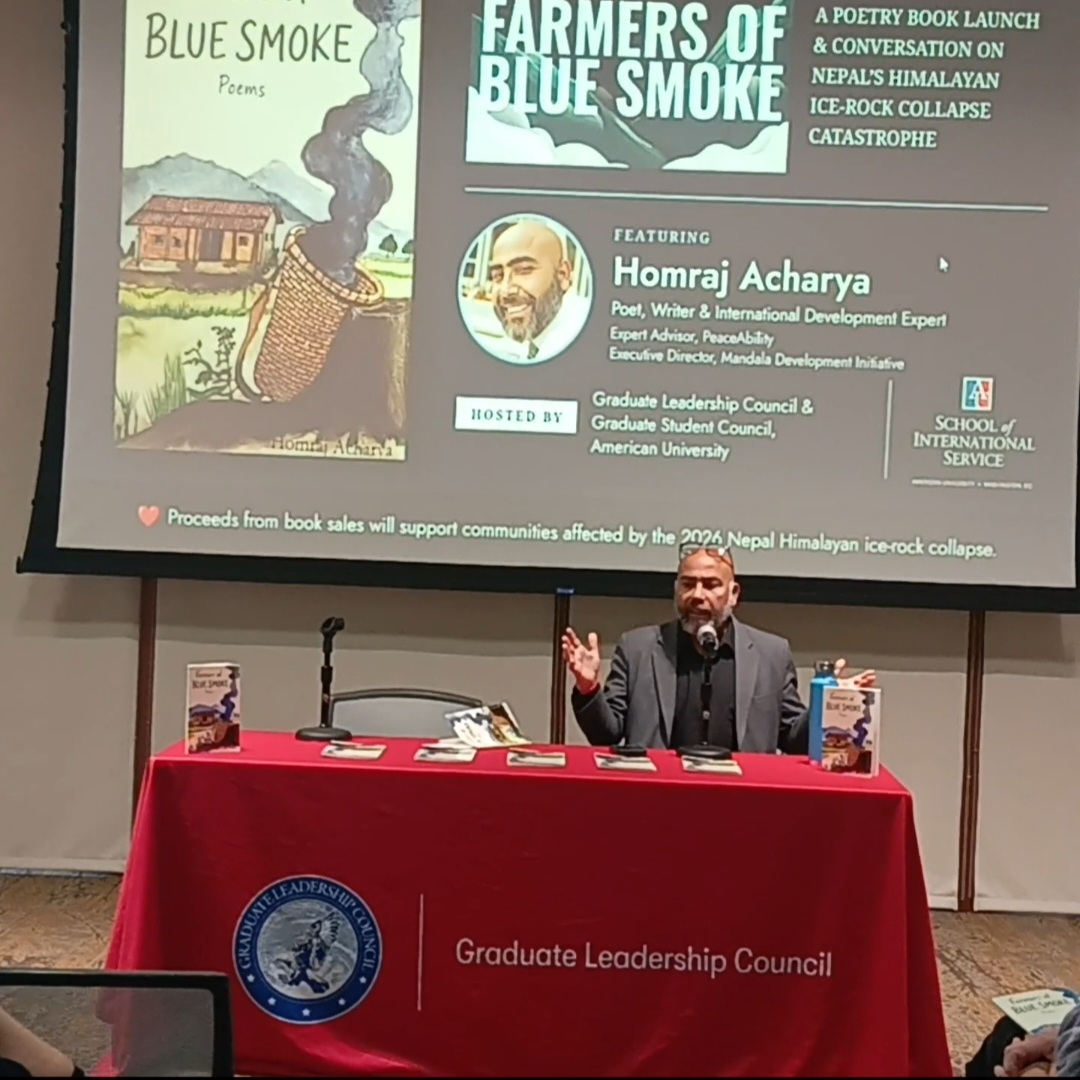
Together, these efforts helped raise funds for communities affected by the disaster in Nepal. On October 6, the Graduate Leadership Council and Graduate Student Council at American University hosted a poetry book launch and conversation featuring Acharya and his collection, Farmers of Blue Smoke.
The event explored Nepal’s Himalayan ice-rock collapse catastrophe and the role of poetry in bringing attention to the experiences of vulnerable communities. Proceeds from book sales supported relief efforts for communities affected by the disaster.
On October 12, Acharya participated in “Voices from Nepal: Climate Justice, Rebuilding, and the Power of Storytelling,” organized by the South Asia Society, International Development Club, and Energy & Environment Club at Johns Hopkins University’s School of Advanced International Studies (SAIS).
The discussion highlighted Nepal’s disaster challenges, community resilience, and the role of storytelling in connecting public awareness with humanitarian action. Acharya, who has worked in international development for more than two decades, said the initiative sought to connect literary expression with humanitarian responsibility.
“Development reports can tell us how many people have died, how many homes have been destroyed and how much reconstruction will cost. But numbers alone cannot capture the human suffering behind these tragedies,” Acharya said.
His poetry collection, Farmers of Blue Smoke, explores poverty, caste discrimination, migration, child labor, environmental degradation, and human resilience, drawing on his experiences working with marginalized communities. Rooted in the villages, rivers, and farmlands of Nepal, the collection reflects on land, labor, migration, memory, and the challenges facing communities affected by environmental change.
Acharya emphasized that disaster recovery must extend beyond immediate humanitarian assistance to include rebuilding schools, restoring livelihoods, strengthening local institutions, and protecting vulnerable children from further disruption to their education.
He also highlighted the importance of diaspora engagement in supporting disaster-affected communities and strengthening Nepal’s long-term resilience to climate-related disasters. Expressing gratitude to those who attended the poetry events, purchased his book, and contributed to the fundraising effort, Acharya said the contribution represented a collective humanitarian effort.
“Although the amount is modest compared to the scale of destruction, it reflects the compassion and solidarity of everyone who supported this initiative. I am grateful that poetry could bring people together to make a meaningful contribution,” he said.
The initiative demonstrates how literary and cultural activities can mobilize communities across borders to support humanitarian relief and post-disaster recovery in Nepal, while creating opportunities for dialogue about the human consequences of disasters and the long-term work of rebuilding affected communities.


Comment