




KATHMANDU: Last week offered a revealing snapshot of Nepal at a moment when disaster, diplomacy, institutional reform and questions of justice converged. The devastating Bhotekoshi floods remained the dominant backdrop to national affairs, but the government’s response extended well beyond emergency relief.
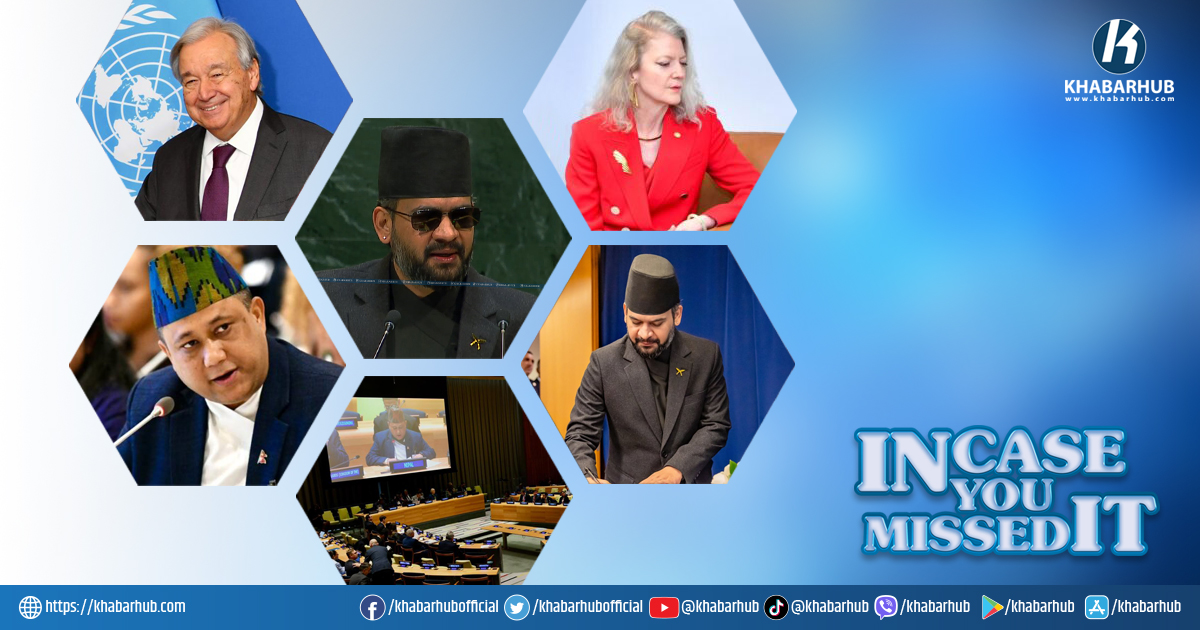
At the United Nations, Prime Minister Balendra Shah (Balen) sought to turn Nepal’s vulnerability into a diplomatic argument for climate justice. Foreign Minister Shisir Khanal carried the same message into international forums, while the United States announced additional assistance for Nepal’s recovery.
At home, the Supreme Court issued important rulings concerning police practices and presidential pardons, while the government continued to make institutional appointments and pursue economic and connectivity initiatives. The week therefore reflected two parallel aspects of Nepal’s current trajectory: an attempt to project a stronger voice abroad and a continuing effort to reshape governance at home.
Bhotekoshi disaster becomes the defining issue
The Bhotekoshi floods provided the immediate context for much of the week’s political and diplomatic activity. The scale of the disaster gave Nepal’s representatives at the United Nations a powerful real-world example with which to illustrate the consequences of climate change.
Prime Minister Shah’s decision to travel to New York despite considering cancellation was itself significant. The government abandoned the customary ceremonial farewell at the airport, including the guard of honour and other formalities, against the backdrop of the deaths and destruction caused by the floods.
That decision communicated that the government regarded the disaster as both a national emergency and an issue requiring international attention.
Shah subsequently made the Bhotekoshi disaster central to his UN address. His question—“The Bhotekoshi flood was a warning to the world, did you hear it?”—was designed to move the discussion beyond sympathy toward responsibility.
The underlying argument was familiar in international climate diplomacy but particularly relevant to Nepal: a country that contributes relatively little to global emissions can nevertheless face severe consequences from a changing climate.
The political significance of the argument lies in how the disaster was framed. Rather than treating the floods solely as an emergency requiring humanitarian assistance, Shah presented them as evidence of a structural failure in global climate action.
Climate diplomacy moves toward regional cooperation
Shah’s address also attempted to give Nepal a more active role in the regional climate debate. His proposal for a Himalayan Climate Resilience Mechanism involving Nepal, India and China was particularly notable. The idea recognizes that glaciers, rivers, floods and other environmental systems do not conform to political boundaries.
The proposal also reflects Nepal’s distinctive geographical position. The country sits between two major powers but shares ecological systems with both. Climate resilience could therefore provide an area of practical cooperation even when wider geopolitical relationships remain complicated.
For such an initiative to become meaningful, however, rhetoric would need to be followed by institutional arrangements. Data sharing, glacial monitoring, early-warning systems, emergency communications and coordinated disaster response would require sustained technical and political cooperation.
The proposal nevertheless gives Nepal a potentially useful diplomatic framework: rather than presenting the Himalayas only as a vulnerable region, it presents them as a region where cooperation is necessary.
From climate vulnerability to climate justice
Foreign Minister Khanal reinforced the same argument at the G7 Development Ministers’ Meeting.
His description of the Bhotekoshi disaster as a “stark warning from the Himalayas to the entire world” echoed the prime minister’s UN message. But Khanal placed greater emphasis on the practical requirements of recovery: climate finance, disaster preparedness, concessional financing, early-warning systems and international support.
The distinction between climate assistance through grants and assistance through loans is particularly important for developing countries. If countries already facing fiscal constraints must borrow extensively to recover from climate-related disasters, reconstruction can become part of a cycle of debt and vulnerability.
Khanal’s call for easier access to the Loss and Damage Fund therefore goes beyond Nepal’s immediate recovery needs. It reflects a wider debate over whether international climate-finance mechanisms are sufficiently accessible to countries facing severe climate risks.
The challenge is that climate finance remains an area of competing interests. Developing countries generally seek larger, faster and more accessible resources, while donor countries and financial institutions operate through procedures, conditions and competing priorities.
Nepal’s task is therefore twofold: to make a persuasive international case for greater support and to demonstrate that any resources received can be translated into resilient infrastructure and stronger local preparedness.
International assistance begins to take concrete form
The US announcement of an additional $31 million in assistance gave some practical substance to Nepal’s international appeal.
The package includes $10 million for permanent bridges, $8 million for water, sanitation, shelter, livelihoods and winterization support, and $13 million worth of US-made drones to strengthen disaster-response capacity.
The significance of the assistance goes beyond its monetary value. The proposed bridge support, for example, links disaster recovery with connectivity and economic activity. The provision of drones points toward a longer-term investment in disaster preparedness rather than simply post-disaster relief.
The announcement also demonstrates the difference between diplomatic appeals and concrete outcomes. Nepal’s climate diplomacy will ultimately be judged partly by whether international solidarity produces resources that reach affected communities and strengthen resilience before the next disaster.
The Supreme Court and the question of state power
While climate diplomacy dominated Nepal’s international agenda, important developments were also taking place within the country’s legal and institutional framework.
The Supreme Court’s interim order restricting arbitrary use of handcuffs represents an important statement about the treatment of people in state custody.
The court did not prohibit handcuffs in every circumstance. Instead, it directed police to assess the necessity of their use on a case-by-case basis, considering factors such as the possibility of escape, violent behaviour or risks to the individual or others.
The ruling places greater emphasis on proportionality and documentation. Where handcuffs are considered unavoidable, police must record the reason. This has implications beyond police procedure. It raises broader questions about how a democratic state exercises coercive authority and how constitutional guarantees of personal liberty and dignity should operate in practice.
The case also highlights the importance of institutional standards. When laws leave significant discretion to authorities, clear procedures can help prevent routine practices from becoming normalized.
Presidential pardon ruling closes another legal dispute
The Supreme Court’s decision to dismiss the challenge to the presidential pardon granted to Resham Lal Chaudhary also brought renewed attention to the constitutional powers surrounding pardons. The case involved the presidential decision to pardon Chaudhary, who had been convicted in connection with the 2015 Tikapur incident.
The ruling does not erase the controversy surrounding the pardon. Rather, it establishes the court’s decision in the particular legal challenge brought against it. The case illustrates the difficult intersection of constitutional authority, criminal justice, political reconciliation and victims’ concerns.
Nepal’s experience with pardons has repeatedly demonstrated that the exercise of constitutional powers can generate political and social debate even when formal procedures are followed. The issue is therefore larger than the individual case: it concerns how a state balances legal punishment, executive authority and broader considerations of reconciliation.
Passport contract dispute highlights institutional credibility
The Supreme Court’s decision to uphold the passport printing contracts awarded to German companies also brought procurement and institutional credibility into focus.
The disputed contracts had been challenged by French company IDEMIA, which questioned the procurement process. The court ultimately upheld the decision to award the contracts to the German companies.
The case had acquired political significance because allegations of irregularities had emerged around the procurement process, while a separate corruption investigation had also followed.
The court ruling settles the legal challenge to the contracts, but the episode illustrates a broader institutional issue: large public procurements require not only technically sound decisions but also procedures capable of withstanding scrutiny from competing companies, oversight bodies and the public.
For Nepal, the credibility of public procurement is particularly important because major contracts often involve substantial public resources and long-term commitments.
Government seeks to establish a different political tone
Another recurring theme of the week was the Shah government’s effort to distinguish itself from previous administrations. The prime minister’s decision to avoid a ceremonial airport farewell before departing for the UN was one example. His emphasis on disaster and climate issues at the UN was another.
Such gestures are politically meaningful because they seek to establish a governing style based on urgency, directness and reduced ceremonialism.
But political symbolism can only go so far. The government’s credibility will increasingly depend on its ability to translate this style into institutional performance. That means faster disaster response, effective reconstruction, transparent procurement, stronger public services and credible implementation of the reforms being discussed.
Institutional appointments and the role of regulation
The appointment of Santosh Shrestha as chairman of the Advertising Board was another relatively low-profile but relevant development.
The advertising sector sits at the intersection of media, commerce and public regulation. The government’s emphasis on making the sector more systematic suggests that regulatory institutions remain an important component of its broader governance agenda.
The appointment also reflects the government’s reliance on individuals with professional experience in the sector. Whether such appointments produce meaningful reform will depend on the independence, authority and performance of the institutions concerned.
Pokhara takes a step toward international connectivity
The start of regular Flydubai flights between Dubai and Pokhara offered a contrastingly positive development amid a week dominated by disaster and institutional questions. Pokhara International Airport has faced a longstanding challenge: infrastructure was completed, but sustained international connectivity remained limited.
Regular Dubai service could therefore have significance beyond aviation. Dubai is a major international transit hub, and a more reliable connection could benefit tourism, business and Nepali travelers. Yet the service’s long-term significance will depend on passenger demand, route sustainability and the ability of the airport to attract additional international operators.
For Pokhara, the central question is no longer simply whether the airport can receive international flights. It is whether international connectivity can become commercially sustainable.
A week of warning, response and institutional testing
Taken together, last week’s events reveal a Nepal confronting several interconnected challenges.
The Bhotekoshi disaster forced climate vulnerability to the center of the national agenda. The prime minister and foreign minister used the disaster to press for greater international responsibility, while US assistance demonstrated how diplomatic engagement can translate into practical support.
At the same time, Supreme Court rulings highlighted questions about how state power is exercised domestically—from the treatment of arrested persons to the use of presidential pardon powers. The passport procurement case underscored the continuing importance of transparent and legally robust public administration.
Meanwhile, the government’s decision-making style and the launch of regular international flights from Pokhara pointed toward a broader attempt to project a different political and economic direction.
The common thread is implementation.
Nepal has no shortage of policy arguments, diplomatic appeals or institutional decisions. The more difficult task is turning them into durable systems. Climate resilience requires functioning early-warning networks and infrastructure. International assistance requires effective reconstruction. Legal protections require compliance by state institutions. Procurement decisions require public confidence. And new connectivity requires sustained commercial operation.
Last week, Nepal made several important arguments about the kind of country it wants to be: more climate-resilient, more assertive diplomatically, more attentive to individual rights and more connected economically. The coming months will show whether those arguments become measurable changes on the ground.




Comment