




Tribhuvan University (TU), Nepal’s largest and oldest university, is at a critical juncture. With more than 500,000 students enrolled across hundreds of constituent and affiliated campuses, the university’s highly centralized administrative structure has increasingly struggled to respond to the demands of modern higher education. Administrative bottlenecks, examination delays, and the politicization of university affairs have become persistent challenges.
This situation calls for structural reform rather than incremental adjustments. The Government of Nepal should begin the process of “unbundling” Tribhuvan University by granting greater autonomy to mature institutes that have the capacity to function as independent universities.
The Institute of Engineering (IOE) should be the first and most urgent candidate for this transition. Its transformation into an autonomous national University of Engineering and Technology (UET) would provide Nepal with an opportunity to modernize technical education, strengthen research capacity, deepen industry collaboration, and address the continuing outflow of engineering talent.
Why IOE Should Lead the Transition
Engineering education is fundamentally different from many other areas of higher education. It requires curricula that can evolve rapidly, close engagement with industry, substantial investment in laboratories and research, and the ability to respond quickly to technological change.
Under the existing centralized governance structure of TU, many decisions affecting engineering education must pass through multiple layers of administration. This can limit the ability of IOE to respond quickly to emerging academic and technological needs.
Administrative delays
Decisions related to faculty recruitment, international research collaboration, procurement of laboratory equipment, academic programs, and examination administration can be slowed by centralized procedures.
For an institution operating in rapidly changing fields such as artificial intelligence, renewable energy, advanced structural engineering, robotics, and other emerging technologies, such delays can have significant consequences.
Curriculum development
Engineering curricula need to be updated continuously to reflect technological developments and changing industry requirements. Under the current system, introducing new courses or revising existing programs can require lengthy administrative processes.
An autonomous university would have greater authority to develop and revise curricula in a timely manner while maintaining appropriate academic standards and quality assurance.
Research and brain drain
Nepal continues to lose talented students, researchers, and faculty members to universities abroad. While many factors contribute to this trend, limited research opportunities, inadequate facilities, and institutional constraints are among the issues that need to be addressed.
Greater institutional autonomy could allow UET to develop stronger research programs, attract competitive funding, establish international partnerships, and create an environment in which talented academics and students can pursue advanced work within Nepal.
What Institutional Autonomy Could Deliver
Transforming IOE into an autonomous University of Engineering and Technology would not simply involve changing its name. It would require granting the institution meaningful academic, administrative, and financial authority.
Academic innovation
UET could have the authority to regularly revise academic programs, establish specialized postgraduate fields, develop joint-degree programs with international universities, and introduce interdisciplinary programs in emerging areas of science and technology.
Such flexibility would allow the university to respond more quickly to both national development priorities and global technological trends.
Financial flexibility and resource mobilization
An autonomous institution could develop a more flexible framework for mobilizing resources. This could include public-private research partnerships, industry consultancy, competitive research grants, alumni endowments, and other legitimate sources of revenue.
Greater financial autonomy should, however, be accompanied by strong transparency, independent auditing, and public accountability.
Operational efficiency
A university dedicated specifically to engineering and technology could establish academic calendars and examination systems suited to its programs. Greater administrative autonomy could help ensure that examinations are conducted on schedule and that results are published without being affected by administrative problems elsewhere in the university system.
A Four-Step Roadmap for Establishing UET
The transformation of IOE—including its Pulchowk, Thapathali, Eastern, Western, and Paschimanchal campuses—into a national University of Engineering and Technology could be undertaken through a phased process.
- Enact UET legislation
The Government of Nepal should draft and introduce a University of Engineering and Technology Act in Parliament. The legislation should clearly define the university’s academic, administrative, and financial autonomy, as well as mechanisms for quality assurance, accountability, transparency, and public oversight.
- Transfer assets and resources
The infrastructure, land, physical facilities, laboratories, equipment, and other relevant resources currently under IOE should be transferred to the newly established university through a transparent legal and administrative process.
The status, rights, and responsibilities of existing faculty and staff should also be clearly defined to ensure a smooth transition.
- Establish independent governance
UET should have an independent and professionally constituted governing structure. A Board of Governors could include senior academics, engineering and technology professionals, industry representatives, and distinguished alumni.
The objective should be to establish institutional accountability while protecting academic and administrative decision-making from undue political interference.
- Ensure a phased transition for students
Students currently enrolled under Tribhuvan University should be allowed to complete their degrees under the existing TU framework. At the same time, students entering the newly established university after its legal creation could be admitted to UET programs.
This approach would minimize disruption and provide a predictable transition for students, faculty, and staff.
UET as the Beginning of Wider TU Reform
The proposed establishment of UET should not be viewed as an isolated institutional change. Rather, it could become the first stage of a broader restructuring of Tribhuvan University.
Given the enormous scale and diversity of TU, a single centralized institution may no longer be the most effective model for managing the country’s higher education system. Over time, mature institutes and regional academic centers could be developed into specialized and regional public universities.
A broader restructuring could eventually lead to a network of perhaps 10 to 15 specialized and regional public universities, each with greater responsibility for its academic mission, resources, research, and regional development.
Such a transformation would not necessarily mean weakening public higher education. On the contrary, appropriately designed autonomy could strengthen institutional accountability, academic quality, and responsiveness.
A Necessary Policy Decision
Continuing with the existing structure without addressing its fundamental weaknesses risks limiting Nepal’s ability to compete academically and technologically. Technical education in particular requires institutions capable of moving at the speed of technological change.
Granting greater autonomy to a mature institution such as IOE should therefore be understood not simply as the fragmentation of Tribhuvan University, but as a potential evolution of Nepal’s public higher education system.
The Government should immediately constitute an expert committee comprising academics, engineers, legal experts, education policymakers, industry representatives, and other relevant stakeholders to prepare a draft UET Enabling Act and a detailed transition plan for consideration in the upcoming legislative session.
It is encouraging that Member of Parliament Hon. Sagar Dhakal has recently raised this issue in Parliament. Such parliamentary attention can help initiate a broader national discussion on the future structure of Nepal’s public universities.
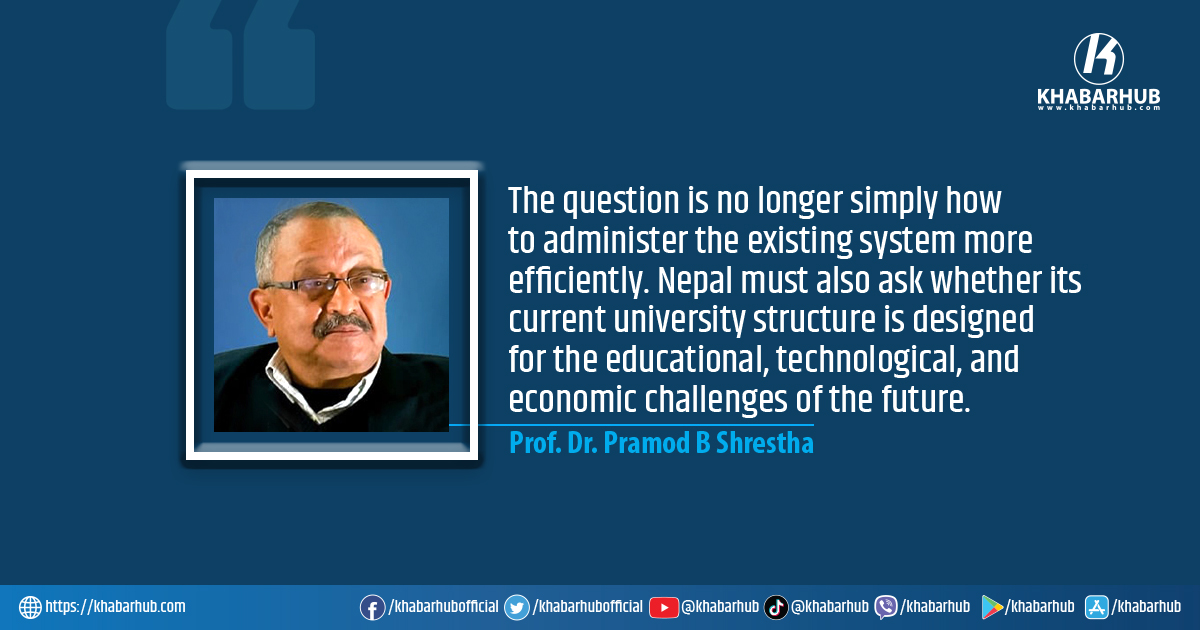
The question is no longer simply how to administer the existing system more efficiently. Nepal must also ask whether its current university structure is designed for the educational, technological, and economic challenges of the future.
The proposed University of Engineering and Technology could provide a practical starting point for answering that question.






Comment