




The Middle East conflict is often described through images of destruction, shattered cities, displaced families, political extremism, and generations raised under the shadow of war. From the Arab-Israeli conflict to the Syrian civil war and growing regional tensions involving Iran, Israel, and neighbouring states, the world has become accustomed to viewing the region primarily through the lens of crisis.
Yet if the international community is to move beyond endless cycles of reaction and blame, it must adopt a more constructive global response, one grounded in diplomacy, economic cooperation, humanitarian responsibility, and long-term institution building.
The first step toward a constructive response is recognising a difficult truth: there is no purely military solution to the region’s deepest conflicts.
History repeatedly demonstrates that even overwhelming military superiority cannot produce sustainable peace if political grievances remain unresolved. Decades of violence have shown that security built solely on force creates temporary stability at best and deeper resentment at worst. Ceasefires collapse, insurgencies re-emerge, and extremist ideologies thrive in environments where hopelessness becomes permanent.
This is why diplomacy must reclaim centre stage.
International actors often engage only after violence reaches catastrophic levels, treating diplomacy as emergency damage control rather than sustained preventive engagement. A more constructive approach would institutionalise regional dialogue involving rivals as well as allies.
Many regional crises worsened because political systems excluded ethnic, religious, or ideological groups from meaningful participation. Marginalisation breeds resentment, and resentment eventually destabilises entire nations.
Agreements such as the Camp David Accords and the Abraham Accords demonstrate that even deeply entrenched adversaries can move toward cooperation when incentives are aligned around security, trade, and development. While these agreements remain imperfect and controversial, they reveal an important lesson: sustained communication reduces the risk of perpetual escalation.
Equally important is the need to shift global attention from short-term military aid toward long-term human development.
Many Middle Eastern societies face persistently high youth unemployment, weak public institutions, corruption, and educational inequality. In several countries across the Middle East and North Africa, youth unemployment continues to exceed 25 percent, among the highest rates globally. These conditions create fertile ground for instability and extremism.
Young people deprived of economic opportunity are more vulnerable to recruitment by militant groups and political radicals. A constructive response from the international community would therefore prioritise investments in schools, digital infrastructure, vocational training, healthcare, and entrepreneurship.
Stability is not created only by borders and armies; it is built through functioning societies that offer dignity and opportunity.
The world should also recognise the extraordinary innovation that has emerged from adversity in the region.
Scarcity and insecurity have pushed countries to develop advancements in water conservation, renewable energy, emergency medicine, agriculture, and cybersecurity. Israel’s leadership in desalination and drip irrigation, for example, demonstrates how environmental pressure can drive transformative innovation.
Rather than isolating these advancements within geopolitical rivalries, nations should promote collaborative scientific partnerships that benefit the wider world, particularly as climate change intensifies global water and food insecurity.
The region remains among the most water-stressed in the world, making environmental vulnerability increasingly intertwined with political instability.
Another essential component of a constructive response is humanitarian responsibility.
The conflicts in the Middle East have produced one of the largest refugee crises in modern history. According to the UNHCR, more than 13 million Syrians alone have been displaced since the outbreak of the Syrian conflict, while millions more have fled violence in Iraq, Yemen, and elsewhere in the region.
Countries such as Lebanon and Jordan continue to host some of the world’s largest refugee populations relative to their economic capacity. Yet refugees too often become political symbols rather than human beings deserving protection and opportunity.
A constructive global response requires greater international coordination in refugee resettlement, access to education, employment integration, and humanitarian funding. Refugees should not remain trapped in permanent uncertainty for generations.
At the same time, the international community must confront the destructive role of proxy warfare.
External powers have repeatedly fuelled conflicts by supporting armed factions for strategic advantage. Competing regional and global interests have transformed local disputes into prolonged geopolitical battlegrounds, devastating civilian populations while deepening mistrust between nations.
Constructive engagement means reducing incentives for proxy escalation and creating stronger international accountability mechanisms for external interference. Great powers cannot credibly claim to support peace while simultaneously enabling endless militarisation.
The role of information and media also deserves urgent attention.
Modern conflicts are fought not only on battlefields but across digital platforms where misinformation, propaganda, and sectarian narratives spread rapidly. Social media can amplify hatred faster than diplomacy can contain it.
A responsible global response should therefore include greater investment in media literacy, independent journalism, and transparent public communication. Citizens worldwide must increasingly learn to distinguish facts from manipulation, particularly in emotionally charged geopolitical crises where false narratives can inflame violence across borders.
But that future depends on whether global powers continue to treat the region as an arena for competition or begin treating it as a shared responsibility demanding cooperation, restraint, and long-term vision.
Perhaps the most overlooked lesson from Middle East conflicts is the importance of inclusive governance.
Many regional crises worsened because political systems excluded ethnic, religious, or ideological groups from meaningful participation. Marginalisation breeds resentment, and resentment eventually destabilises entire nations.
Governments that protect minority rights, encourage civic participation, and build trust across communities are more resilient during periods of crisis. The international community should consistently support governance reforms rooted in accountability, judicial independence, and equal citizenship rather than backing authoritarian stability for short-term convenience.
Economic integration may ultimately offer one of the strongest foundations for peace.
The Middle East remains central to the global economy, accounting for roughly one-third of global oil production and serving as a critical crossroads for trade, energy flows, and maritime transport. Nations deeply connected through trade, infrastructure, energy systems, and investment are less likely to benefit from prolonged conflict.
Europe’s post-war transformation demonstrated how economic cooperation can reduce the appeal of conflict between former adversaries. The Middle East possesses similar potential through regional energy partnerships, transportation corridors, technology hubs, and climate cooperation.
Instead of treating the region solely as a security problem, global powers should help create frameworks for shared prosperity.
Ultimately, a constructive global response to the Middle East conflict requires moral consistency.
Civilian suffering must matter equally regardless of nationality, religion, or political alignment. Selective outrage undermines international credibility and fuels perceptions of hypocrisy. Human rights, humanitarian law, and the protection of civilians cannot be applied selectively according to geopolitical interests.
If the world wishes to contribute meaningfully to peace, it must demonstrate fairness not only in words but in policy.
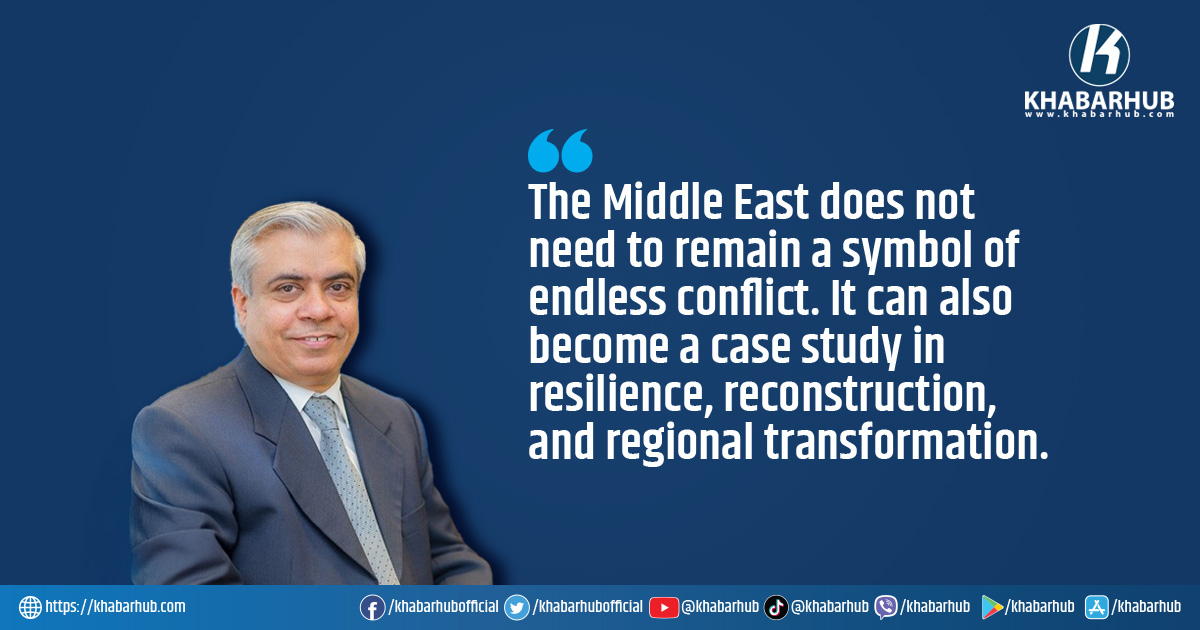
The Middle East does not need to remain a symbol of endless conflict. It can also become a case study in resilience, reconstruction, and regional transformation.
But that future depends on whether global powers continue to treat the region as an arena for competition or begin treating it as a shared responsibility demanding cooperation, restraint, and long-term vision.
The choice before the international community is increasingly clear: perpetuate cycles of destruction or invest seriously in the difficult, patient work of peace.
(Manmohan Parkash is a former Senior Advisor in the Office of the President and former Deputy Director General for South Asia at the Asian Development Bank (ADB). Views expressed are personal.)





Comment