




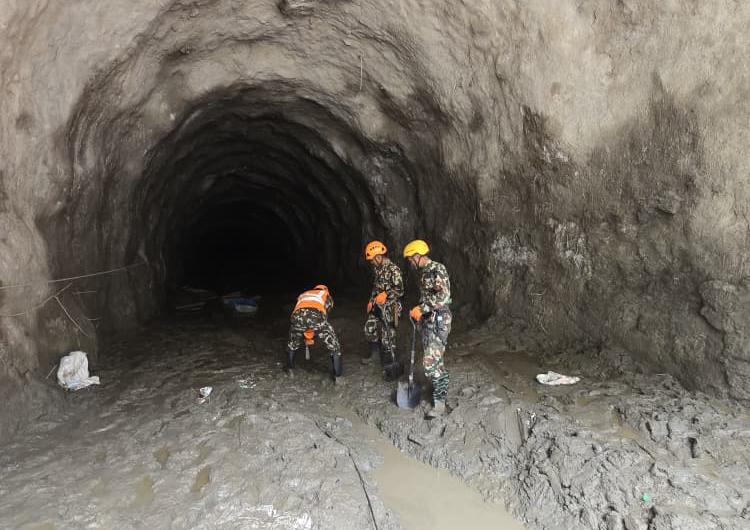
KATHMANDU: The Nepali Army has described tunnel-based search and rescue operations as the most challenging aspect of the disaster response following the Bhotekoshi-Trishuli floods.
Following extensive efforts, seven people were rescued alive from inside hydropower project tunnels.
On September 4, the tenth day after the disaster, two people were rescued from the Trishuli-3A project. The rescue operation involved drilling machines, excavators, rock breakers, controlled blasting and oxygen pumps.
A Chinese national trapped 225 metres underground in the audit tunnel of the Upper Trishuli-1 project was rescued with the help of a rubber boat and a thermal camera. Later, 37 bodies were recovered from the site.
At the Chilime tunnel, five bodies and human remains were recovered after an alternative route of around 1,050 metres was excavated to reach the tunnel.
Search and excavation operations were also carried out at Rasuwagadhi and Trishuli-3B. Personnel and equipment from neighbouring and other friendly countries also assisted in the tunnel rescue operations.
For healthcare assistance, emergency treatment centres were established in Trishuli and Dhunche, while medical patrols were conducted, providing direct medical services to 4,003 people.
Those rescued with severe injuries were airlifted to Birendra Hospital in Chhauni, Kathmandu.
Displaced people were accommodated in temporary shelters and relief camps. A sanitation campaign was also conducted to prevent possible outbreaks of waterborne and other infectious diseases in the affected areas.
Regarding infrastructure restoration, a 60-metre-long Bailey bridge with a load capacity of 60 tonnes was installed over the Tadi River at Devighat, Nuwakot, within five days and brought into operation on September 10.
Temporary means of transportation, including tuins (traditional ropeways) and wooden bridges, were repaired at Syaphrubesi-Chilime and Indrenighat. Work also progressed on preparing access roads for the construction of a Bailey bridge at Betrawati.
The Nepali Army concluded that the Bhotekoshi-Trishuli floods highlighted the need to view disaster response not simply as a routine administrative task, but as a joint operation involving significant risks and uncertainties and requiring effective coordination among multiple agencies.
According to the Nepali Army, coordination and collaboration among the Nepali Army, Nepal Police, Armed Police Force, local administration, local governments and communities under government direction played a crucial role in rescue, relief, healthcare and rehabilitation efforts.


Comment