




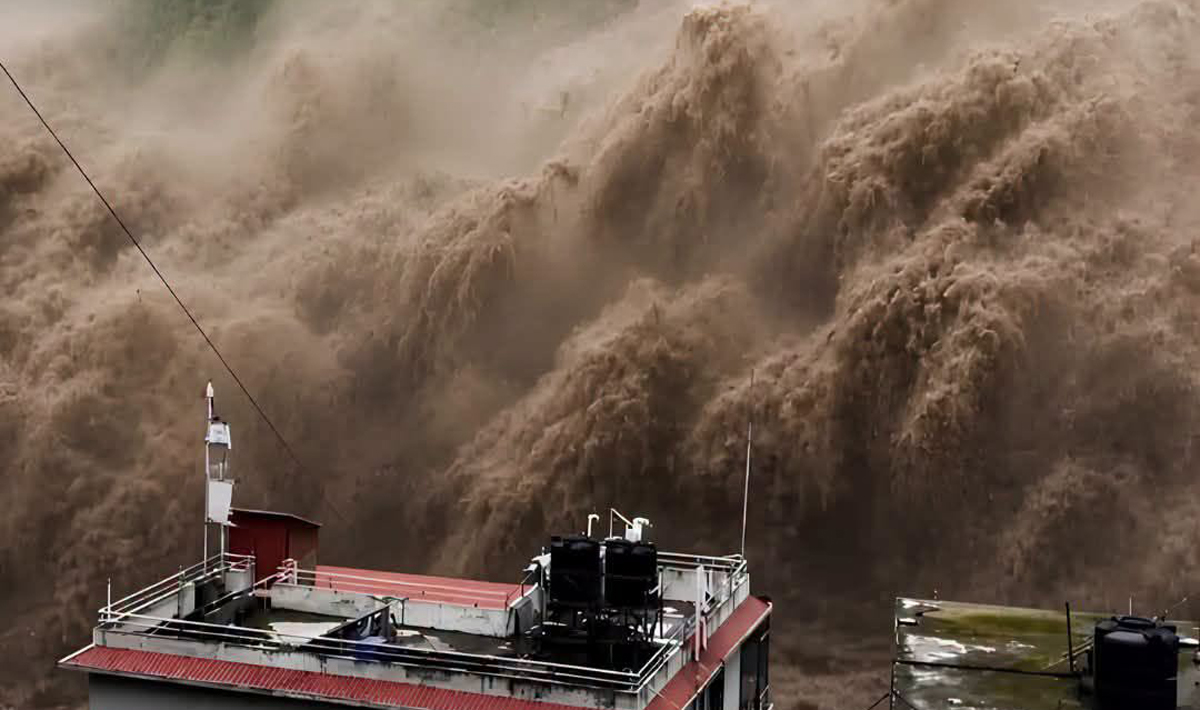
KATHMANDU: The devastating flood that struck Nepal on Wednesday caused extensive loss of life and property, while the Kerung (Gyirong) border port in Kerung County of Shigatse City in China’s Tibet Autonomous Region also suffered significant damage, according to Chinese experts.
A massive debris flow triggered by a landslide at around 10:30 am on Wednesday caused extensive destruction in the Kerung port area. More than 300 people have reportedly been reported missing on the Chinese side.
Experts from China’s Ministry of Natural Resources said the disaster was triggered by the collapse of a large mass of glacier ice in Nepal’s high Himalayan region.
According to the experts, as the large ice mass rapidly descended from the mountains, it swept up glacial soil, rocks and debris along its path, transforming into an extremely fast-moving and destructive debris flow.
The flood then entered the Kerung Changbo River and reached the Kerung port area, where it caused extensive damage before continuing downstream towards Nepal.
Muo Chaocheng, director of the Geological Disaster Research and Monitoring Centre under the China Aero Geophysical Survey and Remote Sensing Centre, said the debris flow generated by the collapse of the glacier was the primary cause of the disaster.
He said a large mass of ice collapsed in the high mountainous region and rapidly descended, carrying glacial soil, rocks and debris from the river channel along with it.
The high-speed debris flow continued to expand as it moved along the river, damaging structures in the port and surrounding border areas.
According to Muo, similar incidents have occurred in the Qinghai-Tibet Plateau in the past, although they are considered extremely rare. He cited the February 7, 2021 disaster in Chamoli, Uttarakhand, India, as an example of a similar event.
He said such events could have a greater destructive impact than glacial lake outburst floods (GLOFs), as collapsing glacier masses can generate greater destructive force and affect areas over longer distances.
Chinese experts estimate that the debris flow that struck the Kerung area travelled at a speed of around 50 metres per second.
Due to its extremely high speed, people had very little time to respond, while the impact extended across an area of more than 20 kilometres.
Muo said disaster risk reduction and preparedness measures on the Qinghai-Tibet Plateau should account for extremely severe and unprecedented scenarios.
He added that disaster prevention, safety standards and preparedness measures in the region need to be more stringent than those applied in China’s inland areas given the region’s unique geographical and climatic risks.






Comment