




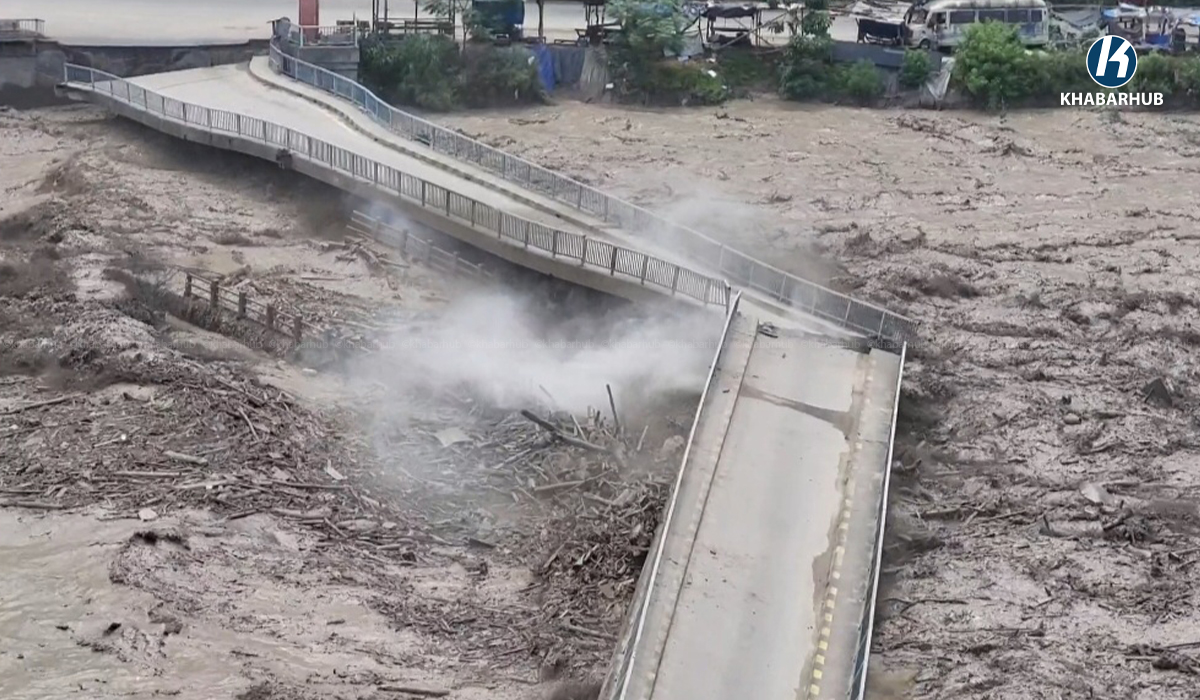
KATHMANDU: The devastating flash flood in the Bhotekoshi River triggered by a landslide and glacial collapse in Tibet on Wednesday has caused extensive damage to infrastructure across Nepal’s northern border areas and downstream corridors.
Physical Infrastructure Minister Sunil Lamsal said preliminary estimates put the damage to Nepal’s infrastructure sector alone at more than Rs 200 billion.
The flood has caused unprecedented destruction to roads linking major trade routes, bridges, customs infrastructure and hydropower projects.
32 strategic bridges destroyed, roads disrupted
The intense flow of floodwater carrying rocks, mud and debris swept away or severely damaged bridges and roads in Rasuwa, Nuwakot and Dhading.
According to the Department of Roads, 32 bridges in the three districts have been completely washed away.
Among the destroyed bridges are the historic Friendship Bridge at Rasuwagadhi, Timure bridges 1 and 2, the Bhotekoshi and Chilime Khola bridges in Chilime, Syafrubesi Bridge, and five bridges in the Trishuli and Mailung areas of Rasuwa.
In Nuwakot, the old and new Betrawati bridges, the Trishuli River bridge at Tupche, two bridges in Trishuli Bazaar, Simchaur Bridge, the Mid-Hill Highway bridge at Devighat, two Tandi Khola bridges and four other bridges over the Trishuli River have been swept away.
In Dhading, the Syaltār road bridge, Ghatbesi Bridge, Phurke Khola Bridge at Malekhu and two bridges over Kolpu Khola have been completely destroyed. Master Bridge, Jarebagaincha Bridge and the new Kolpu Khola bridge have also sustained partial damage.
A 40-kilometre strategic road section connecting Betrawati in Nuwakot with the Rasuwagadhi border point has been completely damaged.
The road linking Betrawati through Mailung and Syafrubesi to Rasuwagadhi has been severely damaged, while around 10 kilometres of road between Galchhi and Trishuli remains closed.
Around 13 kilometres of the Prithvi Highway has also been covered with mud and debris. Clearing the debris and reopening the road has been prioritised.
Officials said 41 bridges have been completely damaged. The government has seven Bailey bridges of up to 50 metres in length and is preparing to install them at locations where feasible. India and China have also expressed their readiness to provide Bailey bridges if required.
Authorities are prioritising the reopening of the Prithvi Highway and reconnecting Rasuwa with the national road network. Preparations are underway to install a Bailey bridge at Betrawati.
Until the road to Betrawati is reopened, access to Dhunche and Syafrubesi remains difficult.
Twenty pieces of equipment—10 provided by the government and 10 by the private sector—have been deployed to accelerate debris clearance and road restoration.
431.1 MW of electricity knocked out
The flood has also caused major damage to operational and under-construction hydropower projects along the Bhotekoshi and Trishuli river corridors.
According to the Nepal Electricity Authority and the Ministry of Energy, Water Resources and Irrigation, 12 power generation facilities have been shut down, taking 431.1 MW of electricity out of the national grid.
This represents around 10 percent of the country’s total electricity generation capacity.
Among the major operational projects affected are the 111 MW Rasuwagadhi Hydropower Project, 78 MW Sanjen Khola, 60 MW Upper Trishuli 3A, 22 MW Chilime, 20 MW Langtang, 24 MW Trishuli, 14 MW Devighat and the Nepal Electricity Authority’s 25 MW solar project.
Several hydropower projects under construction have also suffered significant damage.
220 kV substation destroyed
The flood has damaged not only power plants but also electricity transmission and distribution infrastructure.
According to the Nepal Electricity Authority, the Trishuli 3B Hub 220 kV substation in Nuwakot has been completely destroyed.
A tower at the Chilime 220 kV hub has also collapsed, while the Samundratar–Trishuli 132 kV transmission line, Chilime–Trishuli 66 kV line, Chilime Hub–Trishuli 3B Hub–Matatirtha 220 kV line and Trishuli–Balaju 66 kV line have been disrupted.
The authority has arranged alternative power supplies to most essential facilities in Nuwakot following disruptions to the regular electricity network.
Electricity has been supplied to affected areas by charging 66 kV lines from Dhading, Kathmandu and Sindhupalchok at 11 kV.
Rasuwagadhi customs and dry port devastated
The first wave of the flood completely destroyed the physical infrastructure of the Rasuwagadhi Customs Office at Nepal’s main northern border point with China.
According to the Ministry of Finance, the customs office and infrastructure in the dry port area have suffered extensive damage.
The Nepal Truck Transport Entrepreneurs’ Federation said around 100 cargo containers parked at the Timure customs yard and Betrawati area, many carrying goods imported from China for upcoming festivals, were swept away.
Around 200 electric vehicles kept at the customs yard for clearance were also reportedly swept away by the flood, according to customs chief Rajendra Prasad Dhungana.
87 telecom towers affected
Telecommunications infrastructure in Rasuwa, Nuwakot and Dhading has also been severely affected by the disaster.
Floods and landslides have disrupted 87 telecommunications towers in the affected areas.
According to Nepal Telecom, 60 of the 152 communication sites in the flood-affected areas remained out of operation as of Thursday, according to the Ministry of Communications.
The scale of destruction has disrupted transport, electricity, telecommunications and cross-border trade infrastructure, while authorities continue efforts to restore essential services and connectivity in the affected areas.



Comment