




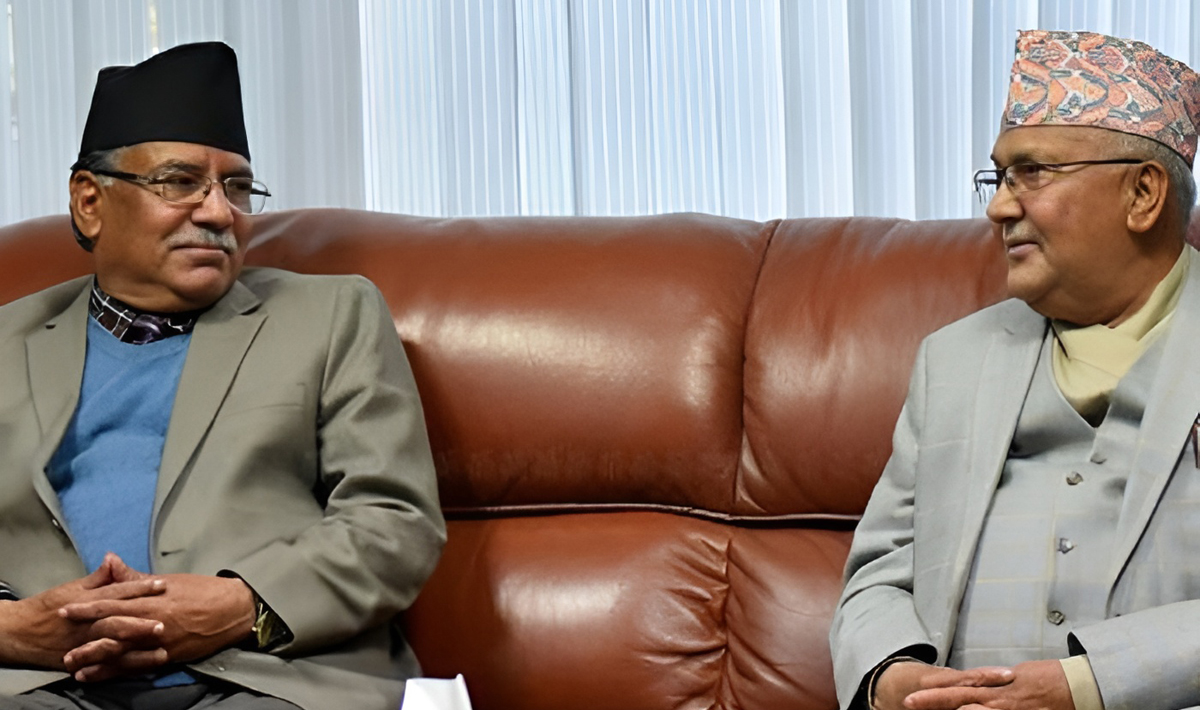
KATHMANDU: Nepal’s communist politics has entered another phase of realignment after the CPN-UML and Nepali Communist Party (NCP) agreed to revive political cooperation, 754 days after their previous partnership collapsed.
UML Chair KP Sharma Oli and NCP Coordinator Pushpa Kamal Dahal ‘Prachanda’ signed a three-point written agreement on Saturday at Oli’s residence in Gundu, Bhaktapur, paving the way for new coalition governments in several provinces.
The agreement focuses primarily on forming new provincial governments through alliance between the two parties. Under the proposed arrangement, UML will lead governments in Koshi, Bagmati and Lumbini provinces, while NCP will take the chief ministerial positions in Karnali and Sudurpaschim provinces.
In Madhesh and Gandaki provinces, the two parties do not have enough seats to form governments independently. The agreement states that discussions will be held with other political parties to decide leadership and participation in those provinces.
The latest cooperation marks another chapter in the long and turbulent relationship between Oli and Prachanda, whose political partnership has repeatedly shifted between alliance and confrontation.
The two parties had first contested the 2017 parliamentary election together before merging to form the Nepal Communist Party (NCP) in 2018. However, the party collapsed after the Supreme Court invalidated the NCP name in 2021, leading to the return of UML and Maoist forces as separate entities.
The two leaders again joined hands after the 2022 election, but their cooperation lasted only two months. Their latest confrontation came after the July 2024 agreement between Nepali Congress and UML that removed Prachanda from government leadership.
Political changes following the Gen Z movement have further altered Nepal’s political landscape. While no traditional party currently leads the federal government, provincial governments have continued to face instability due to shifting alliances.
The recent tensions between Congress and UML, particularly over budget disputes and power-sharing arrangements in provinces like Sudurpaschim and Karnali, created the environment for renewed cooperation between UML and NCP.
Leaders from both parties have described the agreement as a “necessity” rather than a strategic partnership, arguing that it is aimed at preventing provincial governments from collapsing.
NCP leaders Narayan Kaji Shrestha and Barsha Man Pun said cooperation with UML was needed to avoid constitutional complications and political deadlock, particularly after disputes between Congress and UML threatened provincial stability.
UML leader Pradeep Gyawali said the parties were attempting to move forward by learning from past mistakes.
Limited enthusiasm within both parties
Despite the agreement between the two top leaders, the alliance has not generated significant enthusiasm among party cadres.
Several leaders from both sides have either remained silent or publicly expressed dissatisfaction. NCP Co-chair Madhav Kumar Nepal is reportedly unhappy with the agreement, claiming that he was informed discussions with Oli would only focus on possible dialogue rather than an immediate provincial power-sharing deal.
UML leader Kiran Gurung also expressed dissatisfaction through social media, warning leaders not to pursue decisions that could weaken themselves or their parties.
Other leaders, including UML’s Surya Thapa and NCP’s Birendra Basnet, have questioned whether the agreement represents genuine political cooperation or merely a temporary arrangement.
A struggle for political survival
The renewed cooperation comes at a time when Nepal’s communist forces are facing one of their weakest political positions since 1990.
The Gen Z movement of September 2025 and the subsequent parliamentary election significantly reshaped Nepal’s political balance, pushing several traditional parties into a defensive position.
With UML and NCP losing considerable influence at the federal level, provincial and local governments have become crucial platforms for maintaining political relevance.
Observers say the alliance may also be influenced by upcoming local and provincial elections, although the agreement itself does not mention electoral cooperation.
Both UML and NCP leaders have clarified that immediate party unification is not on the agenda. However, they have suggested that issue-based cooperation could eventually create conditions for deeper political alignment.
A test of trust between Oli and Prachanda
The biggest challenge for the alliance remains the history of mistrust between Oli and Prachanda.
Previous partnerships between the two leaders collapsed largely due to disputes over power-sharing and leadership control. Their last fallout was marked by sharp personal criticism, with Prachanda accusing Oli of betrayal after UML later partnered with Nepali Congress.
Analysts say the latest cooperation will determine whether Nepal’s communist forces can rebuild political strength or whether it will become another short-lived arrangement driven only by power calculations.
The UML-NCP alliance now faces the challenge of proving whether it can bring stability to provincial governments and restore public confidence—or repeat the cycle of unity followed by division that has defined Nepal’s communist politics in recent years.




Comment