




Education, the foundation of all development initiatives, is at Sustainable Development Goal 4. It is said that a child who successfully navigates the school system is far more likely to secure a stable income, make informed life decisions, resist early marriage or harmful social practices, as well as champion gender and social justice.
Nepal’s legal architecture reflects this via the Constitution of Nepal 2015, which guarantees education as a fundamental right in Article 31. This mandate is heavily reinforced by other frameworks: the 16th Periodic Plan, the Act Relating to Free and Compulsory Education (2075), the National Education Policy (2076), and the 25-Year Long-Term Vision (Vision 2100 BS).
While looking closely at the recent 2082/83 national budget, a stark reality emerges where national ambition seems legally sound but financial execution is practically impossible.
As per the UNESCO Education 2030 Framework, it is recommended that allocation of 15–20% of the total national budget or 4–6% of GDP should be in the education sector. Nepal’s education budget for FY 2083/84 shows that total allocation for the education sector is NPR 218.30 billion, which is just 10.28%.
A municipality should receive its next tranche of infrastructure or training funds because its Grade 5 retention rate improved or its IEMIS data was updated on time, not simply because a new fiscal year began.
While this represents a nominal increase over previous years, it falls short of international benchmarks. As Nepal prepares to graduate from Least Developed Country (LDC) status, this funding deficit is not a minor statistical rounding error; rather, it stands as a structural barrier threatening to derail the 10-year School Education Sector Plan (SESP) and the 16th Periodic Plan.
The crisis is not just the size, but how it is distributed. The current composition of the education budget reveals a rigid structural trap where operational survival starves qualitative growth. The current education expenditure pattern shows a strong concentration of resources in human resources costs, with teachers’ salaries forming the largest share of the budget at NPR 133.80 billion, or 61.3 percent of total education spending.
This reflects the dominant cost structure of the education system, where human resources account for the bulk of recurrent expenditure. Administrative staff salaries constitute a smaller yet significant portion, amounting to NPR 11.50 billion, or 5.3 percent of the total allocation.
It is evident that salaries for teachers and administrators take more than two-thirds of the overall education budget, indicating that the education system is heavily focused on human resources.
In the recent budget, 25.7% of the total education budget is allocated for operational costs, higher education, and the midday meal program. This indicates that the budget covers essential system-level student support mechanisms, which are the second-largest expenditure in the education budget.
Targeted scholarships account for NPR 8.60 billion, representing 3.9 percent of total spending. This allocation aligns with the access and equity objectives of SESP. Investment in science, technology, and AI-related research remains limited at NPR 4.00 billion, or 1.8 percent of the budget.
Similarly, teacher mentoring, coaching, and continuous professional development receive NPR 3.20 billion, accounting for 1.5 percent, suggesting relatively modest emphasis on instructional quality improvement mechanisms. Likewise, school infrastructure audit and repair are allocated NPR 1.00 billion, which is only 0.46 percent of total expenditure.
This indicates that infrastructure monitoring and maintenance receive the smallest share of the current budget, despite their importance for ensuring safe and functional learning environments in remote contexts of Nepal.
Salaries and administration take nearly 67% of the entire budget. This may be a political and legal reality because salaries cannot be compressed. In fact, recent adjustments saw a 21% increase in the salary component. However, when the overall budget ceiling remains low, this fixed expansion directly affects the vital inputs required to make teaching effective.
It seems that the infrastructure sector is underfunded (0.46%). Less than half a percent is left for school infrastructure. Consequently, thousands of community schools lack the basic Minimum Enabling Conditions (MEC) defined by the SESP: safe classrooms, clean drinking water, timely textbooks, and Gender Equality, Disability, and Social Inclusion (GEDSI)-friendly WASH facilities.
It also seems that teachers’ professional development funding (1.5%) is shadowed. High-performing global education systems invest 2% to 3% of their budgets purely in continuous classroom mentoring and coaching. Nepal spends half of that, leaving teachers without the tools.
The difference between policy and finance becomes dangerously sharp under the Act Relating to Compulsory and Free Education (2075). The law guarantees free, compulsory basic education (up to Grade 8) and free secondary education (up to Grade 12). But the deficit seems high. Fully implementing this mandate nationwide might require an estimated additional NPR 230 billion, a sum larger than the entire current national education budget.
Realistically, it is not possible to double Nepal’s revenue overnight, so it must abandon a “one-size-fits-all” approach. Nepal must adopt a phased implementation, prioritizing highly vulnerable municipalities and groups first rather than spreading thin resources invisibly throughout the country.
The free and compulsory education strategy’s hard legal deadline is fast approaching on 1st Baisakh 2085. By this date, the law stipulates that any citizen who has not completed basic education will become legally ineligible to be elected, nominated, or appointed to any public or private sector position.
Municipalities that fail to rapidly finance and execute aggressive literacy and retention programs are not just missing an abstract development target; they are legally disenfranchising a portion of their own future workforce.
Under Nepal’s federal structure, local governments hold sole constitutional jurisdiction over school education. The critical challenge lies in the uneven administrative capacity across 753 municipalities. This is where the Local Government Institutional Capacity Self-Assessment (LISA) becomes highly consequential.
Under the National Natural Resources and Fiscal Commission (NNRFC) Act, up to 5% of the Fiscal Equalization Grant pool is tied directly to performance indicators measured by LISA.
The Local Education Act, data-driven local education plans, and the establishment of a functional Integrated Education Management Information System (IEMIS) portal may create a strong foundation for improved governance and planning in the education sector at the local level.
Together, these reforms may enable eligibility for federal matching grants, as funding allocations are increasingly tied to verified data quality and system functionality. If a local level fails to meet the required clean data standards or maintain reliable reporting through the IEMIS system, it risks losing access to these performance-based financial transfers.
If a municipality passes its own local education act, approves a data-driven local education plan, staffs a functional education section, and maintains meticulous records on the national Integrated Education Management Information System (IEMIS) portal, it may secure its share of the grant pool.
Conversely, a municipality with weak data discipline does not just lose reputational standing; it loses real money. It disqualifies itself from federal matching and conditional grants designed for larger infrastructure projects. Thus, federal policy and financing must shift to provide targeted technical assistance to help under-capacitated local units clear this administrative hurdle.
The National Education Policy 2076 has prioritized inclusion, including converting resource classes into mainstream integrated education. It calls for shifting flat-rate scholarships into intersectional, need-based stipends and mandates an inclusive sub-system within the IEMIS to pinpoint exactly which children are out of school and why.
In practice, gaps are deep, where fewer than 8% of early-grade teachers currently meet basic inclusive teaching qualification standards. Next, accessibility retrofits, Braille materials, and assistive technologies remain entirely dependent on whether an individual municipality chooses to prioritize them. Without ring-fenced, specific budget lines dedicated strictly to inclusive infrastructure, policy mandates remain entirely optional in practice.
To bridge the gap between policy provisions and current budgetary patterns, Nepal’s educational ecosystem should focus on performance, accountability, and targeted funding. Politicians and policymakers should commit to the 15–20% benchmark for the education sector.
Most importantly, development partners should fund DLIs. They should fund direct technical assistance toward strengthening local data architecture and planning systems, ensuring under-funded municipalities can successfully capture federal performance grants.
Next, they can create a fund to establish a dedicated Minimum Enabling Conditions (MEC) equalization fund specifically protected for schools falling furthest below baseline standards. Likewise, a pivot to performance-linked tranches is necessary, where federal education grants are transitioned away from automatic renewals.
A municipality should receive its next tranche of infrastructure or training funds because its Grade 5 retention rate improved or its IEMIS data was updated on time, not simply because a new fiscal year began.
Similarly, practitioners should treat data as revenue. They should recognize that data discipline is no longer just a paperwork exercise; rather, it is a critical funding mechanism. Local units that keep IEMIS records current and complete and local education plans on schedule will always be first in line to draw down matching federal grants.
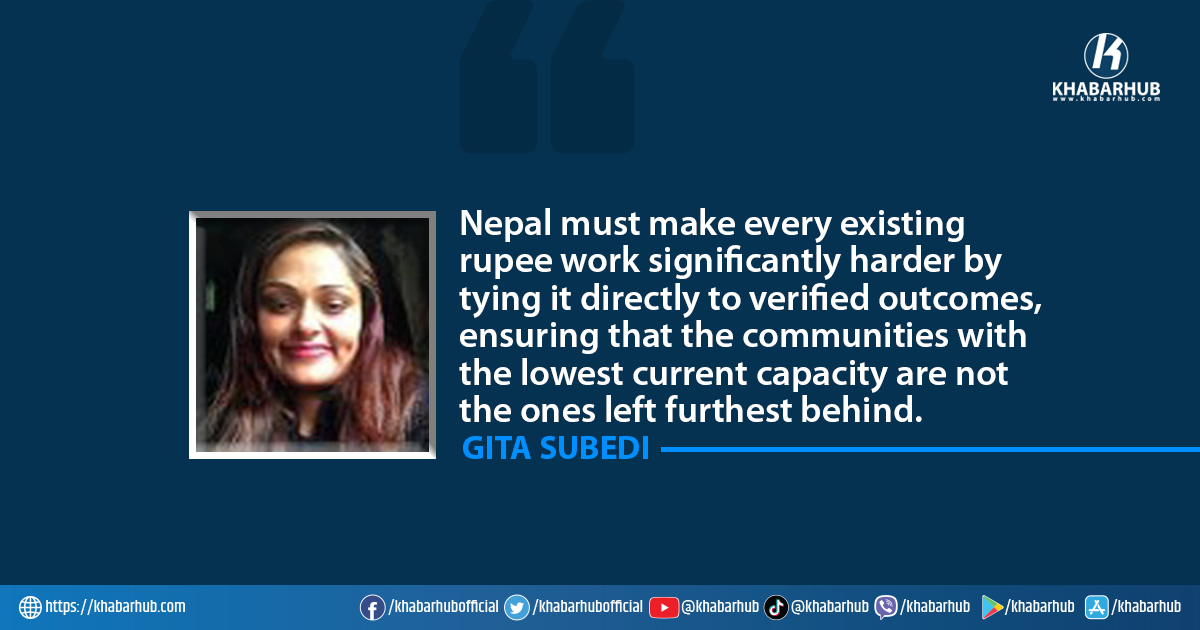
Nepal must make every existing rupee work significantly harder by tying it directly to verified outcomes, ensuring that the communities with the lowest current capacity are not the ones left furthest behind.
They should prioritize foundational coaching or shift local in-service training time heavily toward foundational literacy and numeracy (FLN) coaching for Grades 1 to 3. Direct classroom mentorship yields far higher learning returns than one-off or theoretical workshops.
Most importantly, development partners should fund DLIs. They should fund direct technical assistance toward strengthening local data architecture and planning systems, ensuring under-funded municipalities can successfully capture federal performance grants.
Simultaneously, Corporate Social Responsibility (CSR) could help the government structurally. CSR contributions can be channeled into local government funding deliberately to mitigate equity gaps, Early Childhood Education and Development (ECED) fundamentals, and rural inclusive infrastructure.
In a nutshell, Nepal’s education policies are not the problem. The Constitution, Acts, Periodic Plans, and National Education Policies describe a system that is inclusive, well-staffed, digitally enabled, and locally accountable.
The resulting friction is being absorbed unevenly in teacher salaries, squeezed out of infrastructure and training, and left almost entirely to local discretion for inclusion and equity. Nepal must structurally move its education spending closer to international benchmarks.
Nepal must make every existing rupee work significantly harder by tying it directly to verified outcomes, ensuring that the communities with the lowest current capacity are not the ones left furthest behind.





Comment