




The joint announcement made on 23 November 2026 in New Delhi by Prime Ministers Narendra Modi and Balendra Shah to establish an offshore campus of the Indian Institute of Technology (IIT) in Nepal, alongside a Startup Incubator and Innovation Hub, potentially marks a significant milestone in Nepal–India educational and technological cooperation.
It reflects India’s expanding international higher-education engagement and its broader “Neighbourhood First” development diplomacy.
For Nepal, this initiative could create new opportunities in advanced engineering education, research, technological innovation and regional academic collaboration. However, an announcement is only the beginning. Its success will depend on the institutional architecture, contractual arrangements and governance framework negotiated by the two governments.
As bilateral working groups begin discussions on the campus’s location, academic mandate, financing and operational arrangements, Kathmandu and New Delhi must approach the negotiations with clarity, confidence and a long-term national perspective.
I write this personal note as a retired Nepali engineering professor with more than five decades of experience in teaching, research, institutional leadership and engineering education consultancy in Nepal and abroad. Having witnessed the evolution of Nepal’s engineering education system, I believe this opportunity deserves both appreciation and careful scrutiny.
My concern is not whether an IIT campus should come to Nepal, but how it should come, under what conditions and in whose long-term interest. Nepal should welcome academic excellence without confusing international cooperation with institutional dependence.
Experiences from other offshore IIT initiatives, including IIT Madras in Tanzania (2023) and IIT Delhi in Abu Dhabi (2024), offer useful lessons. Their reported annual tuition levels of approximately US$10,000 and US$20,000, respectively, raise important questions about affordability, access and their positioning within host countries’ higher-education systems.
IOE has demonstrated that Nepali institutions can achieve academic excellence and compete internationally when provided with opportunities and institutional support.
Nepal must avoid creating a high-fee, externally governed academic enclave that occupies valuable public land while remaining disconnected from domestic universities and inaccessible to most qualified Nepali students.
I propose five essential policy safeguards for the proposed operating agreement.
Grant-Financed Development: Nepal Should Not Underwrite the Investment
The initial establishment of the campus, including infrastructure, laboratories, workshops and academic facilities, should be financed primarily through India’s bilateral grant-in-aid framework, consistent with the spirit of the joint understanding.
Nepal should not divert scarce public resources from strengthening its own universities, engineering colleges and technical institutions to finance an externally governed establishment.
The agreement must clearly distinguish capital investment, operational expenditure, academic costs and future maintenance liabilities. Any Nepali contribution, whether in land, infrastructure or other resources, should be transparently valued and documented.
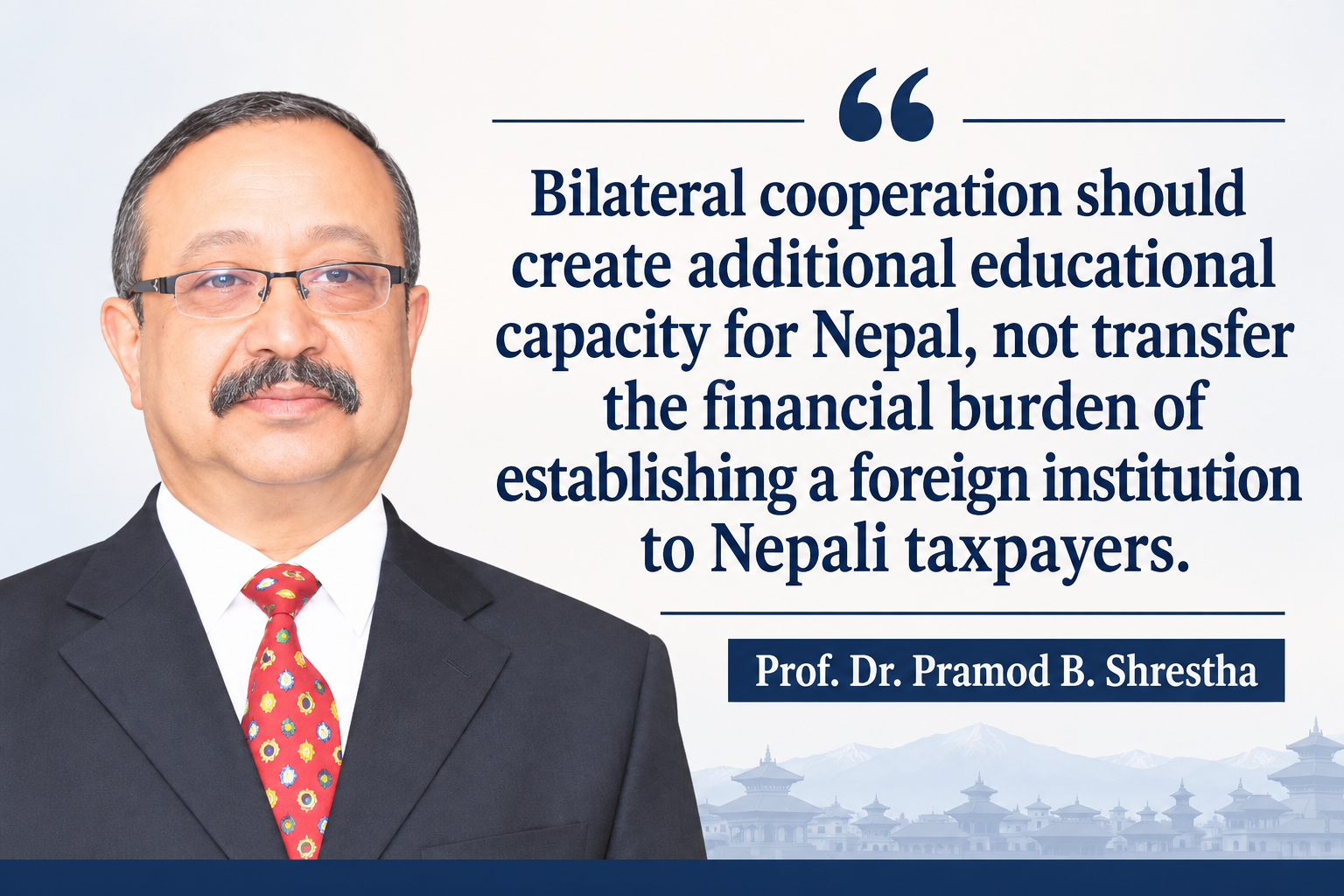
Bilateral cooperation should create additional educational capacity for Nepal, not transfer the financial burden of establishing a foreign institution to Nepali taxpayers.
Equitable Access and Affordable Education
An IIT campus in Nepal must serve Nepal, not merely operate within its territory.
I propose reserving at least 50–60 per cent of student seats for Nepali citizens, subject to transparent admission criteria and internationally credible academic standards. Admissions should follow a jointly agreed, merit-based entrance framework, complemented by need-based financial assistance.
Tuition fees should reflect Nepal’s economic realities. Qualified Nepali students should receive substantial subsidies, while students from economically disadvantaged backgrounds should have access to full scholarships. Contributions from full-fee-paying international students and other funding sources could support a cross-subsidy mechanism.
The objective is not to lower academic standards but to ensure that financial circumstances do not prevent talented Nepali students from accessing world-class education.
The institution’s success in Nepal should be measured not only by its international reputation but also by the number of deserving Nepali students it enables to succeed.
Regional Location and Leasehold Tenure
The campus location deserves careful consideration. Rather than adding pressure to Kathmandu’s already congested infrastructure, the governments should explore suitable locations outside the capital, including Chitwan, Pokhara or other appropriate provincial locations.
Such a decision could promote regional development, strengthen local innovation ecosystems and encourage new academic and technological centres beyond Kathmandu.
IOE has demonstrated that Nepali institutions can achieve academic excellence and compete internationally when provided with opportunities and institutional support.
Land should be provided through a fixed-term, non-transferable educational lease rather than an unconditional or permanent transfer of public property. The agreement should include clearly defined educational land-use restrictions, prohibit unauthorised commercial exploitation or transfer, provide for periodic compliance reviews and establish a sovereign reversion clause.
Land and associated public assets should revert to Nepal under clearly specified conditions upon expiry or termination of the agreement.
Public land is a national asset. Its allocation must serve long-term public interests rather than become an administrative formality.
Collaborative Research, Regulation and Intellectual Property
The proposed IIT offshore campus should become a collaborative knowledge and innovation platform, not an isolated academic establishment. Its research agenda should address Nepal’s development priorities, including:
Hydropower, renewable energy and energy systems.
Seismic engineering, earthquake resilience and disaster risk reduction.
Glacial hydrology, climate change and mountain ecosystems.
Artificial intelligence, digital technologies and advanced computing.
High-altitude transportation, infrastructure and sustainable mobility.
Jointly governed Centres of Excellence should provide research, laboratory and innovation opportunities for Tribhuvan University’s Institute of Engineering (IOE), other Nepali universities, research institutions and local industries.
The proposed Startup Incubator and Innovation Hub should also operate through collaborative arrangements involving Nepali students, researchers, entrepreneurs and faculty members.
Equally important is regulatory compliance. The campus must follow applicable Nepali laws and professional requirements, including relevant accreditation and recognition arrangements involving the Nepal Engineering Council (NEC).
Research using public resources, local knowledge, Nepali contributions or jointly financed facilities must have clearly defined intellectual property ownership, benefit-sharing and technology-transfer arrangements. Intellectual property should be protected under Nepal’s legal framework while respecting legitimate rights arising from international collaboration.
Nepal must become a co-creator of knowledge and technology, not merely a consumer of imported academic products.
Parallel Domestic Reform: Give IOE a Level Playing Field
Perhaps the most important issue extends beyond the proposed IIT campus. Nepal must not allow this initiative to deepen the structural imbalance between internationally supported institutions and its own public universities.
The proposed IIT campus may enjoy international academic networks, financial resources, institutional autonomy and operational flexibility. Meanwhile, Nepal’s engineering institutions continue to face bureaucratic constraints, limited financial flexibility and governance structures that often restrict academic innovation.
One lesson remains particularly relevant: institutions are not built by buildings, international labels or financial investments alone. They are built through sound governance, institutional autonomy, academic freedom, capable people and a shared sense of purpose.
Having served the Institute of Engineering (IOE), Tribhuvan University, for more than three decades, including in academic and institutional leadership positions, I have witnessed its contributions to engineering education, research, infrastructure development and national human-resource capacity.
IOE has demonstrated that Nepali institutions can achieve academic excellence and compete internationally when provided with opportunities and institutional support.
It is difficult to justify establishing a new internationally supported engineering institution while leaving our premier public engineering institution constrained by outdated administrative and governance frameworks.
This bilateral initiative should therefore serve as a catalyst for granting IOE meaningful statutory autonomy, including independent academic governance, greater financial and administrative flexibility, authority to develop academic programmes, stronger industry–university collaboration and the capacity to establish international partnerships.
This is not a demand for preferential treatment but for a level playing field.
Nepal should not have to choose between importing international excellence and developing its own institutions. It must pursue both. An IIT campus should complement IOE and other engineering institutions, not overshadow them.
Beyond the Agreement: A Question of National Confidence
The proposed IIT offshore campus could become a landmark in Nepal–India educational cooperation. However, it could also become a missed opportunity if infrastructure and institutional branding take precedence over governance, affordability, research collaboration, national ownership and domestic institutional development.
Its success should be measured by:
The number of Nepali students receiving quality, affordable education.
Research and technological capabilities developed within Nepal.
Collaboration with domestic universities and industries.
Contributions to regional economic and technological development.
Strengthening of Nepal’s own higher-education institutions.
Lasting benefits for both countries and the wider South Asian academic community.
Appreciating India’s willingness to extend its educational and technological partnership with Nepal is entirely compatible with insisting on arrangements that protect Nepal’s national interests. A mature bilateral partnership should welcome such clarity.
Final Reflection
I have spent more than five decades in engineering education, beginning in 1975 as a young lecturer at Tribhuvan University’s Institute of Engineering and continuing through institutional leadership, research, consultancy and international academic cooperation.
One lesson remains particularly relevant: institutions are not built by buildings, international labels or financial investments alone. They are built through sound governance, institutional autonomy, academic freedom, capable people and a shared sense of purpose.
Nepal should welcome the proposed IIT offshore campus with an open mind but negotiate with its eyes wide open. Let us get the institutional design right before breaking ground.
Above all, let us remember that Nepal’s greatest educational asset is not an imported institutional brand but the talent, creativity and potential of its own people.
Welcome IIT to Nepal—but let us also empower IOE and our own universities and engineering institutions. That would be the real measure of a successful Nepal–India educational partnership.
(Pramod Shrestha writes on higher education policy, engineering education, institutional governance, infrastructure and technology development in Nepal)






Comment