




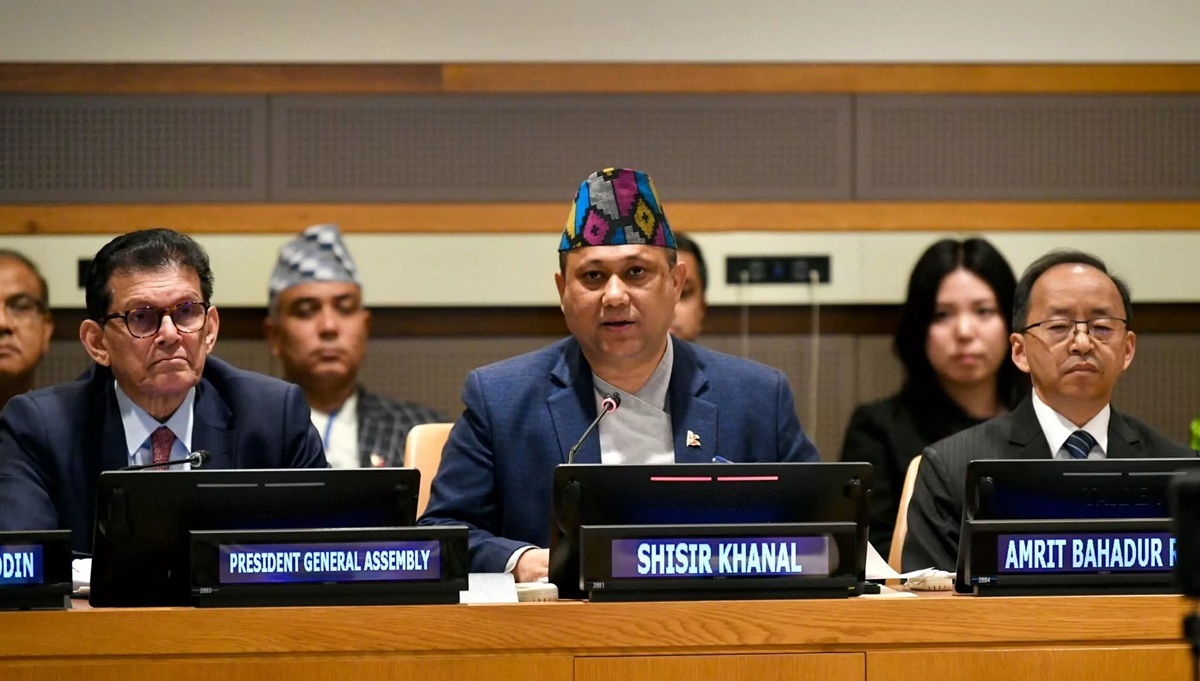
KATHMANDU: Nepal has emphasized the need for collective and coordinated international efforts to address climate risks spanning the mountains to the sea in an integrated manner.
Speaking at a special program organized by Nepal at the United Nations Headquarters under the title “From Everest to the Sea: A Call to Action for a Climate-Resilient Future,” Foreign Minister Shisir Khanal said that, as the climate system does not recognize political boundaries, mountains, rivers, seas and coastal areas should be viewed as parts of a single ecosystem.
The program was organized in the context of Nepal drawing international attention to the risks posed by climate change and its impacts following recent climate-related disasters. Minister Khanal said that a large volume of rocks and glacial ice fell in the Langtang region last month, causing extensive damage to lives, property and critical infrastructure.
Describing the incident as a “Himalayan tsunami,” the minister emphasized the need for an urgent and sustained international debate on climate-related disasters, according to his personal secretariat.
Minister Khanal said the Himalayan region contains the world’s largest body of ice outside the polar regions, with more than 63,700 glaciers originating there.
Noting that Nepal has lost about one-third of its ice cover over the past three decades, he said the rapid loss of glaciers is also affecting communities in downstream and coastal areas.
As island and coastal countries face rising sea levels, coastal erosion and displacement, Minister Khanal stressed that mountains and oceans should not be viewed separately but as interconnected components of a single climate system.
He said that addressing the climate crisis requires the relationship between mountains, freshwater systems and the ocean to be incorporated into science, policymaking and investment. He also called for greater priority to be given to mountains in the global climate process and for accelerated emissions reductions in line with the goal of limiting the rise in global temperatures to 1.5 degrees Celsius.
Stressing that developing countries need adequate, predictable and easily accessible climate finance, technology and capacity-building support, Minister Khanal called for the loss and damage fund to be made effective and accessible, with adequate resources.
“Climate justice is realized when the level of responsibility, capacity and risk is reflected in the assistance received by countries,” he said.
The Foreign Minister said Nepal is also contributing to climate change mitigation and environmental protection. He noted that forests cover about 46 percent of Nepal’s land, while hydropower generation and electric transportation are expanding. He added that the government has prioritized community-led environmental protection and management.






Comment