




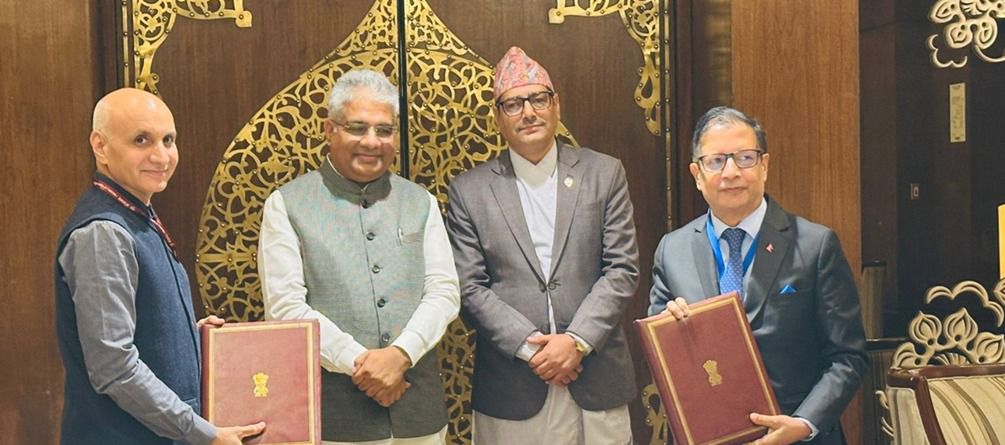
KATHMANDU: Nepal and India have signed a bilateral Memorandum of Understanding (MoU) on biodiversity conservation aimed at strengthening cooperation in protected areas and controlling wildlife crime.
The MoU was signed in New Delhi on Wednesday in the presence of Nepal’s Minister for Forests and Environment, Madhav Prasad Chaualgain, and India’s Minister for Environment, Forest and Climate Change, Bhupendra Yadav.
Nepal’s Ambassador to India Dr. Shankar Prasad Sharma signed the agreement on behalf of Nepal, while Tanmay Kumar, Secretary at India’s Ministry of Environment, Forest and Climate Change, signed on behalf of the Indian government. Senior officials from both countries were present on the occasion.
Both Nepal and India are signatories to various international environmental treaties under the United Nations framework, including those related to biodiversity conservation. The two countries share several protected areas and biological corridors along their border regions that serve as habitats for wildlife such as elephants, rhinos, and tigers, which frequently move across borders.
The MoU is expected to facilitate coordination and cooperation between the two countries in managing protected areas, conserving biodiversity, controlling wildlife crime, adopting joint strategies, and building the capacity of personnel working in conservation sectors.
Minister Chaualgain said the agreement would help curb poaching and illegal wildlife trade in cross-border areas, promote research and monitoring, and enhance awareness and local-level capacity building.
The implementation of the MoU will include regular joint patrols and meetings in border areas, exchange of knowledge and best practices, and timely sharing of information related to wildlife and illegal trade. The agreement also allows for the exchange of wildlife crime-related information through the South Asia Wildlife Law Enforcement Network (SAWEN) to address transnational wildlife crimes.
On Nepal’s side, the Ministry of Forests and Environment, along with the Department of Forests and Soil Conservation and the Department of National Parks and Wildlife Conservation at the federal level, and relevant provincial ministries, protected areas, and divisional forest offices, will coordinate implementation.
The MoU will be automatically renewed every five years unless either country notifies termination through diplomatic channels. It will be reviewed every three years, and any disputes arising during implementation will be resolved through mutual understanding.






Comment