




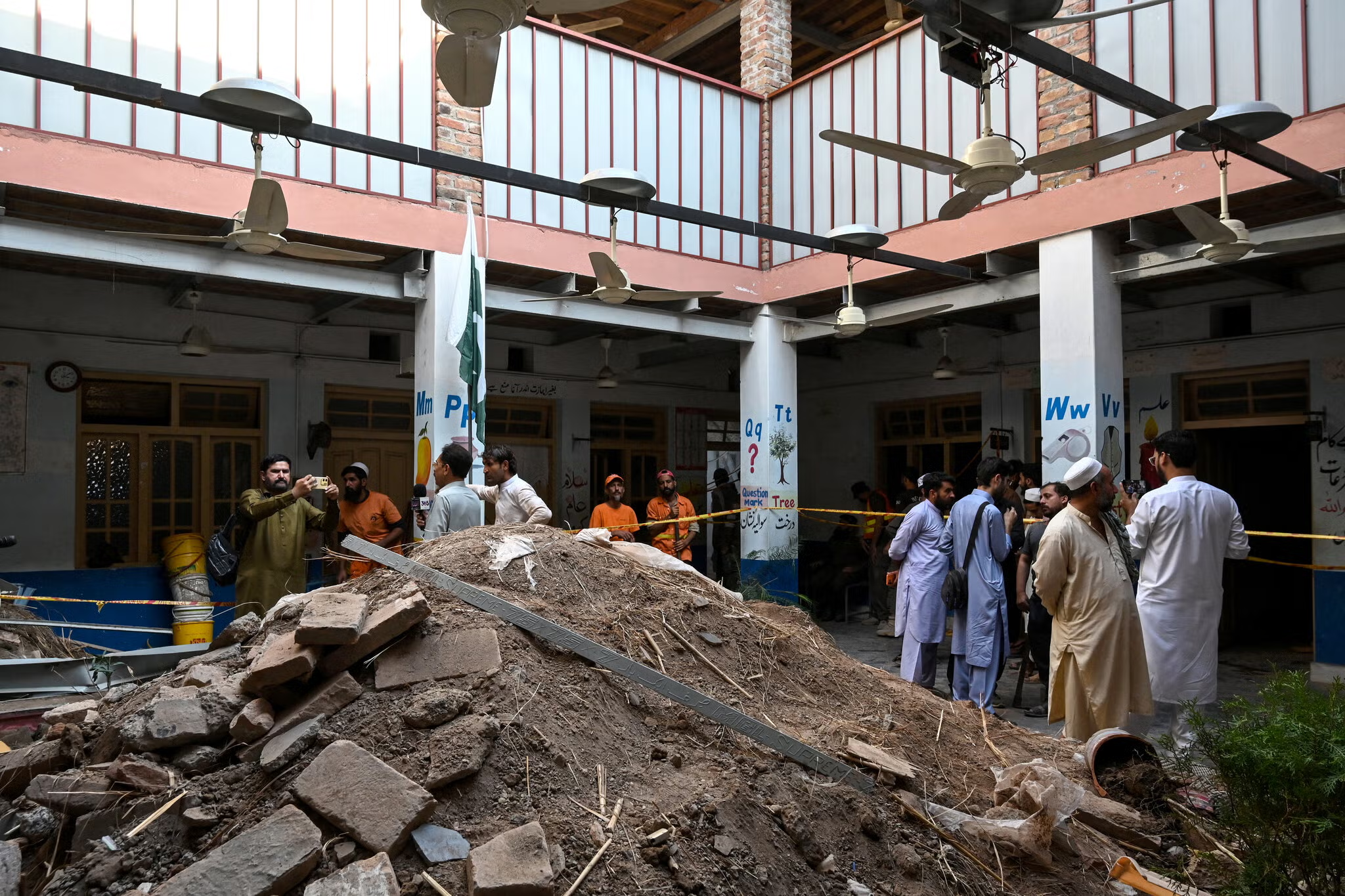
The collapse of school buildings and boundary walls, alongside shortages of basic facilities, has raised concerns about the safety and condition of educational infrastructure in Pakistan.
The deaths of five men following the collapse of a government school boundary wall in Karachi’s Orangi Town on September 11, 2026, brought attention to the condition of public infrastructure. A subsequent school-building collapse in Peshawar on October 15 resulted in the deaths of 34 children and a female teacher, according to Reuters, further highlighting concerns about structural safety in educational institutions.
The two incidents occurred under different circumstances. In Karachi, a boundary wall at a government school collapsed while the school was closed. In Peshawar, a roof collapsed at a private educational institution during morning classes.
Despite these differences, both incidents have raised questions about building safety, maintenance, regulatory oversight and the responsibilities of those managing educational premises.
Questions over a deteriorating boundary wall
On September 11, 2026, a boundary wall at a government school in Sector 11 of Orangi Town, Karachi, collapsed, killing five men and injuring two others. Police told Dawn that the school was closed at the time.
According to police accounts, several people had gathered at the site to consume narcotics, while some were allegedly attempting to remove steel from the wall when it collapsed.
These circumstances form part of the investigation into the incident. Separately, reports indicated that residents had raised concerns about the deteriorating condition of the wall before it fell.
The Express Tribune subsequently reported that approximately 450 boys and girls attending the school could be exposed to further risks because other sections of the boundary wall were also in a precarious condition.
The incident has raised questions about the maintenance and inspection of school infrastructure, as well as how authorities respond to reports of potential hazards. Investigations would be needed to establish the precise factors that caused the collapse and determine whether any failures in maintenance or oversight contributed to it.
The condition of the remaining wall sections is also a concern for students, staff and residents. School authorities and the relevant government agencies have a responsibility to assess structural risks and take appropriate measures to protect people using or visiting the premises.
Collapse at a private school
On October 15, the roof of the Al-Khair Education Centre in Peshawar collapsed during morning classes, killing 34 children and a female teacher and injuring 45 children, Reuters reported. Most of the victims were under 13 years old.
Initial reports attributed the collapse to weaknesses in the building’s structure and additional weight placed on an already fragile roof. Police arrested the school’s owner as an investigation into the incident proceeded. Families of victims reportedly alleged that the institution had failed to address known structural problems.
The precise causes and any legal responsibility must be established through the investigation and relevant proceedings.
Unlike the Karachi incident, which involved a government school boundary wall, the Peshawar disaster occurred at a private educational institution while classes were underway. The distinction is important when examining ownership, maintenance arrangements and regulatory responsibilities.
However, both incidents have drawn attention to the need for educational buildings to meet appropriate safety standards. Regular inspections, timely repairs and effective responses to reports of structural deterioration are important measures for reducing risks to students, staff and others.
Basic facilities remain a challenge
The condition of school buildings is part of a wider infrastructure challenge facing Pakistan’s education system. Figures cited in the Pakistan Economic Survey 2025–26 indicate that public schools continue to face shortages of electricity, drinking water, toilets and boundary walls.
A report published by Dunya News in June 2026 stated that 65 percent of public schools had electricity, leaving 35 percent without it. Approximately 76 percent had drinking-water facilities, while around 23 percent lacked toilets. The report also indicated that 25 percent of public schools did not have boundary walls.
These figures describe different infrastructure needs and do not, by themselves, establish whether a particular school building is structurally unsafe. Nevertheless, they illustrate the range of challenges affecting school facilities.
Electricity is important for lighting, ventilation and the use of educational equipment. Access to safe drinking water and adequate sanitation is essential for students’ health and daily school experience. Boundary walls can also serve security and safety functions, depending on the location and design of the premises.
Infrastructure conditions vary considerably across provinces. Dunya News reported that electricity was available in only 21 percent of public schools in Balochistan and 32 percent in Sindh.
Such differences point to the importance of assessing local needs rather than assuming that schools across the country face identical problems. They also underline the need for reliable, regularly updated data on school infrastructure and the condition of individual buildings.
A school may remain operational despite shortages of essential facilities. Its continued operation, however, does not necessarily establish that its buildings meet all relevant safety standards or that students have access to adequate learning conditions.
Education financing and infrastructure needs
UNICEF estimates that 25.1 million children aged five to 16 are out of school, equivalent to approximately 35 percent of the population in that age group. The organisation has identified low public spending as one of the constraints affecting educational progress.
According to figures cited by UNICEF from the Pakistan Economic Survey 2024–25, education expenditure fell to approximately 0.8 percent of gross domestic product in the 2024–25 fiscal year. UNICEF has also noted that nearly 90 percent of education expenditure goes towards recurrent costs, primarily salaries, leaving less funding available for infrastructure, learning materials and other improvements.
These national figures do not establish that funding shortages directly caused either the Karachi or Peshawar collapse. The causes of each incident must be determined through building-specific assessments and investigations.
However, the figures provide context for understanding the financial pressures surrounding school maintenance and infrastructure development. Repairing ageing buildings, upgrading facilities and carrying out regular structural inspections require funding, planning and clear responsibility for implementation.
Where deterioration is identified, timely assessments and repairs can help reduce the risk of structural failure. Authorities and school management bodies also need procedures for responding to safety complaints and restricting access to buildings or areas that pose an immediate danger.
School safety and access to education
The condition of educational facilities has implications beyond the immediate risk of injury or death. Pakistan faces substantial challenges in ensuring that children enrol in school and continue their education, with UNICEF estimating that millions remain outside the education system.
For families who depend on public schools, the availability and condition of nearby institutions can influence access to education. In areas where alternatives are limited, inadequate facilities may create additional difficulties for students and parents.
Unsafe buildings and shortages of basic amenities are distinct problems, but both affect the environment in which children learn. Addressing them requires reliable information about school conditions, adequate maintenance budgets and clear accountability for safety measures.
The responsibilities also vary according to the type of institution. Government authorities are responsible for managing and maintaining public facilities within their jurisdiction, while private school owners and operators have obligations relating to their premises. Regulatory agencies have a role in ensuring compliance with applicable building and safety requirements.
The two recent collapses have brought these responsibilities into focus, although the circumstances and potential causes of each incident differ.
Investigations and preventive measures
The Karachi and Peshawar incidents demonstrate the importance of investigating structural failures and identifying measures that could prevent similar events.
In Karachi, reported concerns about the boundary wall’s condition warrant examination alongside the circumstances immediately preceding its collapse. In Peshawar, investigators need to establish the structural causes of the roof failure and determine whether construction, alterations, maintenance or other factors contributed to the disaster.
The findings of these investigations can help authorities identify any failures in inspection, maintenance or regulatory enforcement and determine what corrective measures are required.
Beyond individual investigations, a systematic assessment of school infrastructure could help identify buildings requiring urgent repairs, detailed structural examinations or temporary closure. Such assessments would need to account for differences in building design, age, location and exposure to environmental hazards.
Regular inspections, maintenance records, clear reporting procedures and adequate funding can support safer educational environments. Publicly available information about identified hazards and remedial work could also help families understand what measures are being taken to address safety concerns.
School infrastructure is an important part of the education system. Alongside enrolment, teaching quality and learning outcomes, the physical safety and adequacy of school facilities deserve sustained attention from authorities, school management bodies and regulators.




Comment