




Technology has profoundly transformed governmental communication. A single social media post can now reach millions of citizens in seconds, offering unprecedented speed and accessibility. This is welcome.
However, communication is not governance. In a constitutional democracy, the state cannot make, amend, or withdraw public policy merely through a digital announcement. Social media may serve as a tool for information dissemination, but it must never replace constitutional processes, Cabinet deliberations, parliamentary oversight, or the rule of law that define accountable governance.
This principle comes into sharp focus following reports that the Government of Nepal has withdrawn the recently introduced indirect taxes on education (3%) and health (5%). According to initial reports, this decision was first communicated via a social media post. If accurate, this raises several fundamental constitutional questions:
Has the Council of Ministers formally approved this reversal?
Was the matter subject to due deliberation at the most recent Cabinet meeting?
Has the Ministry of Finance initiated the statutory legal process required to amend the annual budget?
Or are citizens now expected to accept a social media post as de facto government policy?
These are not political questions; they are constitutional ones. The Annual Budget for Fiscal Year 2026/27 is not an ordinary administrative document. It is a legal instrument approved by Parliament following rigorous debate and a formal vote. Any amendment to its provisions must follow the same constitutional procedures that govern its enactment. To do otherwise sets a troubling precedent.
Democracies are governed by laws, not by posts. When governments begin to rule through social media rather than through due process, institutions erode and public confidence diminishes.
If a tax can be withdrawn via a social media post, tomorrow another policy might be introduced by the same means. Over time, institutions become subordinate to personalities, and procedure yields to convenience. This is not the architecture of democratic governance.
A government elected with an overwhelming public mandate carries enormous expectations. Citizens did not vote for new faces alone; they voted for a new political culture—one defined by transparency, accountability, institutional discipline, and unwavering respect for the rule of law. Good intentions, however commendable, cannot substitute for proper procedure. Even widely popular decisions must proceed through their lawful channels.
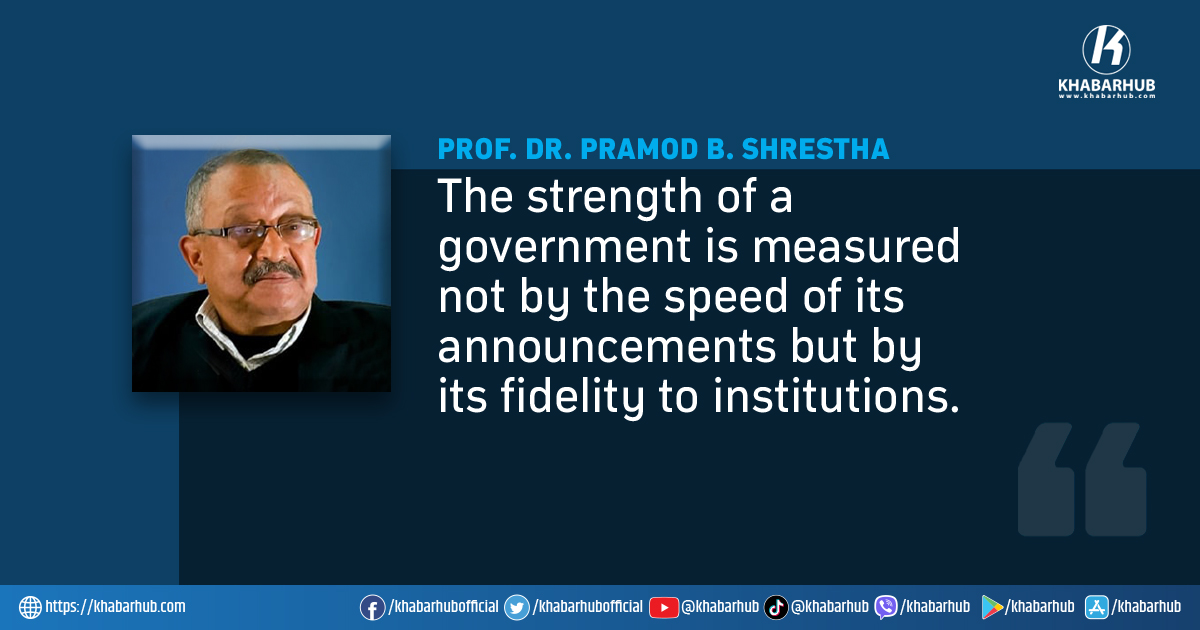
The strength of a government is measured not by the speed of its announcements but by its fidelity to institutions. Social media is an excellent tool for informing the public; it must never become a substitute for Cabinet decisions, ministerial protocols, parliamentary authority, or constitutional governance.
Democracies are governed by laws, not by posts. When governments begin to rule through social media rather than through due process, institutions erode and public confidence diminishes. The “New Nepal” that so many citizens aspire to build requires not only energetic leaders but also disciplined, resilient institutions. The rule of law is never an obstacle to good governance—it is its strongest foundation.






Comment