




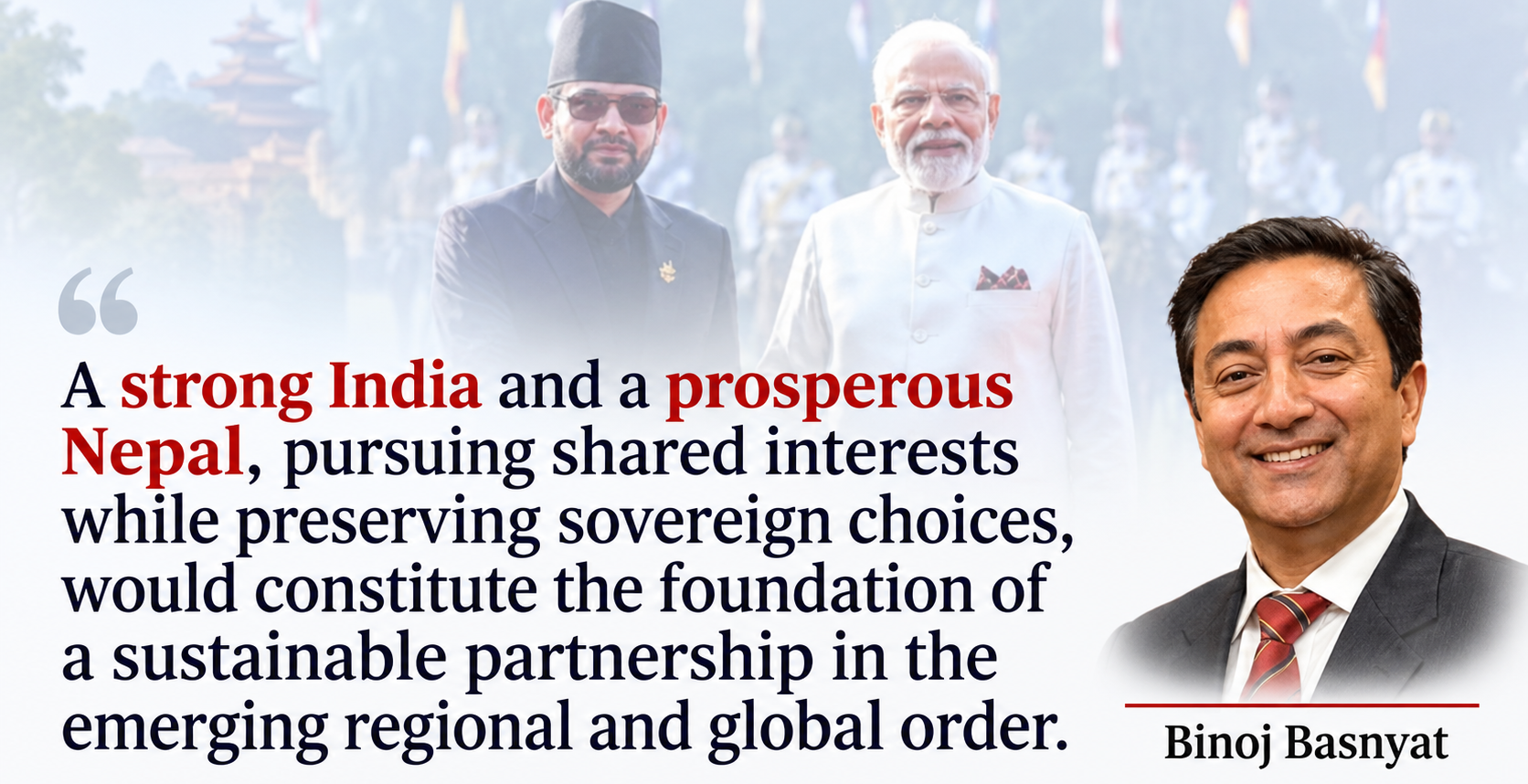
The state visit of Nepal’s Prime Minister Balendra Shah to India on 22–23 November 2026 offers an important opportunity to reconsider the future direction of Nepal–India relations. The joint statement issued at the conclusion of the visit reflects an ambitious agenda covering economic cooperation, connectivity, energy, infrastructure, technology, education, security and climate resilience.
Under the Balen administration, economic statecraft has been the main focus in revisiting bilateralism. More importantly, the visit suggests an opportunity to move the relationship beyond its traditional political and historical sensitivities towards a more pragmatic, development-oriented and future-facing partnership.
The significance of the visit, however, should not be measured simply by the number of agreements signed, financial commitments announced or diplomatic assurances exchanged. Its real importance lies in whether both countries can translate their shared interests into sustainable economic benefits while respecting each other’s sovereignty, political independence and strategic priorities.
The central proposition is that India and Nepal need to move from historical proximity to strategic complementarity.
Beyond historical sensitivities
Nepal and India share an unusually close relationship shaped by geography, history, culture, religion, open borders, economic interdependence and extensive people-to-people connections. Yet, despite these advantages, their relationship has periodically experienced mistrust, political misunderstandings and disagreements over sovereignty, security, trade, transit and boundary issues.
Nepal’s geographical position between two major powers is a permanent strategic reality. However, geography should not become a constraint on its foreign policy or a source of external pressure.
The challenge has been that geographical proximity and historical ties have not always translated into predictable political confidence.
For India, Nepal represents an important strategic neighbour, a source of clean energy, a potential connectivity partner and an essential component of its Himalayan security environment. A stable, prosperous and friendly Nepal is in India’s long-term national interest.
For Nepal, India is an indispensable economic and transit partner, providing access to markets, infrastructure, employment opportunities, investment and regional connectivity. However, Nepal’s national interest also requires sovereign equality, independent foreign policy choices and the freedom to maintain constructive relations with both immediate neighbours and other international partners.
These interests are not inherently contradictory. The difficulty lies in managing their asymmetry and ensuring that cooperation is based on mutual confidence rather than expectations of political alignment.
The November visit appears to recognise the importance of this relationship and provides an opportunity to give it a more contemporary strategic direction.
From political engagement to economic interdependence
One of the most significant outcomes is the development assistance commitment of INR 15,000 crore, comprising INR 3,500 crore in grant assistance and INR 11,500 crore in a rupee-denominated line of credit. The assistance is intended to support post-disaster reconstruction, infrastructure and energy-sector projects.
The proposed Agro-Industrial Park in Chitwan, progress on the National Police Academy and the proposed offshore IIT campus also indicate an expanding development partnership.
However, Nepal must look beyond the financial magnitude of these commitments. Grants, credit and investment have different financial implications. Their strategic value will depend on project selection, financing conditions, implementation capacity, economic returns and the extent to which they strengthen Nepal’s productive economy.
The objective should be to transform development assistance into productive capacity, employment, industrialisation, technological advancement and export competitiveness.
For India, a more prosperous Nepal offers an expanding market, stronger economic connectivity, investment opportunities and a reliable energy partner. For Nepal, deeper economic engagement should reduce structural vulnerabilities rather than create new forms of dependence.
This is where economic interdependence becomes strategically meaningful.
Connectivity: Transforming geography into opportunity
The announcement of access to Deendayal Port at Kandla and the future availability of Paradip Port is particularly significant for Nepal’s long-term economic interests.
As a landlocked country, Nepal’s access to international markets depends substantially on transit arrangements through neighbouring countries. Consequently, the predictability, cost and reliability of transit are central to its economic security.
Additional maritime access, railway connectivity and improved border infrastructure can strengthen Nepal’s commercial options. The proposed Raxaul–Kathmandu electrified railway, collaboration on Nepal’s East–West Railway, additional Integrated Check Posts and cross-border bridges could contribute to a more integrated regional economy.
The bidirectional Kathmandu–Bhairahawa–Lucknow aviation route also offers opportunities for tourism and commercial engagement.
Nevertheless, connectivity should not be understood merely as the construction of physical infrastructure. It must connect production centres with markets, reduce logistical costs, facilitate exports and generate economic opportunities.
Nepal should pursue connectivity with India while progressively developing complementary links with China and other regional and international markets. Diversification should not be interpreted as distancing itself from India; rather, it should strengthen Nepal’s economic resilience and negotiating capacity.
Nepal must transform geography into connectivity, connectivity into economic capacity, and economic capacity into strategic autonomy.
Energy and water: The foundation of strategic complementarity
Energy cooperation could become the most consequential pillar of the future India–Nepal relationship.
The 669 MW Lower Arun Hydroelectric Project, cross-border transmission lines and the commitment to accelerate the Pancheshwar Multipurpose Project demonstrate the potential for long-term cooperation.
Nepal possesses considerable hydropower resources, while India’s growing economy requires reliable and cleaner energy supplies. This creates a natural basis for economic complementarity.
However, Nepal must ensure that hydropower development generates substantial domestic economic benefits through revenue, employment, industrial development, infrastructure and technology transfer. Predictable electricity market access, commercially viable pricing and transparent investment arrangements are essential.
Water-resource cooperation requires equally serious attention. The Pancheshwar, Saptakoshi and Sunkoshi projects have implications extending beyond electricity generation. They involve irrigation, flood control, water management and regional environmental security.
The two countries should move towards integrated river-basin management, combining hydropower development, flood forecasting, irrigation, disaster preparedness and climate resilience.
The Himalayan ecosystem does not recognise political boundaries. Floods, glacial risks and changing river systems affect communities on both sides. Cooperation in this domain should therefore be treated as a shared strategic necessity rather than an occasional development initiative.
From traditional security to comprehensive security
The visit also indicates an expansion of cooperation beyond conventional security concerns.
The agreements involving the National Police Academy, Rashtriya Raksha University, forensic science institutions and civil-service training provide opportunities for institutional capacity-building. Cooperation in satellite communications, digital services, financial connectivity, space technology, health and innovation introduces new dimensions to the partnership.
For Nepal, these areas are particularly important because national security in the contemporary environment extends beyond territorial protection. It includes economic security, energy security, cyber resilience, food security, disaster preparedness and institutional credibility.
India and Nepal should strengthen cooperation against terrorism, organised crime, trafficking and other transnational threats while ensuring that security arrangements respect the sovereignty and institutional independence of both countries.
The experience of the Rasuwa–Bhotekoshi floods also demonstrates the importance of cooperation in humanitarian assistance, disaster response and early-warning systems.
A comprehensive security partnership should make both countries more resilient without compromising Nepal’s sovereign choices.
Strategic autonomy and the regional geopolitical environment
The future of India–Nepal relations cannot be considered independently of the wider regional and international environment, particularly the growing strategic competition between India and China.
The outstanding boundary issues, detailed project arrangements for major water-resource initiatives, reliable electricity market access, transit costs and infrastructure timelines require sustained diplomatic attention
Nepal’s geographical position between two major powers is a permanent strategic reality. However, geography should not become a constraint on its foreign policy or a source of external pressure.
Nepal must avoid being reduced to a buffer state or becoming an arena for geopolitical competition. Its objective should be to develop the capacity to engage both neighbours constructively, based on national interests, mutual respect and sovereign equality.
India, in turn, should recognise that Nepal’s independent relations with China and other international partners are legitimate expressions of its sovereignty. Nepal’s strategic autonomy should not be interpreted as strategic distance from India.
Equally, Nepal must recognise India’s legitimate security concerns and ensure that its territory is not used for activities that threaten the security of its neighbours.
The way forward is not geopolitical alignment but strategic equilibrium.
Nepal’s foreign policy should remain equicentric in principle, while recognising that relationships with different countries have different geographical, economic and strategic characteristics. India is an indispensable immediate neighbour and economic partner; China is a strategic neighbour; and the United States and other middle powers are important development, technology and investment partners.
The purpose of such engagement is not to balance one country against another. It is to expand Nepal’s choices and strengthen its national capabilities.
From agreements to strategic outcomes
Despite the positive announcements, the real test of the visit will be implementation. The outstanding boundary issues, detailed project arrangements for major water-resource initiatives, reliable electricity market access, transit costs and infrastructure timelines require sustained diplomatic attention.
Both governments should establish an effective joint implementation and monitoring mechanism, with measurable targets, designated institutions, transparent financing arrangements and regular progress reviews.
A strong India and a prosperous Nepal, pursuing shared interests while preserving sovereign choices, would constitute the foundation of a sustainable partnership in the emerging regional and global order.
Nepal must also strengthen its own administrative and technical capacity to negotiate, evaluate and implement complex projects. Diplomacy cannot deliver sustainable outcomes without capable domestic institutions. A partnership becomes strategic not because it produces an ambitious joint statement, but because it creates enduring institutional arrangements and measurable national benefits.
Towards a new strategic understanding
The November 2026 visit provides an opportunity to redefine India–Nepal relations around a more balanced and forward-looking understanding.
India’s long-term interest is a stable, prosperous and friendly Nepal that contributes to regional connectivity, energy security and Himalayan stability. Nepal’s long-term interest is a strong economic partnership with India that supports its development while preserving its sovereignty, strategic autonomy and freedom of international engagement.
These objectives can reinforce each other.
The future of the relationship should not be measured by how closely Nepal aligns with India, but by how effectively both countries build a partnership that advances their respective national interests.
Geography brought the two countries together. History and culture gave their relationship depth. Economic interdependence can provide its future strength, while mutual respect and sovereign equality must provide its political foundation.
The ultimate objective should be to move from a relationship of historical proximity to strategic complementarity, from dependence to interdependence, and from managing differences to shaping shared opportunities.
For Nepal, this means moving beyond the traditional notion of being a buffer between two major powers and developing into a strategic bridge connecting markets, economies, technologies and opportunities.
For India, it means recognising that a prosperous, stable and strategically confident Nepal is not a geopolitical liability but a long-term strategic asset.
A strong India and a prosperous Nepal, pursuing shared interests while preserving sovereign choices, would constitute the foundation of a sustainable partnership in the emerging regional and global order.
(Basnyat is a retired Major General of the Nepali Army and a strategic affairs analyst focusing on international relations, geopolitics, national security and evolving regional power dynamics. His writings examine the strategic forces shaping regional security, statecraft, foreign policy and the changing geopolitical order.)






Comment