




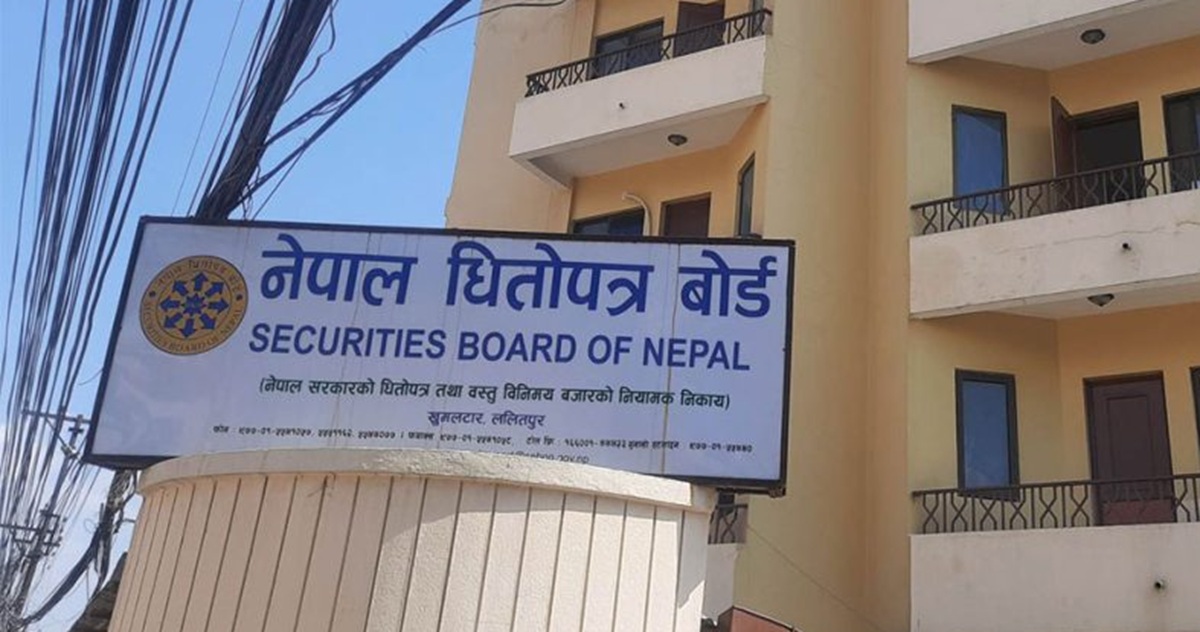
KATHMANDU: The Securities Board of Nepal (SEBON) has made public a concept paper on the implementation of intraday trading in securities.
The board has prepared the “Concept Paper on the Implementation of Intraday Securities Trading in Nepal, 2083” with the objective of making Nepal’s capital market more modern, dynamic and aligned with international standards. The paper provides a detailed analysis and framework covering the legal, institutional, technological and risk-management requirements for introducing intraday trading in Nepal’s secondary market.
Nepal’s securities market currently operates entirely on a delivery-based system, under which securities purchased or sold must be settled within the prescribed period. While this system has contributed to market stability and investor protection, the board said it has also created some limitations in market liquidity, price discovery and flexibility in trading strategies.
Against this backdrop, the concept paper examines the implementation of intraday trading to increase market liquidity, promote more effective price discovery, improve the use of transaction costs and expand institutional investor participation.
The board said the key objectives of the concept paper include assessing the feasibility of intraday trading in Nepal, proposing an appropriate model based on international practices, identifying necessary legal and institutional reforms, and developing measures for risk management and investor protection.
The proposed framework is based on principles including “investor protection first,” “risk-based regulation,” “technology-driven operations,” “transparency” and “phased implementation.”
Intraday trading refers to a system in which investors buy securities and sell them on the same trading day, or, where permitted, sell securities first and repurchase them on the same day to close their position. A key feature is that investors should have no open positions remaining at the end of the trading day.
Under the proposed system, Nepal would initially allow only the “buy first, sell later” model. The “sell first, buy later” model would be introduced only after the legal and technical infrastructure for securities lending and borrowing and covered short selling has been fully developed.
The concept paper links intraday trading to financial theories including the efficient market hypothesis, liquidity theory, price discovery theory, market microstructure theory, information efficiency theory and behavioural finance.
It also examines international developments, from open outcry systems to electronic trading, real-time risk management, and digital and algorithmic trading.
Based on practices in countries including India, the United States, the United Kingdom, Singapore, Malaysia, Australia, Hong Kong and Japan, the board has concluded that Nepal should implement intraday trading according to the principles of “technology first, regulation first and risk management first,” while adapting the system to the country’s market structure.
Nepal’s secondary market has already developed significant infrastructure through the Nepal Stock Exchange’s fully electronic trading system, the Central Depository System and Clearing Limited’s central depository system, online trading management systems and the expansion of demat accounts.
However, the current market structure remains focused on delivery-based trading, creating several structural limitations for intraday trading. These include the absence of real-time risk management, pre-trade risk checks, an intraday margin framework, open-position monitoring and an automated square-off system.
In terms of legal and regulatory readiness, the Securities Act, 2063 provides SEBON with the basic authority to regulate the securities market and issue new directives. However, the board said specific regulations and directives for intraday trading, amendments to NEPSE trading regulations, broker operating standards and new risk-management standards would be required.
The overall assessment is that Nepal’s capital market is legally prepared but remains “conditionally ready” for intraday trading due to the level of technical, institutional and broker-level preparedness.
To facilitate implementation, SEBON has proposed an integrated “Nepal Intraday Securities Trading Framework.” The framework outlines key technical and operational components, including the Nepal intraday trading model and trading cycle, an eligible securities selection framework, investor eligibility criteria, order types and trading sessions, an intraday margin management framework, and a multi-dimensional risk management framework.





Comment