




With Prime Minister Balendra Shah now all set to attend the 81st session of the United Nations General Assembly (UNGA) on September 24 in New York, significant global and domestic attention rests on what he will say about climate change and its devastating impact on Nepal.
Expected to highlight the Bhotekoshi floods as a stark example of the increasingly severe consequences of climate change, he is also anticipated to call for climate justice and compensation for Nepal and international support for vulnerable nations.
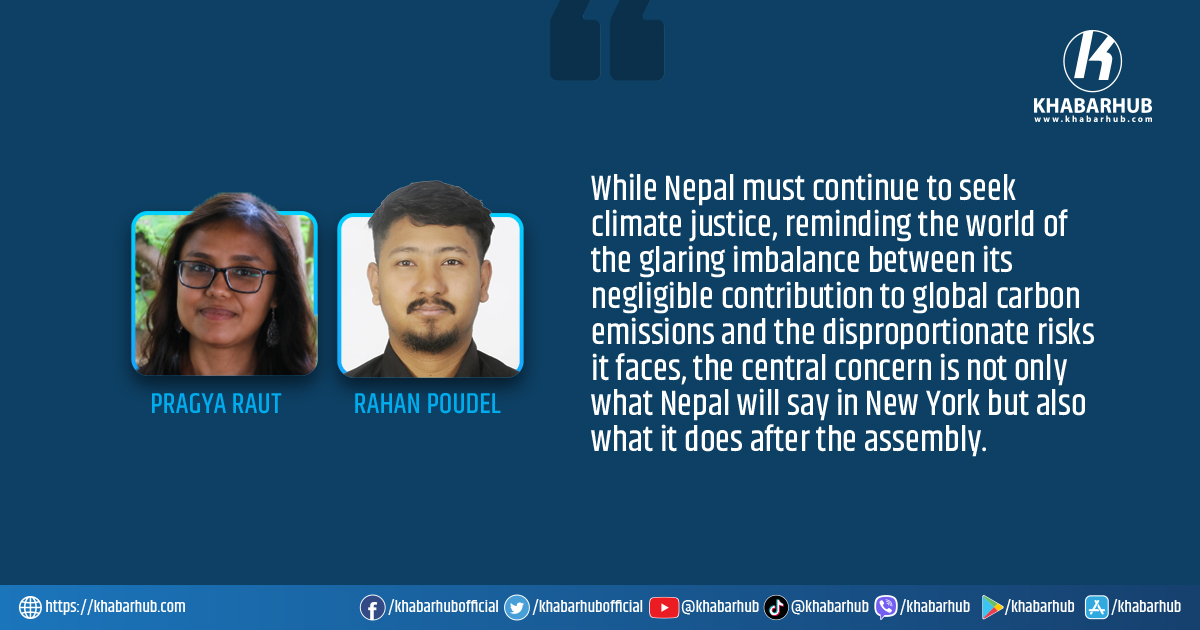
While Nepal must continue to seek climate justice, reminding the world of the glaring imbalance between its negligible contribution to global carbon emissions and the disproportionate risks it faces, the central concern is not only what Nepal will say in New York but also what it does after the assembly. While Prime Minister Balen Shah’s speech can draw international attention to the Bhotekoshi tragedy and strengthen Nepal’s case for support, the real measure of his UN appearance will be the concrete international commitments he secures and the institutional mechanisms Nepal establishes at home to hold those promises accountable.
A Tradition of Eloquence Without Proactive Follow-up
Nepal’s leaders have a long history of sharing the climatic impacts faced by Nepal and appealing for support and climate justice on the international stage. From Prachanda’s appeal for expanded assistance for environmental conservation amid melting glaciers and changing weather patterns in Nepal, to Baburam Bhattarai’s call for assured climate finance and accountability from industrialized nations; from Sushil Koirala’s call for special climate-finance arrangements for LDCs and small island states to Sher Bahadur Deuba’s highlighting of Nepal’s disproportionate climate burden and KP Oli’s call for greater access under the Paris Agreement—ten Nepalese prime ministers have addressed 15 General Assemblies since 1990. Each recited Nepal’s climate victimhood and returned home with just commitments and assurances from the international community.
A realist view of international politics and climate change recognizes that there is no central authority capable of holding powerful states, mostly major emitters, accountable simply because Nepal presents a morally compelling or evidence-based case.
Yet, each time, once the speeches ended, so did the urgency. Without meaningful domestic action or strategic diplomatic pressure, decades of eloquent advocacy have produced little more than polite commitments, leaving ordinary Nepalis to face compounding disasters like the Rasuwa floods.
So, it is imperative that Prime Minister Balen Shah and the Government of Nepal break from past routines and deliver real-world outcomes. Otherwise, his speech will be nothing more than another passionate monologue delivered on the UN stage, and he will merely be another prime minister who spoke well at the global forum.
So, what should both Prime Minister Balendra Shah and Nepal do differently for tangible outputs?
Building an Actionable Post-UNGA Roadmap
First, the most important step would be to develop a concrete, clear, and trackable post-UNGA roadmap. Upon Balendra Shah’s return, the PMO, together with the Ministry of Finance; the Ministry of Agriculture, Forest and Environment; and the newly established Climate Diplomacy Unit under the Ministry of Foreign Affairs, should publish a public post-UNGA climate roadmap outlining specific targets, timelines and milestones, clear institutional responsibilities, and a proper monitoring mechanism.
This should include specific targets for bilateral and multilateral agreements, climate negotiations and funding commitments, as well as follow-up on loss and damage requests and regional forums. Progress could then be tracked through quarterly public briefings or a real-time dashboard showing financial commitments received and funds actually disbursed.
The government should work aggressively as per the roadmap, and within six months to a year, the general public should be able to see and track what commitments have been converted from diplomatic statements into implementation. How much financing has been successfully negotiated? What coalition has Nepal built? What progress has been made on its Loss and Damage request? What new scientific climate research, glacier monitoring, resilient infrastructure, or cross-border early-warning partnerships have been established?
Institutional Capacity and Ground-Level Diplomacy
From trilateral Himalayan cooperation and Global South advocacy to reforms at the United Nations and international financial institutions, intellectuals have put forward all sorts of ideas for assuring the efficacy of this UNGA opportunity. But what’s important to remember is that ideas have never been in short supply. The real challenge has always been execution.
Therefore, Nepal must also strengthen the institutions responsible for pursuing it: its own government agencies, technical capacity, financial resources, and diplomatic missions abroad. Stronger climate diplomacy cannot rest solely on what a prime minister says at an international forum; it must be backed by capable institutions that can negotiate, follow up, build alliances, and turn commitments into outcomes.
Likewise, climate diplomacy and negotiations are almost always happening inside closed conference rooms or hotel ballrooms. But given the scale and severity of the climate crisis and its impact, Nepal should host targeted diplomatic and technical dialogues in climate-vulnerable areas themselves.
While it’s true that Nepal cannot control how quickly major emitters change course, it can, however, make its own climate diplomacy organized, strategic, and a sustained pillar of Nepal’s foreign policy in the pursuit of climate justice.
Bringing foreign diplomats, development bankers, academicians, scientists, and policymakers to Himalayan communities facing melting glaciers, landslide risks, water insecurity, and disaster damage would connect negotiations with ground-level realities. Experiencing these impacts firsthand would help forge empathy and build greater understanding, strengthen evidence-based diplomacy, and make Nepal’s climate advocacy more grounded and credible.
Moving Beyond Moral Appeals to Strategic Cooperation
It is true that today’s developed countries have emitted more and therefore do bear historical responsibility. Nepal should absolutely seek compensation, support, and justice for the loss and damage inflicted by a crisis Nepal did little to cause. This moral argument sounds tempting and has force as well, but the international system/politics operates differently. Moral claims alone are not sufficient in international politics.
A realist view of international politics and climate change recognizes that there is no central authority capable of holding powerful states, mostly major emitters, accountable simply because Nepal presents a morally compelling or evidence-based case. While the international climate regime provides mechanisms for reporting, transparency, and collective commitments, it lacks an enforcement system through which Nepal can directly attribute a particular disaster to specifics and demand compensation.
Major emitters are unlikely to act on moral responsibility alone. Meaningful support is more likely when refusal carries costs, compliance is manageable, or cooperation serves their interests. For Nepal, therefore, meaningful outcomes will depend on strategic climate diplomacy and cooperation.
Therefore, Nepal should rethink its approaches to major emitters by grounding climate diplomacy in mutual interests and incentives. It should identify areas where cooperation can support Nepal’s climate change adaptation, mitigation, and disaster preparedness while also advancing the interests of its partners. Climate cooperation should form part of a broader regional agenda, focusing on areas where climate risk intersects with shared economic and strategic interests.
This could include partnerships with developed countries on early-warning systems, glacier monitoring, climate research, clean energy investments, resilient infrastructure development, and climate-resilient tourism. Such an approach can shift Nepal’s climate vulnerability from a moral appeal toward sustained international cooperation and measurable outcomes.
Conclusion: Making Climate Diplomacy a Permanent Priority
The Bhotekoshi disaster has made Nepal’s vulnerability impossible to ignore. The test of Balendra Shah’s UN appearance, therefore, begins after he leaves New York: when the government publishes its roadmap, assigns responsibility, reports what has been delivered, and demonstrates that climate diplomacy is no longer a seasonal response to disasters. While it’s true that Nepal cannot control how quickly major emitters change course, it can, however, make its own climate diplomacy organized, strategic, and a sustained pillar of Nepal’s foreign policy in the pursuit of climate justice.






Comment