




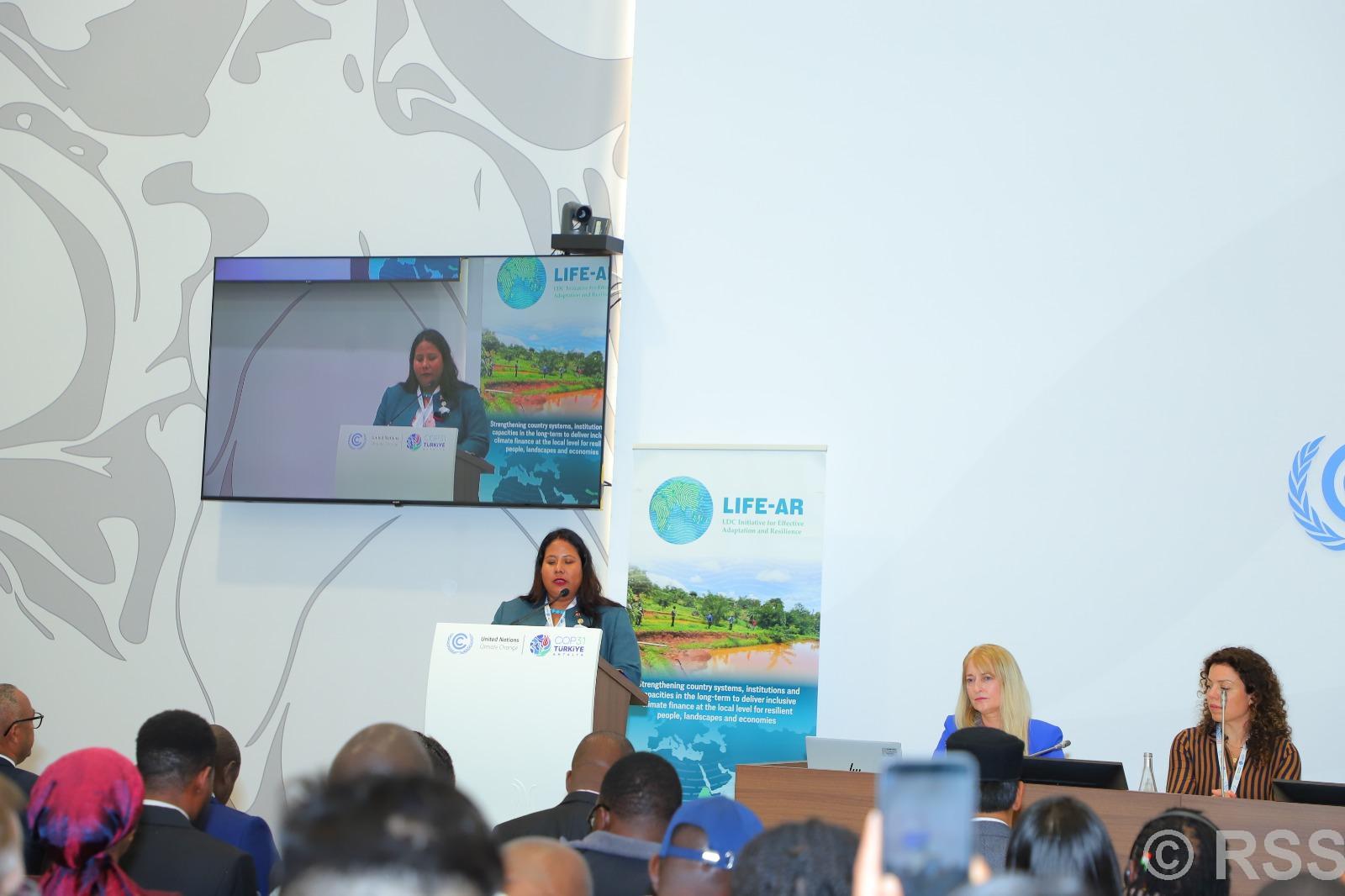
ANTALYA (TÜRKİYE): Nepal has reaffirmed its commitment to advancing the Least Developed Countries Initiative for Effective Adaptation and Resilience (LIFE-AR), with a focus on ensuring that climate finance reaches local communities and supports their priorities through locally led adaptation initiatives.
Minister for Agriculture, Forestry and Environment Geeta Chaudhary said Nepal viewed LIFE-AR not merely as a financing mechanism but as an opportunity to transform how climate action is planned, financed and implemented.
She made the remarks while addressing the official announcement of the LIFE-AR Facility on November 11 on the sidelines of the 31st United Nations Climate Change Conference (COP31) in Antalya.
Describing Nepal as a mountainous country endowed with rich natural resources and unique ecosystems, Minister Chaudhary said the country contributed very little to global greenhouse gas emissions but faced disproportionately severe consequences of climate change.
Recalling the devastating disaster in the Rasuwa-Bhotekoshi region on August 26, 2026, which was widely described as a “Mountain Tsunami”, she said the disaster had caused enormous human, economic and non-economic losses.
According to preliminary estimates, more than 1,457 people lost their lives, while 5,285 remained missing. Around 15,000 households, representing approximately 60,000 people, were directly affected, she said.
Citing a preliminary rapid assessment by the National Disaster Risk Reduction and Management Authority (NDRRMA), the minister said approximately USD 4.78 billion would be required for recovery, rehabilitation and reconstruction, equivalent to nearly 10 percent of Nepal’s gross domestic product (GDP).
She noted that the disaster had not only destroyed infrastructure and livelihoods but also devastated entire settlements, displaced communities and damaged cultural, social and natural assets. Some of these losses were irreversible and could not be adequately measured in monetary terms, she added.
Warning that Nepal could face similar disasters in the future, Chaudhary said climate-induced hazards were becoming increasingly frequent and severe, particularly in mountain regions, as global temperatures continued to rise.
She stressed the urgent need for climate finance, institutional and technical capacity, and advanced technologies, particularly in climate information services and early warning systems.
“As a Least Developed Country (LDC), Nepal continues to call for dedicated, timely, accessible, predictable, additional and grant-based climate finance to address adaptation needs and climate-induced loss and damage,” she said.
Against this backdrop, the minister emphasized that LIFE-AR could play a significant role in translating international climate commitments into meaningful action at the local level.
She described the initiative as a locally led approach that places communities at the centre of climate planning and decision-making, stressing that those most vulnerable to climate change must also be empowered to lead solutions.
Chaudhary informed the gathering that Nepal had signed a Memorandum of Understanding (MoU) with LIFE-AR on May 8, 2026, under her leadership as the Minister for Agriculture, Forests and Environment, and was now making progress towards establishing the initiative.
As Nepal moves towards the new facility and strengthens its implementation mechanisms, she expressed hope that more members of the international community would join the initiative and extend their support.
She said Nepal aimed to strengthen local governments and institutions, empower communities and ensure that climate finance generated tangible benefits for people most affected by climate change.
Expressing gratitude to the International Institute for Environment and Development (IIED) for serving as the initiative’s secretariat and supporting its progress, she reaffirmed Nepal’s support for LIFE-AR’s transition towards a facility that is genuinely led and managed by LDCs.
She expressed confidence that the new facility would continue making a meaningful contribution to LDCs on their own terms.
The minister also announced that Nepal would host the 15th LIFE-AR Board Meeting in Kathmandu next year. On behalf of the Government and people of Nepal, she welcomed the LDC Chair, board members and other relevant stakeholders to the country, expressing hope for productive discussions and stronger collective partnerships.
She further invited representatives of participating countries to visit the Nepal Pavilion at COP31, where Nepal plans to organize thematic events highlighting its mountains, climate vulnerabilities, disaster experiences, climate initiatives and the livelihoods of mountain communities.
Concluding her remarks, Chaudhary reiterated Nepal’s commitment to working with the LDC Group and LIFE-AR partners to ensure that climate action reaches the grassroots and that vulnerable communities are not left behind.
“Together, let us turn climate commitments into locally led action and build resilient communities for a climate-resilient future,” she said.





Comment