




KATHMANDU: Following the mandate of the Gen-Z movement on September 8 and 9, 2025, former Chief Justice Sushila Karki was sworn in as the first female Prime Minister on September 12. Immediately after taking oath, she dissolved the House of Representatives under pressure from the Gen-Z movement.
Her main task thereafter was to hold parliamentary elections and hand over responsibility to a new leadership, which she accomplished on March 5.
However, her six-month tenure was not limited to conducting elections. As the first female Prime Minister to lead a citizen government, Karki had high hopes of laying the foundation for good governance. Yet, instead of fulfilling that expectation, she became embroiled in a series of controversies.
Her legal advisor, Attorney General Sabita Bhandari, has been accused of cleansing those involved in major crimes. In the case of the illegal egg trade involving minors, the Central Investigation Bureau (CIB) of Nepal Police had filed a detailed case, but Bhandari reportedly stalled it because her daughter owned the clinic implicated in the illegal trade. The Prime Minister remained silent on the misconduct of her own legal advisor, drawing public criticism.
Similarly, Karki appointed Adarsh Shrestha, a lower-level Supreme Court official, to her secretariat, later adding his wife as well. She subsequently made Shrestha, her private secretary, the head of the National Trush for Nature Conservation, a post for which he lacked both expertise and competence. marking another controversial decision at the end of her tenure.
Neglected reconstruction
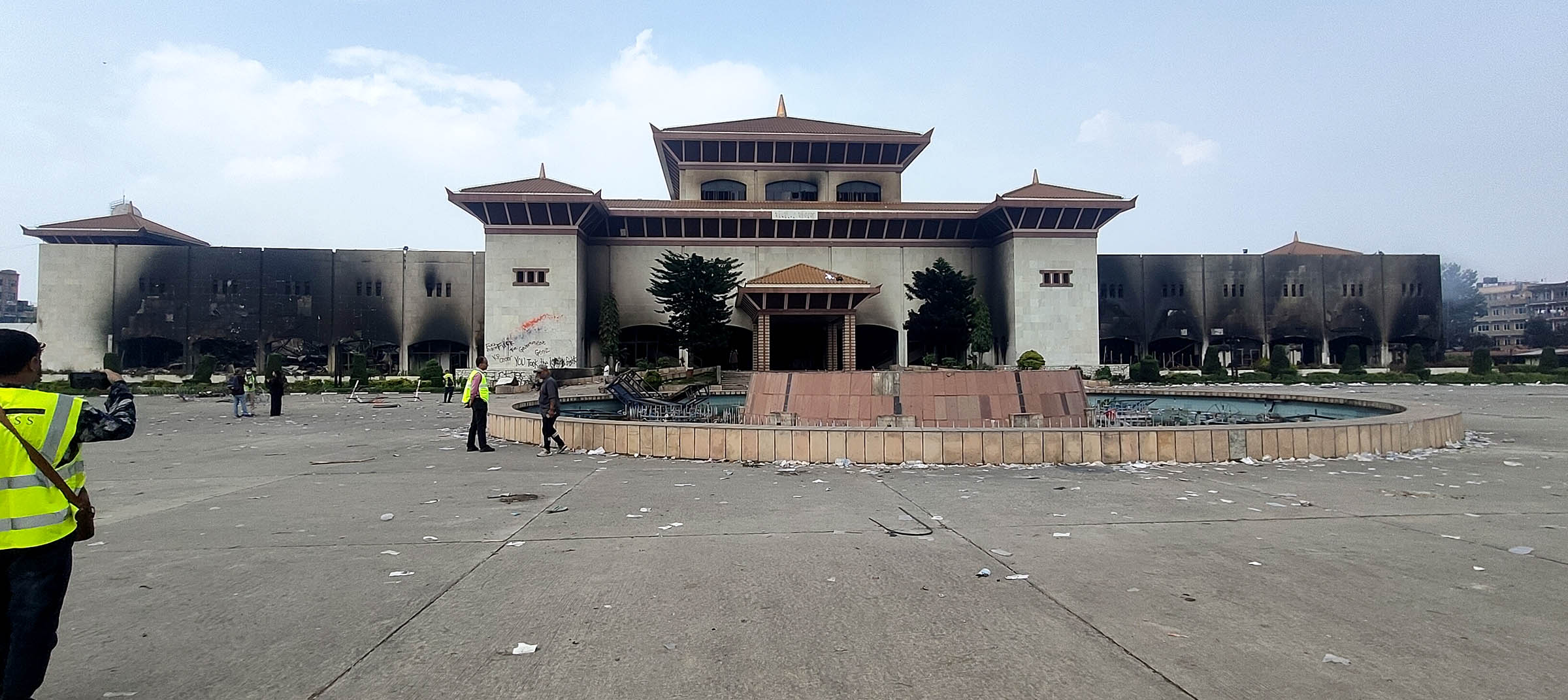
Prime Minister Karki also had the responsibility to rebuild and repair government structures damaged during the Gen-Z movement on September 9, 2025. However, much of this responsibility was neglected. Burnt structures in Singha Durbar and across the capital remain unrepaired.
For example, the damaged International Convention Center in New Baneshwor, used as the parliamentary building, still stands with black soot stains from fire. Simple repairs and repainting could have prevented sending a negative impression internationally, but the citizen government paid little attention to restoration.
The new parliament building under construction at Putali Bagicha could not be completed before MPs’ swearing-in. Consequently, on March 26, lawmakers are taking oath in a temporary hall.
According to Ekram Giri, spokesperson and joint secretary of the Federal Parliament Secretariat, “The construction of the parliamentary hall in the new building was not completed. Therefore, MPs will be sworn in at a multi-purpose hall.”
The building, whose foundation was laid on September 19, 2019, is around 90–92% complete after six years. It will include the central lobby, National Assembly hall, House of Representatives hall, VVIP chambers, and offices for the Prime Minister and President. Initially estimated at Rs 5.67 billion, the cost rose to Rs 6.30 billion after five extensions, with an additional Rs 2.34 billion for interiors and audio systems, bringing total costs to Rs 8.64 billion.
Other state buildings, including the Supreme Court and Kathmandu District Court, are also in poor condition, with black stains from fire damage. Despite six months passing since the Gen-Z movement, the neglected infrastructure continues to send the wrong message internationally.
Government sources said that during the movement, 629 buildings were completely destroyed and over 560 partially damaged. Of these, 310 government offices were fully destroyed, and 836 suffered partial damage, according to police records.
The Ministry of Physical Infrastructure and Transport has not yet made any decisions regarding the reconstruction of damaged structures. Ministry Deputy Secretary and Information Officer Gyanraj Lamsal confirmed, “No discussion or instruction has come from the government to rebuild structures damaged during the Gen-Z movement.”
The Department of Urban Development and Building is handling reconstruction under the federal government. Of 166 buildings with minor damage, 54 have been restored for use, 34 are under repair, and 56 out of 100 partially damaged structures have tendered contracts. Another 44 are under evaluation, while 28 severely damaged buildings require full reconstruction.
Police offices were heavily affected, with 177 buildings rendered unusable and 258 repairable. Most buildings have resumed service after reconstruction.
Political party offices were also affected—45 party offices fully destroyed, 174 partially damaged. The Nepali Congress office in Sanepa, Lalitpur, is in final stages of repair. The CPN-UML office in Chyasal, Lalitpur, resumed operations after repairs on November 21, 2025, and the Nepali Communist Party office at Paris Danda is also operational post-repair.
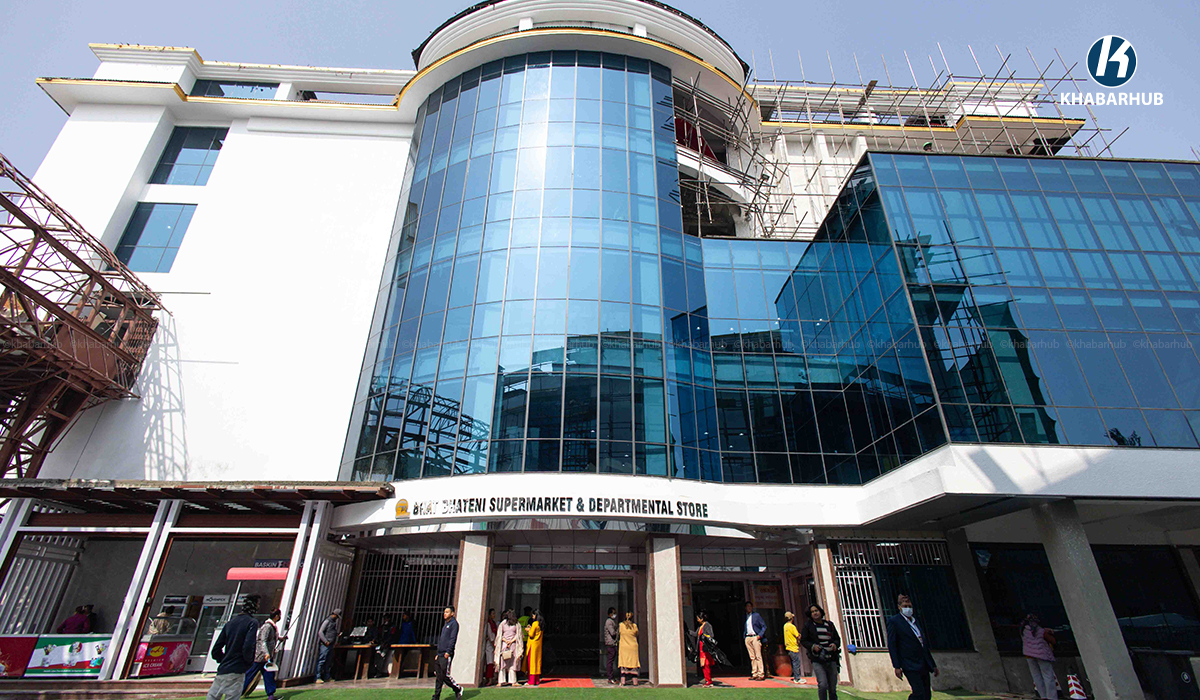
Commercial buildings, including Bhat-Bhateni Superstores, were heavily targeted. Owned by Min Bahadur Gurung, Bhat-Bhateni was the highest taxpayer in the country but faced vandalism during the movement. Nationwide, 28 stores were affected—12 completely destroyed, 9 partially damaged. Total estimated losses reached around Rs 10.5 billion.
Three stores have already resumed operations. “Of the 21 damaged stores, we have reopened Wire House, Maharajgunj, and Koteshwor branches. The remaining stores will resume by May,” said Chief Operating Officer Panu Paudel. Chairman Gurung is working to fully restore all damaged stores by July.






Comment