




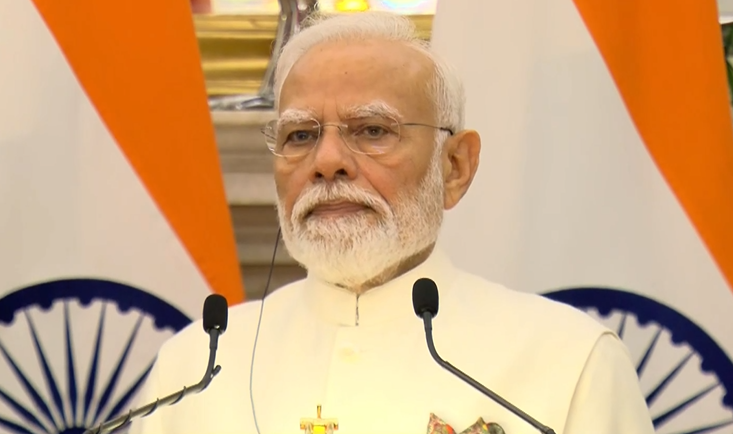
NEW DELHI: Indian Prime Minister (PM) Narendra Modi has announced a development cooperation package worth NPR 240 billion to support Nepal’s reconstruction and long-term development.
Addressing a joint press conference in New Delhi on Monday following bilateral talks with Nepali Prime Minister Balendra Shah (Balen), Modi expressed condolences over the loss of lives in the devastating floods that struck Nepal in August before announcing the assistance package.
He said the initiative was aimed at helping affected families restore their livelihoods, creating new opportunities and strengthening Nepal’s capacity to respond to future disasters.
During his address, Modi also highlighted several initiatives to expand bilateral cooperation in connectivity, energy, trade, education, agriculture and sports.
In the connectivity sector, he referred to the inauguration of the motorable bridge connecting Dharchula in India’s Uttarakhand state with Nepal and the foundation stone laying for an Integrated Check Post (ICP) at Banbasa. He also announced that work on the proposed ICP at Dodhara Chandani on the Nepali side would be expedited. Additionally, he said Nepal would be provided access to the ports of Kandla and Paradip to facilitate its international transit trade.
On energy cooperation, Modi highlighted Nepal’s considerable potential for clean energy generation and said India’s vast energy market could help transform the country’s hydropower resources into a source of economic prosperity.
He reaffirmed India’s commitment to the timely completion of the Arun-III Hydropower Project and welcomed the advancement of the Lower Arun Hydropower Project through the foundation stone laying ceremony.
Noting that India had continued supplying fuel and other essential commodities to Nepal even during challenging periods, Modi highlighted the inauguration of the second phase of the Motihari-Amlekhgunj petroleum pipeline and the foundation stone laying for a petroleum storage terminal in Jhapa as further steps towards strengthening bilateral energy cooperation.
In the education and innovation sectors, Modi announced India’s support for establishing startup incubation facilities, innovation hubs and an off-campus centre of the Indian Institute of Technology (IIT) in Nepal. He also mentioned plans to increase scholarships for Nepali students in law and technology and support the development of agro-industrial parks.
Modi further highlighted the launch of the Saryu-Kamala Express passenger train service linking Janakpurdham and Ayodhya. He also referred to an invitation extended to a Nepali delegation to participate in the WAVES summit, which seeks to promote the Ramayana and shared cultural heritage.
He pledged to expand cooperation in sports infrastructure and training, including cricket.
Expressing confidence in Shah’s vision and commitment towards Nepal’s future and Nepal-India relations, Modi said the two countries would also unveil a joint vision document to advance their shared aspirations of building a ‘Viksit Bharat’ (Developed India) and a ‘Samunnat Nepal’ (Prosperous Nepal).
Full text of Prime Minister Narendra Modi’s address
Prime Minister Balendra Shah,
Members of the delegations from both countries, and friends from the media—Namaskar!
I am delighted to welcome Prime Minister Balendra Shah to India on his first bilateral visit since assuming office.
A few months ago, when he addressed the United Nations as one of the world’s youngest prime ministers, we caught a glimpse of his visionary outlook. Today, through our conversations over the past few hours, I have personally witnessed his clear vision and commitment towards Nepal’s future and Nepal-India relations.
The historic mandate given to him by the people of Nepal this year reflects the aspirations and expectations of the country’s younger generation.
India has always been a partner in Nepal’s development journey towards building a strong and prosperous nation. Guided by this spirit, we have taken several important decisions today to take our bilateral relationship to new heights.
The relationship between India and Nepal is not merely that of neighbouring countries; it is a bond founded on deep affection and unwavering trust. We share both our joys and challenges. We are partners in each other’s progress and stand by one another during difficult times.
We extend our deepest condolences over the loss of lives caused by the devastating floods in Nepal last August.
Today, to strengthen Nepal’s reconstruction efforts and long-term development, we announce a development cooperation package worth 240 billion Nepali rupees.
It is our firm commitment to help affected families restore normalcy to their lives, create new opportunities and further strengthen Nepal’s capacity to cope with future disasters.
The relationship between India and Nepal is woven together through shared history, faith, culture and deep-rooted people-to-people ties. Lord Ram and Mother Sita are enduring symbols of our shared civilisation and faith.
In 2018, while visiting the sacred land of Janakpur, I remarked: “Without Nepal, our dhams (sacred pilgrimage sites) are incomplete; without Nepal, even our Ram is incomplete.”
In 2024, the ‘Pran Pratishtha’ (consecration ceremony) of Ram Lalla was held in Ayodhya. This historic occasion infused renewed energy into our shared religious faith. Since then, millions of devotees have travelled to Ayodhya to seek the blessings of Ram Lalla. In 2025 alone, approximately 300 million (30 crore) devotees from India and around the world visited the holy city.
With the launch of the Saryu-Kamala Express train service today, we are adding a new dimension to this sacred bond. The service will make it easier for devotees visiting Ayodhya to travel to Janakpur and seek the blessings of Mother Sita. We will also work together to improve connectivity between important religious destinations in our two countries, including Lumbini and Bodh Gaya, which are associated with Buddhism and the Shiva-Shakti traditions.
Today, we have inaugurated the Dharchula road bridge connecting Uttarakhand with Nepal and laid the foundation stone for an Integrated Check Post (ICP) at Banbasa. We will also expedite the development of the Dodhara Chandani Integrated Check Post on the Nepali side.
These initiatives will make trade and the movement of people between Uttarakhand and Nepal more convenient. We will also accelerate projects aimed at expanding road, railway and cross-border connectivity between Nepal and various Indian states, particularly Bihar and Uttar Pradesh. To facilitate Nepal’s transit trade, we will provide access to the ports of Kandla and Paradip.
I am confident that these initiatives, with their emphasis on commercial connectivity and investment, will give fresh impetus to Nepal’s economic development.
Nepal’s rivers hold immense potential for clean energy generation. India’s vast energy market can help transform this potential into a strong foundation for Nepal’s economic prosperity. The foundation stone laying ceremony for the Lower Arun Hydropower Project today, together with our commitment to completing the Arun-3 project on schedule, reflects this shared vision.
For many years, India has remained a reliable supplier of petroleum products and other essential commodities to Nepal. Guided by our Neighbourhood First policy, we have ensured the uninterrupted supply of fuel, chemical fertilisers and other essential goods to Nepal, even amid the serious challenges affecting oil supplies this year.
The inauguration of the second phase of the Motihari-Amlekhgunj petroleum pipeline and the foundation stone laying for the Jhapa Petroleum Terminal today will further strengthen this longstanding partnership.
Nepal’s younger generation is endowed with immense talent, energy and aspirations. India is committed to partnering with Nepal in helping its young people realise their dreams.
To translate this commitment into action, we will establish startup incubators, innovation hubs and an off-campus facility of the Indian Institute of Technology (IIT) in Nepal. We will also expand scholarship opportunities for Nepali students in India, particularly in the fields of law and technology.
Furthermore, to promote food processing and value addition, we will support the development of agro-industrial parks in Nepal.
The story of the Ramayana is reaching younger generations and audiences across the world through cinema and modern technology. We want young creative talents from Nepal and India to work together to showcase our shared heritage to the world through new and innovative platforms.
In this spirit, we look forward to welcoming a large Nepali delegation to the upcoming WAVES summit.
Similarly, we will expand our cooperation in sports, particularly cricket, by supporting the development of sports infrastructure and providing training opportunities for Nepali athletes.
Your Excellency,
Today, we are releasing a joint vision document to chart a new course for our shared future. It will serve as a roadmap for jointly realising our respective aspirations of building a ‘Developed India’ (Viksit Bharat) and a ‘Prosperous Nepal’ (Samunnat Nepal).
We have a clear vision, mutual trust and the capacity to turn these aspirations into reality. Above all, we have the blessings of Mother Sita, Lord Ram and Lord Buddha.
I am confident that, guided by this spirit, we will translate our shared vision into tangible achievements and together write a new golden chapter in Nepal-India relations.
Long live Nepal-India friendship! Thank you very much.


Comment