




Once a crossroads between the Gangetic Plain and the Tibetan Plateau, Kathmandu can draw on her history and cultural wisdom to reconnect her people, neighbourhoods and natural systems.
At 5:40 every morning, an older woman wakes up, starts the water pump, climbs the stairs to check the tank and carries a bucket if the water has not arrived. Later, she steps around a motorcycle parked on the footpath and walks into traffic. This is not an extraordinary Kathmandu morning. That is precisely the problem.
Tradition tells of the seventh-century Licchavi princess Bhrikuti, who travelled across the Himalaya to marry the Tibetan king Songtsen Gampo. Although historians treat the account cautiously, Kathmandu Valley’s historical connections with South Asia are well documented. Newar merchants and artisans travelled through the Kerung and Kuti passes, linking markets, people and ideas. Kathmandu was not simply a settlement along a route; she was a commercial and cultural crossroads.
Today, she remains Nepal’s political centre, with the potential to become an even stronger centre of learning, culture, enterprise and regional connection. The challenge is not simply to build more. It is to reconnect the city.
A village inside a concrete shell
Kathmandu Valley’s urban area expanded by 412 percent between 1989 and 2016, accompanied by the conversion of approximately 31 percent of agricultural land. This transformation has brought new homes, businesses and opportunities, while also increasing the demands on infrastructure and public services.
Public open spaces, once central to traditional settlements through courtyards, neighbourhood squares and communal grounds, remain essential to the city’s future. The 2015 earthquake demonstrated their importance when Tundikhel became a refuge for thousands of families.
Water tells another part of the story. The Bagmati, Bishnumati, Manohara, Hanumante, Dhobikhola, Tukucha (Ichhumati), Balkhu and Nakkhu, together with smaller streams and seasonal watercourses, form the Valley’s interconnected water system. Their banks, floodplains and natural drainage routes are as much a part of the city’s infrastructure as its roads.
Research following the September 2024 floods highlights how urban expansion, river encroachment and inadequate drainage contribute to flooding. The question is not simply why Kathmandu floods when it rains, but how the city can give water room to move again.
Scientific watershed mapping, protected river corridors, functioning drains and restored ponds can work alongside traditional hiti and rajkulo systems, which historically helped collect, distribute and recharge water. In an earthquake-prone Valley, these spaces can also support emergency access, safe assembly areas and seismic resilience.
These connections bring to mind Panchatatwa, the five elements of existence: Vayu (air), Jal (water), Agni (fire), Prithvi (earth) and Akash (space). They offer a cultural language for modern urban planning. Clean air requires better mobility; water requires living rivers; fire invites cleaner energy; earth calls for responsible construction and the protection of agricultural land; and space demands courtyards, parks and public places where people can gather.
These are not separate ambitions. They sustain one another.
The city is already a classroom
Asan and Indrachowk retain the memory of the trading city. Swayambhu and Boudha remain important Buddhist centres. Pashupati anchors a major pilgrimage landscape, while Maitighar remains a significant space for democratic expression.
Boudha deserves attention beyond tourism. Its monasteries, instrument shops, chanting, artisans and cultural traditions sustain a distinctive urban environment. What is the economic value of this musical life? How many livelihoods depend on it, and what would it take for Kathmandu to recognise her soundscape as part of her cultural economy?
The municipality already has an educational starting point through its local curriculum. But the city itself could become the textbook. Children could study hydrology beside the Bagmati, traditional water engineering at a hiti, seismic design in a historic courtyard and air quality using monitors installed on school rooftops.
Kathmandu could also be a reading city, where a person carrying a book is as familiar a sight as someone carrying a phone. Neighbourhood libraries, school reading rooms open after hours, books in tea shops and children reading beneath trees in public courtyards could all become part of the city’s everyday landscape.
A democratic city must protect the right to protest. She should also make room for reading, discussion, music and learning between her protests.
A heritage that can teach, not merely attract
Kathmandu does not need to become another city on the world map. She needs to recognise what places around the world have organised around their own strengths and develop institutions suited to her own history.
She can invest in local heritage skills, train traditional builders and use tourism revenue to support conservation. A citywide academic consortium could bring universities, public institutions and local industries closer together. A dedicated heritage institution could rehabilitate historic neighbourhoods, traditional Newar settlements, courtyards, temples and public spaces while sustaining the artisans and livelihoods that give them life.
Kathmandu’s responsibility can also extend beyond her municipal boundaries. She can become a city that carries her institutional knowledge and experience to the rest of Nepal.
The tenants’ city and the new caravan
The 2021 census shows that 55.53 percent of households in Kathmandu district live in rented homes. Migration continues to concentrate people seeking employment, education, healthcare and opportunities that remain difficult to access in their home districts.
Kathmandu has become a place where people come to build their futures. Her next contribution should be to help make that possible across the country, too.
Better regional hospitals, universities, vocational institutions, digital infrastructure and local enterprises could allow people to build meaningful livelihoods closer to home. Returning to one’s village or district should be an opportunity, not an economic compulsion.
The new caravan is also made of laptops. Nepal’s IT economy offers Kathmandu an opportunity to connect universities, enterprises and skilled workers across the country. A more distributed economy could ease pressure on the capital while enabling other cities and towns to grow.
A greener city that creates value at home
Kathmandu once had an electric trolleybus system. Rather than treating that history only as nostalgia, the Valley could draw on it to develop a modern, accessible electric public transport network.
Low-floor buses, wheelchair access, reliable stops, affordable fares and routes connecting residential neighbourhoods with schools, hospitals, markets and workplaces would make the transition meaningful to people who cannot or do not want to own a vehicle.
Investment in charging infrastructure, vehicle maintenance, electrical engineering, battery diagnostics, repair and recycling could create skilled employment and retain more value within Nepal. The objective should be to move beyond importing finished products towards developing the skills and industries that sustain a green transport system.
Making the connections practical
Kathmandu needs ward-level walkability audits, stronger building-code enforcement, protected river corridors, restored water systems, trained traditional builders and partnerships between schools, universities and local industries.
A September 2026 report put the number of digitally mapped roads across Kathmandu Metropolitan City at 12,811, with more than 2,800 entered into its official GIS database with names.[6] But beyond counting and mapping roads, where are these 12,811 connections leading? Do they bring a child closer to school, a patient to a hospital, a resident to public transport, or a neighbourhood back to its river?
The measure of a road network should be the opportunities it connects, not simply the routes it records.
Flood and earthquake preparedness can also become part of community education, with residents learning to identify drainage routes, protect neighbourhood water systems and understand local evacuation spaces.
Municipal engineering and enforcement remain essential, but responsibility cannot rest entirely on whoever occupies the mayor’s office. Residents, schools, heritage communities, businesses and universities must also become active participants in understanding and caring for their city.
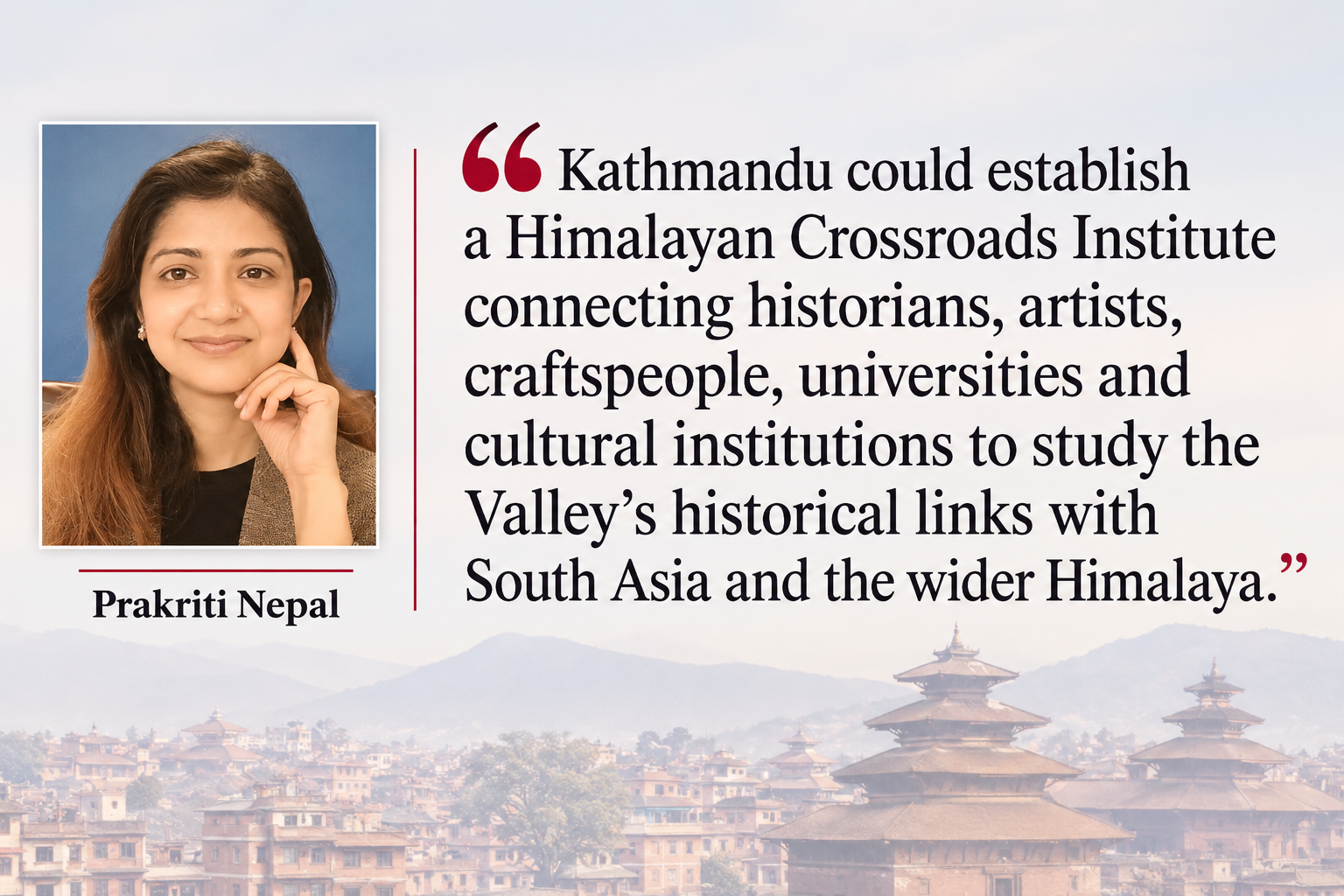
Kathmandu could establish a Himalayan Crossroads Institute connecting historians, artists, craftspeople, universities and cultural institutions to study the Valley’s historical links with South Asia and the wider Himalaya.
Return to the woman at 5:40 in the morning. Imagine water reaching her home reliably, a continuous footpath outside and a safe crossing on her way to the market. Her knees may still hurt. A better city cannot promise to eliminate every discomfort, but she can stop turning an ordinary walk into an obstacle course.
Perhaps she can eventually sit in a courtyard with a cup of tea while a child reads on the next bench. Nearby, a music group rehearses, and a school studies the neighbourhood’s river system. An accessible electric bus connects her neighbourhood to the rest of the Valley.
A thousand years ago, Kathmandu’s connections helped make her a crossroads between worlds. Her next chapter can reconnect her own people, her rivers and her natural systems. She can also enable other Nepali cities to learn, grow and create opportunities of their own.
The measure of Kathmandu’s future is not how quickly she builds, but how much easier she makes living there, how much value she creates at home, and how much she enables the rest of Nepal to do the same.
She is Kathmandu: a city whose cultural imagination has long been watched over by the living goddess, the Kumari.
(Prakriti Nepal is an education and peacebuilding professional working across international education, training and community engagement. She holds an MA in International Training and Education from American University, Washington, D.C., and is the Co-Founder of Education in Every Home, Nepal)



Comment