




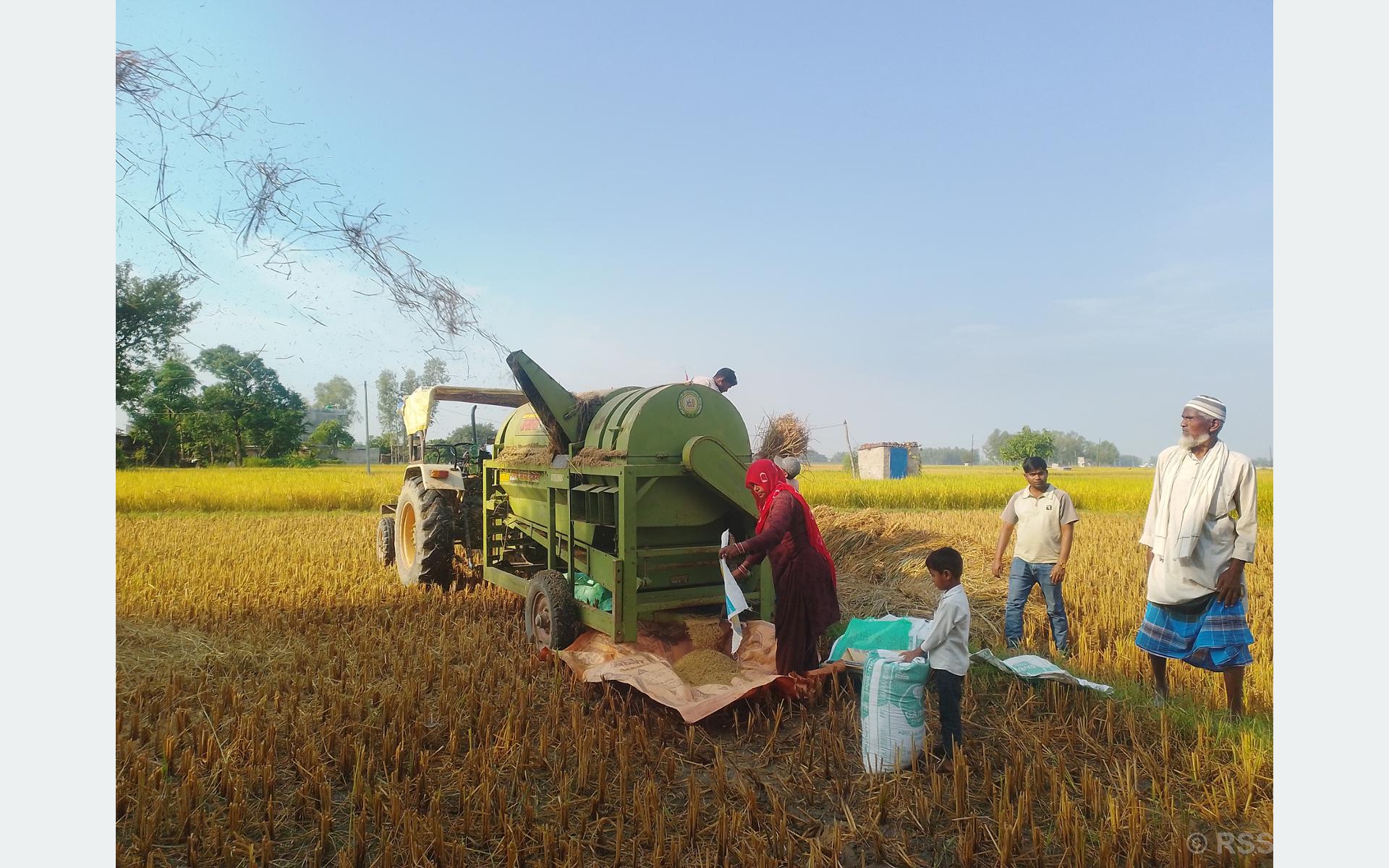
BANKE: Amjad Ali Sheikh, a resident of Nepalgunj Sub-metropolitan City–19 in Banke, has been earning a livelihood in his own village by operating a thresher machine for the past seven years.
At a time when many young people from rural areas are leaving for foreign employment or seeking work elsewhere, Sheikh has demonstrated how agricultural services can provide a reliable source of income at home.
Sheikh invested Rs 350,000 to purchase a thresher machine and said he earns a net profit of approximately Rs 150,000 during the peak paddy-harvesting season alone, after deducting expenses. He charges Rs 2,500 per hour for the service or takes 12 kilograms of paddy for every 100 kilograms processed.
“Farmers who own large areas of land but lack sufficient family members to help with harvesting are the ones who most frequently hire my services,” Sheikh said. “The machine can thresh the paddy harvested from up to 10 katthas of land in just one hour.”
The use of a thresher eliminates the need for traditional manual methods of separating grain from straw and reduces the labour required for winnowing. According to Sheikh, farmers in the village increasingly rely on the machine because it saves time, reduces labour costs and speeds up post-harvest work.
He recalled that, until a few years ago, farmers would gather their harvested paddy at a central location and take turns using a shared thresher. Now, however, the machine must often be transported from one field to another, increasing fuel consumption, operating costs and the time required to provide the service.
Initially, Sheikh operated the machine only in his own village, but demand has since expanded to neighbouring settlements, bringing additional competition. During the current paddy-harvesting season, he frequently takes the machine directly to farmers’ fields and works from 5 a.m. until midnight to meet demand.
The growing use of agricultural machinery in Banke has made traditional farming practices more efficient, helping farmers overcome labour shortages and complete seasonal work on time.
Dhruvakumar Thapa Chhetri, a farmer from Suiya village in Nepalgunj Sub-metropolitan City–19, said he had been using tractors for ploughing and threshers for harvesting paddy and wheat for the past decade.
Reflecting on the changes in farming practices, Chhetri said agricultural mechanisation had significantly reduced dependence on traditional arma-parma, a system of reciprocal labour exchange, and hired farmworkers.
“Finding agricultural labourers in the village has become extremely difficult. Even when workers are available, they charge daily wages ranging from Rs 600 to Rs 1,000,” he said. “Manual farming is time-consuming, whereas a thresher allows us to complete paddy harvesting on time with much less difficulty. With access to the necessary machinery, the entire process, from planting crops to bringing in the harvest, has become considerably easier.”
Sheikh’s experience highlights how investment in agricultural machinery can create rural employment, support farmers and generate income within local communities while helping modernise traditional farming practices.





Comment