




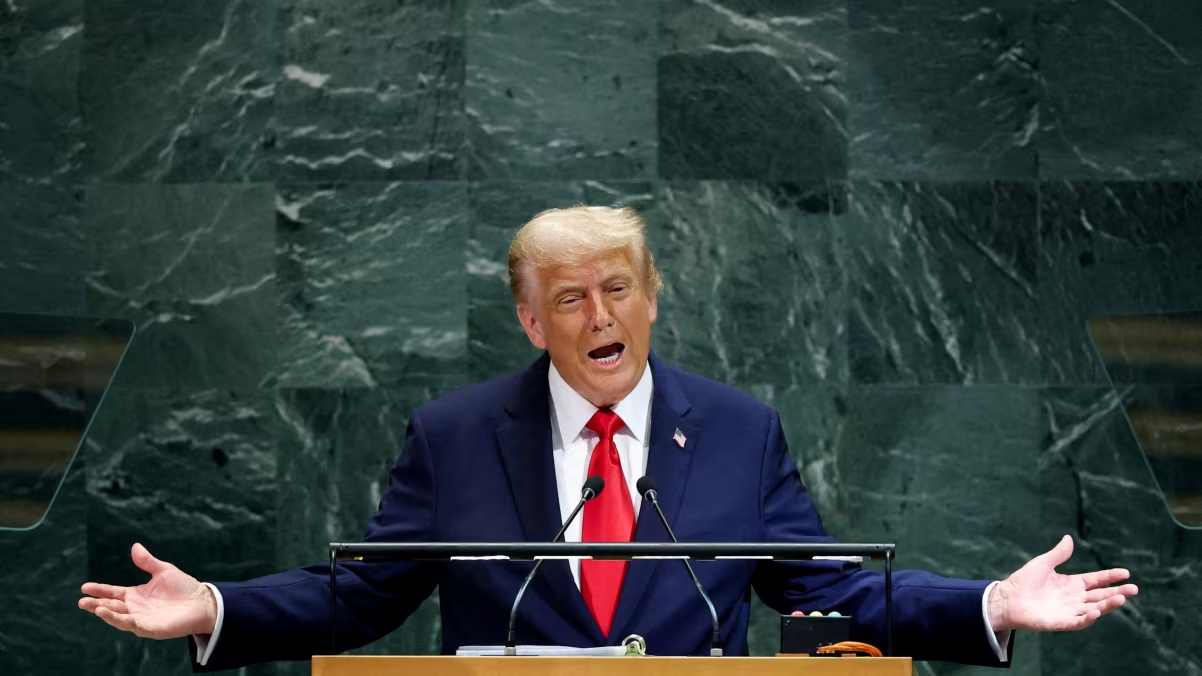
NEW YORK: US President Donald Trump told the United Nations General Assembly (UNGA) on Tuesday that he faces a “big decision” over whether to launch another attack on Iran or pursue a diplomatic agreement.
During his speech in New York, attended by a member of Iran’s delegation, Trump warned that the United States could “annihilate” the Islamic Republic if the conflict remains unresolved.
Speaking to a packed audience, Trump also rejected the idea of “global government,” pledged to help end the war between Russia and Ukraine, and said the United States must maintain its lead in artificial intelligence.
His remarks came amid a day of high-level diplomatic activity, including indirect discussions between US and Iranian representatives. Trump has also been holding meetings with more than a dozen world leaders as conflicts in the Middle East and Ukraine continue to challenge his foreign-policy agenda.
Trump opened his UNGA address by highlighting what he described as achievements on the economy, immigration, border security and violent crime. Much of his speech, however, focused on defending the US-Israeli military campaign against Iran, which has contributed to higher global oil prices and affected his domestic political standing.
His approach contrasted with earlier remarks by UN Secretary-General António Guterres, who warned that divisions among countries were growing and emphasized the interconnectedness of nations.
Trump argued that military action against Iran had prevented Tehran from developing a nuclear weapon and demonstrated what he called “peace through strength.” He presented the situation as a choice between reaching an agreement that would allow Iran to rebuild and taking further military action against the country.
Trump said he expected an agreement with Iran to emerge after the November US elections. His remarks reflected an approach that combines threats of military force with continued efforts to negotiate.
Later, Trump said US officials had held a “very productive” three-hour meeting with the Iranian delegation on the sidelines of the UN General Assembly.
Iranian state television confirmed that Foreign Minister Abbas Araghchi met US Special Envoy to the Middle East Steve Witkoff. US officials said the discussions were conducted indirectly through mediators who moved between the two sides.
Witkoff later said the talks had been completed and described them as potentially constructive, adding that mediators would continue their efforts.
On Ukraine, Trump again expressed confidence that his diplomatic efforts would eventually end Russia’s war against Ukraine, despite continued missile and drone attacks by both sides.
“We’re working very closely with the leaders of Russia and Ukraine, and we will get that one done,” Trump said, adding that he believed an agreement could come sooner than many expected.
US Secretary of State Marco Rubio is scheduled to meet Russian Foreign Minister Sergei Lavrov in New York on Wednesday, according to the US State Department.
(Inputs from BBC)





Comment